5 Documents Partnership Firms Need for LEI
A partnership firm in India usually needs more than a single uploaded document to get an LEI. The strongest LEI application file proves three things clearly: the firm exists, the firm’s legal details match official records, and the person filing is authorised to act for it.
TL;DR: Summary
- A partnership firm applying for an LEI in India will usually need 5 core document types: registration proof, partnership deed, PAN or tax proof, authority proof for the filer, and a supporting corroboration document such as audited financials or an auditor-backed confirmation.
- RBI guidance for partnership firms separately recognises registration proof, the partnership deed, and power of attorney or authority proof for the person transacting on the firm’s behalf.
- GLEIF LEI validation is not just document upload. It checks Level 1 data like official name and registered address against a ValidationAuthority and related ValidationDocuments.
- If the firm name, address, PAN, or registration reference does not match authoritative records, the application can pause in validation and may need correction before issuance.
- If the partnership is registered, the registration certificate usually carries more weight. If it is unregistered, the deed and supporting corroboration become more important.
- Express processing helps only when the file is already clean. Speed does not fix missing authority proof or inconsistent entity data.
That is why the practical question is not only “what documents do I upload?” but also “which records will the Local Operating Unit rely on to validate the entity?” For Indian partnership firms, that distinction matters because LEI validation follows a global data model, while RBI-facing KYC and borrowing requirements follow Indian regulatory logic.
Why does a partnership firm in India need LEI documents at all?
Yes, RBI and GLEIF both make documents central to LEI validation for partnership firms. RBI sets when an LEI is required, while GLEIF defines how the legal entity’s identity is validated in the LEI system.
RBI has said that non-individual borrowers with aggregate exposure of ₹5 crore and above from banks and financial institutions must obtain an LEI. The same direction also warns that borrowers without an LEI from an authorised Local Operating Unit may not get new exposure, or renewal and enhancement of exposure.
For a partnership firm, the documents are not only compliance paperwork. They are the evidence set used to verify the legal name, address, legal form, and the authority of the person filing. A common misconception is that a partnership deed alone is enough. In many cases, it is necessary but not sufficient.
"LEI Service offers a one-minute application and handles validation and submission to GLEIF-accredited LOUs."
Which partnership firm details must match before documents are even checked?
The LEI record must match authoritative data on core identity fields. GLEIF Level 1 data centres on the official legal name and registered address, and Indian applications often also rely on PAN and registration references.
Before validation succeeds, these details should line up across the application form and supporting records:
- Official legal name: Use the partnership firm’s formal name exactly as shown in registration and tax records.
- Registered address: Use the legal registered address, not a branch, warehouse, or correspondence address.
- Headquarters address: If different from the registered address, state it consistently.
- PAN or tax ID: The tax identifier should map cleanly to the same entity.
- Registration authority reference: The number or reference from the relevant registration authority should be accurate and current.
GLEIF’s LEI-CDF 3.1 includes fields like ValidationDocuments and ValidationAuthority, which is why the source of the data matters as much as the files themselves. If the LOU can corroborate the entity details against the right authority, the record is stronger. If not, the file can sit in PENDING_VALIDATION instead of moving to a corroborated state.
Pro tip: many delays come from address formatting, not from missing papers. If your deed shows one address, your PAN records another, and your application uses a third variation, the reviewer has to stop and reconcile them.
What are the 5 documents partnership firms usually need for an LEI in India?
The usual answer is five core document types. RBI KYC guidance and common Indian LEI practice both point to a file pack that proves existence, constitution, tax identity, filing authority, and corroboration.
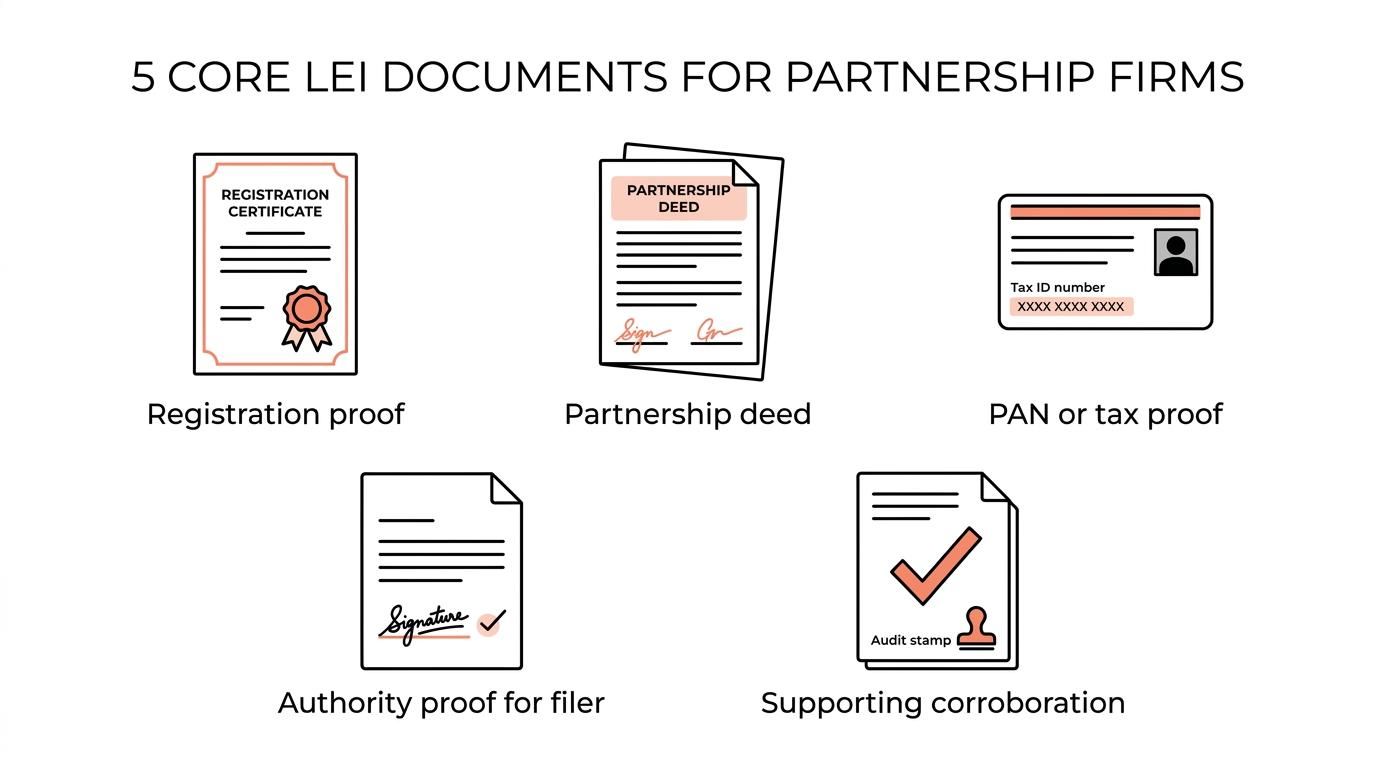
A practical five-document checklist looks like this:
Registration certificate or registration proof
Best for registered partnership firms. This helps establish the firm’s legal existence and registration reference.Partnership deed
This shows the constitution of the firm, partner names, and often the business address and authority structure.PAN card or PAN allotment proof of the firm
PAN helps connect the entity to its tax identity and reduces ambiguity where names are similar.Authority proof for the person filing
This may be a power of attorney, letter of authority, partner authorisation, or a comparable mandate showing who can act for the firm.Supporting corroboration document
Common examples include audited financial statements, a statutory auditor’s certificate, or another recognised record that supports the firm’s legal details.
This is the most defensible file pack because it covers the firm’s existence, legal form, registration details, and authority chain. If your partnership is unregistered, item 1 may be weaker or unavailable, so items 2, 3, and 5 carry more validation weight.
How should a partnership firm prepare the partnership deed and registration proof for LEI validation?
Prepare these two records as the base layer of the LEI file. For most Indian partnership firms, the deed and the registration proof are the first place validators look for legal identity and structure.
Step 1: Check whether the deed and registration proof show the same firm name and address as the application. Even small spelling differences should be fixed before submission.
Step 2: Confirm that the deed is complete, signed, and legible. An unsigned scan, missing pages, or an outdated deed with later amendments left out can trigger queries.
Step 3: If the firm is registered, pair the deed with the registration certificate. If it is not registered, be ready with stronger corroboration from PAN-linked records or financial statements.
A common mistake is treating the deed like a generic attachment. In LEI review, it functions as a validation document tied to a registration authority context. That means the data on it must support the same entity identity the LOU is trying to confirm.
How do you prove the authorised person can file the LEI application for the partnership firm?
Authority proof must be explicit. RBI KYC guidance for partnership firms specifically refers to power of attorney for the person transacting on the firm’s behalf, and LEI reviewers apply similar logic when checking filing authority.
Step 1: Identify who is filing. This could be a managing partner, an authorised partner, a finance officer, or an external representative.
Step 2: Match that person to a written authority record. Depending on the case, this may be a power of attorney, letter of authority, or partner-approved mandate.
Step 3: Make sure the authority document connects the person to the exact legal entity named in the application. If the authority letter names a trade style instead of the registered firm name, the file can pause.
This is where many applications slow down. LEI Service notes that an application can pause if the filer cannot prove authority to act for the entity. A common misconception is that any partner can file by default without showing evidence. Review teams often still need a clear document trail.
"LEI Service guarantees an email response within 24 hours, which is useful when authority proof is missing or unclear."
What is the difference between LEI validation documents and RBI KYC documents for partnership firms?
They overlap, but they are not the same. RBI KYC documents help a bank identify and verify its customer, while LEI validation documents help an LOU create or renew a globally standardised legal entity record.
In practice, the same paper may serve both functions, but the review lens changes:
- RBI KYC focus: Customer due diligence, beneficial relationship context, and authority to transact with the bank.
- LEI validation focus: Official legal name, registered address, registration authority, and corroboration of the entity in the GLEIF data model.
- Shared documents: Registration certificate, partnership deed, PAN proof, and authority proof often appear in both workflows.
This matters because applicants sometimes submit a bank-ready KYC pack and expect instant LEI issuance. If the KYC pack does not support the exact Level 1 data fields needed for the LEI record, the reviewer may still ask for clarifications.
How does a partnership firm apply for an LEI step by step in India?
The process is straightforward when the firm’s official records are already consistent. A registration agent or LOU collects the entity data, validates it, and submits it into the LEI issuance workflow.
Step 1: Enter the legal entity details exactly as they appear in official records. Use the formal partnership firm name, registered address, headquarters address if different, PAN, and registration reference.
Step 2: Upload the matching document set. At minimum, the reviewer should be able to identify the firm, its legal form, and the authority of the filer.
Step 3: Respond quickly if validation queries come back. If the LOU cannot fully corroborate the entity, it may seek clarifications before issuing or renewing the LEI.
A common mistake is using the business’s market-facing name instead of the formal legal name in the deed or registration record. That creates friction because GLEIF Level 1 data is based on the legal entity’s official identity, not branding.
"LEI Service offers express LEI delivery within 2 hours when the application data and supporting documents are ready for validation."
What happens if the partnership firm’s name, address, or PAN details do not match?
Mismatched data usually causes delay, not a soft exception. The reviewer has to stop and confirm whether the documents refer to one legal entity or to different records.
If the mismatch is minor, like punctuation or an expanded abbreviation, a clean registry or PAN-linked record may resolve it. If the mismatch is substantive, like a different address or a changed firm name not reflected across records, the application may need correction before the LEI can move ahead.
This is where terms like PENDING_VALIDATION become useful. They signal that the file is not fully corroborated yet. Once the authority source and documents line up, the record can move toward a stronger corroboration status. Pro tip: correct the upstream record first. If the official source still shows old data, uploading more PDFs rarely fixes the underlying issue.
Should a partnership firm choose express processing, multi-year renewal, or an LEI transfer?
The right choice depends on the firm’s deadline, data quality, and whether it already has an LEI. Express suits urgent, clean files. Multi-year plans suit stable entities. Transfer suits firms that already hold an LEI and want a different service model.
Express processing is useful when a bank, broker, or transaction window is near, but only if the documents are already coherent. If authority proof is missing or the entity details do not match, paying for speed does not remove the validation bottleneck.
Multi-year renewal can reduce admin effort for firms with stable constitution and address details. Transfer is the better route when the firm already has an LEI and wants different pricing, support quality, or renewal handling from another registration agent. One practical rule works well here: if your entity data is stable, optimise for continuity; if your records are messy, clean the file before optimising for speed.