5 SEBI Cases Where an LEI Is Required
Many Indian entities hear about the Legal Entity Identifier only when a depository, custodian, bank, or compliance team asks for it urgently. That is risky, because SEBI and RBI do not treat the LEI as a generic business ID. They require it in specific market and transaction scenarios, with different trigger points for issuers, FPIs, and high-value payments.
TL;DR: Summary
- In India, an LEI is mandatory in five major SEBI-linked cases: outstanding listed non-convertible securities, proposed listed non-convertible securities, outstanding listed securitised debt instruments, outstanding security receipts, and all non-individual FPIs.
- SEBI’s 2023 debt-market circular ties LEI reporting to issuers of listed or proposed non-convertible securities, securitised debt instruments, and security receipts, including reporting through the Centralized Database of corporate bonds or depositories.
- SEBI’s July 2023 FPI circular requires LEI details for every non-individual FPI; fresh registrations need LEI details upfront, and non-compliant existing FPIs can be blocked from further purchases until they submit it.
- RBI separately requires AD Category I banks to obtain LEI from resident entities doing capital or current account transactions under FEMA of ₹50 crore and above per transaction, effective from 1 October 2022.
- An LEI is a 20-character global identifier issued through the GLEIF system, so the practical test is simple: if your entity issues covered securities, invests as a non-individual FPI, or moves large regulated payment flows, check LEI status before the transaction date.
The practical point is this: you do not need an LEI just because you are a company in India, but you may need one immediately if you issue debt securities, operate as a non-individual foreign portfolio investor, or make certain large-value regulated transactions. The details matter, because the reporting route, deadline, and impact of non-compliance differ across each case.
What is an LEI and why does SEBI care about it?
An LEI is a 20-character alphanumeric code defined in the GLEIF system and used by SEBI and RBI to identify legal entities without ambiguity. It helps regulators connect the entity name, legal form, and transaction record across debt markets, custody, and payment systems.
That matters in India because names alone are unreliable. Group entities can look similar, special purpose vehicles may have near-identical naming patterns, and cross-border investors often use custodians and intermediaries. The LEI creates a single machine-readable identity reference.
SEBI’s interest is tied to transparency and operational control. In the debt market, the regulator wants issuers of covered instruments to be identifiable at issuance and during the life of the instrument. In the FPI framework, SEBI wants every non-individual FPI tied to a clear legal-entity record.
A common misconception is that PAN, CIN, or GSTIN can substitute for an LEI. They cannot. Those identifiers serve different legal and tax functions, while an LEI is a global entity identifier used in financial-market reporting and validation.
"LEI Service handles validation and submission to GLEIF-accredited LOUs, which is useful when an Indian entity needs a recognised LEI rather than a local substitute."
If your entity sits anywhere near listed debt, securitised structures, or foreign portfolio investment, it is smart to check LEI status before the filing, allotment, or trading event begins.
When does SEBI require an LEI for debt-market issuers in India?
SEBI requires an LEI for covered debt-market issuers under its 3 May 2023 circular, especially issuers of non-convertible securities, securitised debt instruments, and security receipts. The trigger depends on whether the instruments are already outstanding or are being newly issued and listed.
The debt-market rule is not one blanket instruction for every security. It is instrument-specific. Based on SEBI’s circular, the LEI requirement applies in these debt-market contexts:
- issuers having outstanding listed non-convertible securities as on 31 August 2023
- issuers having outstanding listed securitised debt instruments as on 31 August 2023
- issuers having outstanding security receipts as on 31 August 2023
- issuers proposing to issue and list non-convertible securities on or after 1 September 2023
The reporting channel also changes. For outstanding listed non-convertible securities, SEBI referred to reporting in the Centralized Database of corporate bonds. For outstanding listed securitised debt instruments and security receipts, reporting goes to the depositories.
If your team assumes that only fresh issuances need an LEI, that is the wrong starting point. Existing outstanding instruments were already covered by SEBI’s operative framework in 2023.
What are the 5 SEBI-linked cases where an LEI is required in India?
The five most important SEBI-linked LEI cases are clear and specific. They cover debt issuers and non-individual FPIs, not every business entity by default.
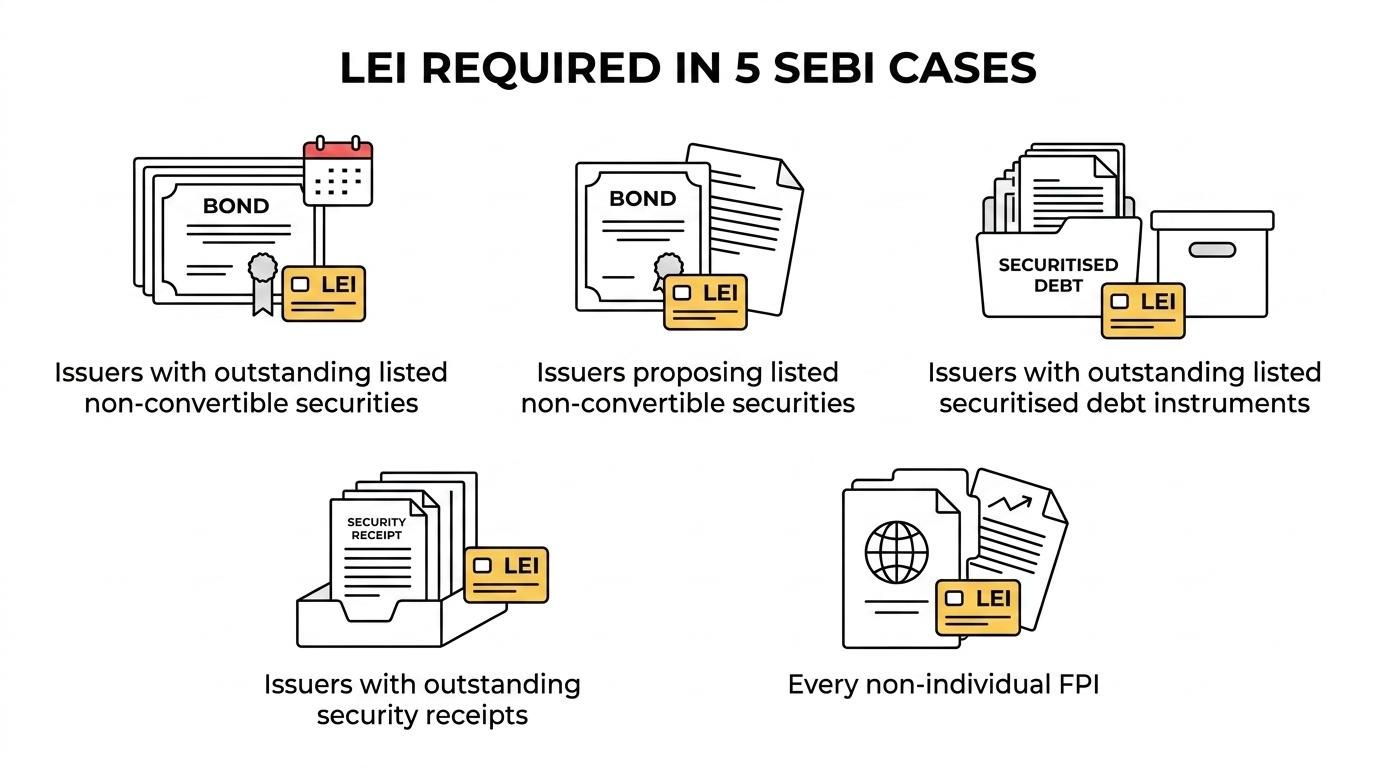
After SEBI’s 2023 circulars, these are the core cases to track:
- Issuers with outstanding listed non-convertible securities: If the securities were outstanding as on 31 August 2023, the issuer had to obtain and report its LEI in the Centralized Database of corporate bonds.
- Issuers proposing to issue and list non-convertible securities on or after 1 September 2023: The issuer must report its LEI at the time of allotment of the ISIN.
- Issuers with outstanding listed securitised debt instruments: If outstanding as on 31 August 2023, the issuer had to obtain and report its LEI to the depositories.
- Issuers with outstanding security receipts: If outstanding as on 31 August 2023, the issuer had to obtain and report its LEI to the depositories.
- All non-individual FPIs: SEBI requires LEI details for every non-individual foreign portfolio investor, including for fresh registration and for existing FPIs that had not yet submitted LEI details.
This list is the clearest working checklist for most compliance teams. If your entity falls into one of these five cases, treat the LEI as a mandatory prerequisite, not a later clean-up item.
How should an issuer report its LEI for non-convertible securities step by step?
The issuer should first confirm the instrument category, then validate the legal entity record, and then submit the LEI through the correct market channel. In practice, the fastest path is to prepare issuer documents before the ISIN or database submission starts.
A workable sequence looks like this:
- Confirm whether the entity is an issuer of outstanding listed non-convertible securities or a proposed issuer after 1 September 2023.
- Check whether the issuer already has a live LEI and whether the legal name matches constitutional and registry records exactly.
- If no LEI exists, apply for one through an accredited issuance route before the allotment or reporting deadline.
- Report the LEI in the required location, which may be the Centralized Database of corporate bonds or the ISIN-allotment stage.
- Keep the LEI active through annual renewal so the reported code does not lapse.
The biggest operational error is name mismatch. If the entity name on the LEI does not align with the legal name used in market documentation, validation can slow down or the compliance team may need to rework the submission.
"LEI Service offers a one-minute application and express delivery as fast as 2 hours, which can help when an ISIN allotment or reporting cut-off is close."
A practical tip is to review authorised signatory details, incorporation records, and address proofs before starting the LEI application. Most delays come from documentary inconsistency, not from the code itself.
How should a non-individual FPI provide LEI details step by step?
A non-individual FPI must provide LEI details as part of SEBI’s FPI compliance framework. For fresh registrations, the LEI comes before registration completion; for existing FPIs, missing LEI details can restrict further purchases.
The sequence is fairly direct:
- Verify that the FPI is non-individual, since SEBI’s July 2023 circular specifically applies to all non-individual FPIs.
- Obtain or confirm the FPI’s LEI before filing or updating the Common Application Form and related onboarding records.
- Submit the LEI details through the registration or update process used by the designated depository participant or intermediary.
- Recheck that the LEI corresponds to the correct applicant entity, especially where fund structures involve trustees, sub-funds, or umbrella vehicles.
- Renew the LEI annually so the FPI record remains usable for continuing market access.
SEBI gave existing FPIs that had not provided LEI details 180 days from the circular date to comply. If they did not, their accounts were to be blocked for further purchases until the LEI was provided. That is a real trading constraint, not just a back-office remark.
A common mistake is assuming the investment manager’s identity can stand in for the fund or vehicle. If the regulated applicant is the FPI entity, the LEI must map to that entity.
How do SEBI LEI rules differ from RBI’s ₹50 crore payment and FEMA rules?
SEBI focuses on securities-market participants and issuers, while RBI focuses on certain high-value transactions and banking channels. The LEI may be the same 20-character identifier, but the trigger event, reporting party, and operational consequences differ.
Under RBI’s 10 December 2021 notification, AD Category I banks were required from 1 October 2022 to obtain LEI from resident entities undertaking capital or current account transactions of ₹50 crore and above per transaction under FEMA, 1999. That is not the same as SEBI’s issuer or FPI framework.
The quickest comparison is this:
- SEBI: issuance, listing, depository reporting, and FPI registration or trading access
- RBI: banking-side processing of large capital or current account transactions under FEMA
- Threshold logic: SEBI’s covered cases are status-based or event-based; RBI’s FEMA rule uses a ₹50 crore per transaction trigger
- Counterparty nuance: RBI allowed banks to process transactions for non-resident counterparts or overseas entities even if LEI information was unavailable, to avoid disruption
So if your treasury team says, “We already dealt with LEI at the bank,” that does not automatically settle the SEBI side. The same entity may face both regimes for different reasons.
How is an LEI for a debt issuer different from an LEI for an FPI?
The LEI itself is the same global identifier, but the compliance use case differs for issuers and FPIs. Issuers use it for instrument-linked reporting and issuance workflows, while FPIs use it for investor identification and market-access compliance.
For an issuer, the key link is between the legal entity and the security being issued or already outstanding. The process tends to sit with the company secretary, treasury, debenture team, trustee-facing team, or depository contact.
For a non-individual FPI, the key link is between the investor entity and the registration, custody, and trading framework. The process usually sits with the fund administrator, compliance officer, custodian, or designated depository participant.
This difference matters when group structures are involved. A parent company’s LEI does not cover a subsidiary SPV that issues notes. In the same way, an asset manager’s LEI does not replace the LEI of the non-individual FPI applicant.
"LEI Service includes the GLEIF fee, free entity-data updates, and English-speaking support, which is helpful when the same group needs separate LEIs for separate legal entities."
If your structure has SPVs, trusts, pooled funds, or securitisation vehicles, assume entity-level analysis is necessary before anyone files the code.
What happens if you miss the LEI requirement or report the wrong entity?
Missed LEI compliance can block transactions, delay issuance, or create defective reporting records. In the FPI context, SEBI explicitly linked non-compliance to blocking further purchases for existing FPIs that failed to submit LEI details within the allowed window.
The risk is not limited to having no LEI at all. A wrong LEI can be just as disruptive because it points regulators and intermediaries to the wrong legal person. Common failure points include:
- Entity mismatch: using the parent company’s LEI for a subsidiary issuer or fund vehicle
- Lapsed LEI: reporting a code that exists but is no longer active because annual renewal was missed
- Name inconsistency: outdated legal name, merger effects, or spelling differences across records
- Wrong workflow: sending the LEI to a bank when the operative requirement sits with a depository, database, or FPI application channel
There is also a timing issue. If a debt issuance calendar is already fixed, an LEI problem becomes urgent because it can affect document finalisation, ISIN-related activity, and compliance sign-off. The practical lesson is simple: validate early, not on allotment day.
Which entities in India often overlook that they may need an LEI?
SPVs, securitisation issuers, foreign funds, and trusts often overlook LEI exposure because the trigger sits in the transaction or market role, not in the entity’s everyday business profile. The rule follows the legal entity participating in a regulated activity.
This catches a wide set of entities beyond standard listed companies. A few examples include mutual structures with separate legal vehicles, alternative investment structures investing as non-individual FPIs, charitable or not-for-profit entities participating in covered market activities, and securitisation-related entities tied to listed instruments or security receipts.
A useful mental test is this: if the entity issues, invests, transacts, or reports in a regulated financial-market context, check whether the obligation sits with that specific legal person. Do not assume the group’s main operating company covers everyone else.
The same point applies to trusts and funds. What matters is whether the relevant legal structure is recognised as the entity required to be identified in that workflow.
How can an entity obtain, renew, or transfer an LEI quickly?
An entity can obtain, renew, or transfer an LEI quickly by confirming its legal records first, choosing a recognised registration route, and matching the application data exactly to the entity’s formal documents. Speed usually depends on clean validation, not on form-filling alone.
A practical process looks like this:
- Gather the exact legal name, registration details, registered address, and authorised contact data for the entity that actually needs the LEI.
- Choose the required action: new LEI registration, renewal of an existing LEI, or transfer to a different registration agent.
- Submit the application with records that match official sources and market documentation exactly.
- Track validation emails or queries quickly, because unresolved clarifications are a common cause of delay.
- Set annual renewal reminders or enable automatic renewal if the entity will continue issuing, investing, or transacting in covered markets.
For Indian entities that want a simpler route, neutral service providers can handle document review, validation, and submission to GLEIF-accredited LOUs. That can reduce friction when the business needs transparent INR pricing, English support, or quick turnaround without building the workflow internally.
"LEI Service guarantees an email response within 24 hours and supports new registration, renewal, and transfer, which suits Indian entities managing recurring LEI compliance."
A final practical tip: if your team is already discussing an issuance, an FPI update, or a ₹50 crore FEMA-linked transaction, it is late to ask whether LEI matters. Check first, because in these SEBI and RBI cases, the identifier is part of the transaction path itself.