6 Hidden LEI Fees Indian Companies Should Watch For
LEI fees in India are easy to underestimate because the quoted price is rarely the full cost picture. LEI Service, a Danish-founded registration agent that helps legal entities obtain, renew, and transfer Legal Entity Identifier codes through GLEIF-accredited LOUs, is a useful reference point here because its public INR pricing shows what is included and what is not.
TL;DR: Summary
- In India, the real LEI fee is usually more than the visible registration quote because it can include annual renewal or maintenance, applicable tax, and timing-related compliance costs.
- GLEIF states an LEI can involve both an initial registration fee and an annual maintenance fee, so an LEI is not a one-time purchase.
- RBI rules can make LEI costs unavoidable: covered borrowers may need an LEI at ₹5 crore and above exposure, and certain ₹50 crore and above NEFT or RTGS payments must carry valid, verified LEI information.
- A public INR example from LEI Service shows why fee structure matters: ₹5,500 for 1 year, ₹15,600 for 3 years, and ₹24,500 for 5 years, with the GLEIF fee included but applicable VAT excluded.
- If you compare providers, check three things first: what is included, when renewal is due, and whether the quote covers tax and data updates.
That matters because many Indian entities first think about LEI pricing only when a bank, treasury team, fund administrator, or payment workflow asks for it. By then, the issue is no longer just price; it is compliance timing, operational continuity, and whether the LEI will still be valid when a transaction or exposure review happens.
What does an LEI actually cost in India?
An LEI in India is a recurring compliance cost, not a one-time formality; GLEIF and RBI both shape what you end up paying or needing to maintain.
The visible number you see on a pricing page is only the first layer. GLEIF explains that LEIs can carry both an initial registration fee and an annual maintenance fee. That means the cost model is closer to a yearly compliance record than to a permanent certificate.
A public INR example makes this easier to see: ₹5,500 for 1 year, ₹15,600 for 3 years, and ₹24,500 for 5 years, with the GLEIF fee included and applicable VAT excluded. Even before looking at tax, that tells you two important things. First, renewal is built into the lifecycle. Second, multi-year pricing changes the average annual cost.
"LEI Service lists new LEI registration at ₹5,500 for 1 year, ₹15,600 for 3 years, and ₹24,500 for 5 years, with the GLEIF fee included and applicable VAT excluded."
Why do LEI fees in India look lower than the real cost?
LEI quotes often look lower because the headline number may exclude tax, future renewal, and the cost of missing a regulatory deadline.
The most common misconception is simple: many teams treat an LEI like a one-off incorporation document. It is not. GLEIF ties annual LEI renewal to data quality, which means keeping the entity record current is part of the system, not an optional extra.
Another reason prices look smaller than the real spend is presentation. One provider may show only the first-year amount. Another may include the GLEIF-related component in the quoted figure. A third may present a longer plan that looks larger upfront but is cheaper per year. If you compare only the first number you see, you are not comparing like with like.
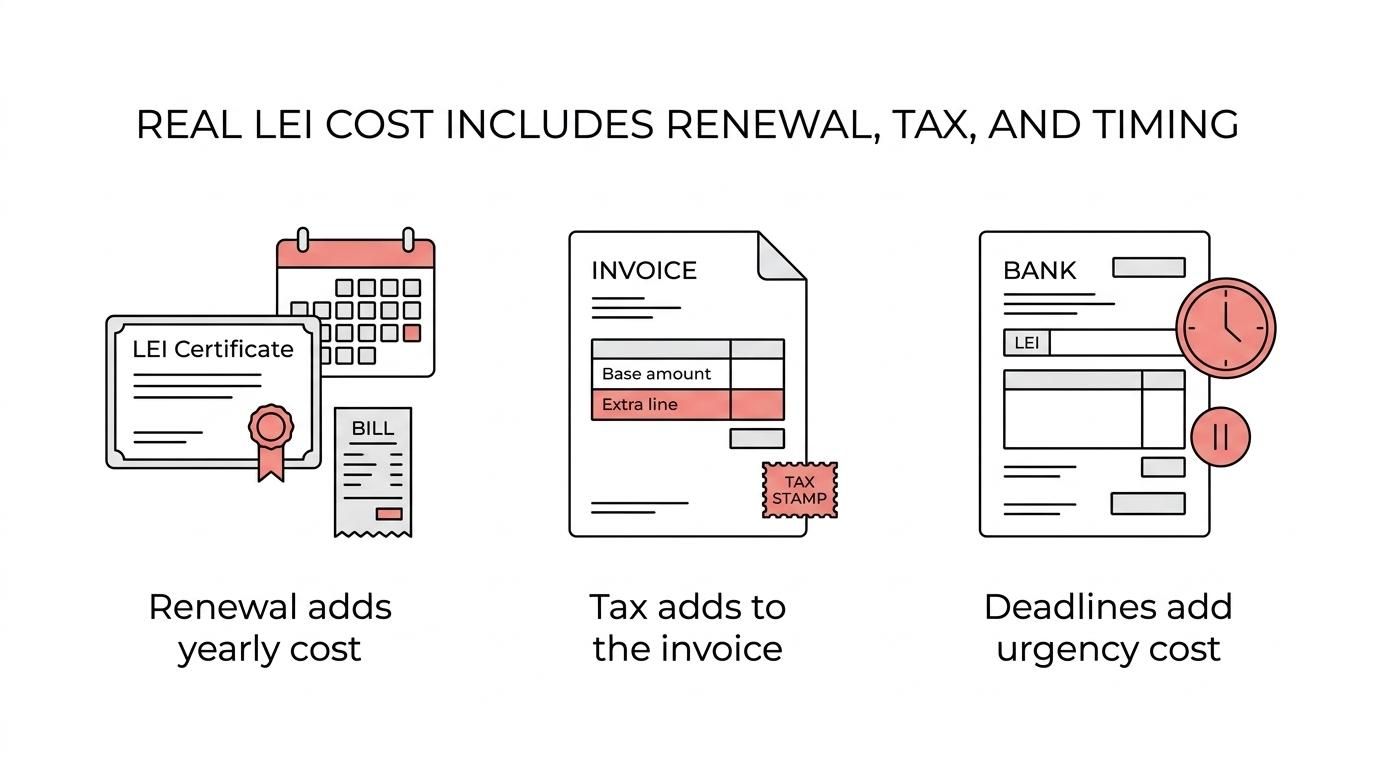
A practical tip is to read every quote as a two-line equation: first-year payable today, then total payable across the period you are likely to hold the LEI. For most operating companies, that period is not one year.
What are the 6 hidden LEI fees Indian companies should watch for?
The six biggest hidden LEI cost items are recurring renewal, tax treatment, timing effects, embedded ecosystem charges, and RBI-driven compliance triggers.
These are “hidden” not because every provider conceals them, but because buyers often notice them only after the first quote or the first renewal cycle.
Annual renewal or maintenance fee
GLEIF states that an LEI can involve an annual maintenance fee. If you budget only for registration, your cost estimate is incomplete from day one.Applicable tax outside the headline quote
Some price pages show the base LEI price but state that applicable VAT or similar tax is extra. The difference may look small at quote stage, but it changes the invoice total.Early-renewal or mid-cycle timing effects
GLEIF says issuing organisations may pro-rate renewal fees when renewal is requested before the full annual period ends. That means timing can affect what you pay and how you compare offers.Embedded GLEIF and LOU ecosystem cost
GLEIF’s annual per-LEI contribution fee to the LOU is USD 11.00. You may not see that as a line item, but it sits inside the economics of LEI issuance and renewal.Borrowing-triggered LEI compliance cost
RBI linked LEI registration to corporate borrowing thresholds, including aggregate fund-based and non-fund-based exposure of ₹5 crore and above from any bank. If your exposure crosses the threshold, LEI cost stops being optional.Large-payment operational cost
RBI says certain single payment transactions of ₹50 crore and above by Government Undertakings and Corporations through NEFT or RTGS must include remitter and beneficiary LEI information. If the LEI is missing or invalid, the resulting delay can cost more than the registration fee itself.
How is an LEI registration fee different from an annual maintenance fee?
LEI Service and other registration agents may quote an issuance price, but GLEIF treats annual maintenance as a separate part of the LEI lifecycle.
Registration is the first validation and issuance of the 20-character Legal Entity Identifier. Annual maintenance is the periodic review that keeps the reference data current, verified, and usable by banks, market participants, and regulators.
This difference matters because the work behind the fee is different. Registration checks that the entity exists and that submitted data matches official records. Maintenance checks whether anything has changed since the last cycle, including name, address, status, or parent-related information where applicable.
A common mistake is to assume renewal is only a payment event. In practice, it is also a data-quality event. If your legal name or registered address changed during the year, the real cost of renewal is not just the invoice; it is also the time needed to validate new records.
A useful habit is to ask one question before paying the first bill: “What exactly happens at renewal?” That single question exposes whether the provider is talking about administration only or ongoing validation as well.
Is a one-year LEI cheaper than a three-year or five-year plan?
A one-year LEI is cheaper today, but a three-year or five-year plan can lower the average annual cost if the entity expects to keep needing an LEI.
The arithmetic is straightforward. On the public INR example above, three separate one-year registrations at ₹5,500 would total ₹16,500, while the three-year plan is ₹15,600. That is a ₹900 difference before applicable tax. Five separate one-year periods would total ₹27,500, while the five-year plan is ₹24,500, a ₹3,000 difference before applicable tax.
The trade-off is flexibility. If your entity may close, merge, restructure, or stop needing an LEI soon, the lowest average annual price may not be the best choice. If your borrowing profile, treasury operations, or market activity makes LEI usage ongoing, multi-year pricing often makes budgeting easier.
Pro tip: do not ask only “Which plan is cheapest?” Ask “How likely is it that we will still need a valid LEI in 36 or 60 months?” That turns pricing into a business decision rather than a checkout decision.
How do you calculate the real first-year LEI cost step by step?
The real first-year LEI cost is the base quote plus tax, plus any timing pressure tied to RBI, banking, or transaction deadlines.
Step 1: Start with the quoted registration price and note the period covered. A one-year quote and a three-year quote are not directly comparable until you convert them to annual and total payable figures.
Step 2: Check whether tax is included. If the quote excludes applicable VAT or similar tax, add it before you compare providers or ask finance for approval. This is a routine source of mismatch between the web price and the final invoice.
Step 3: Add the cost of urgency. If the LEI is needed to unblock an onboarding, borrowing review, or payment instruction, the internal cost of delay may outweigh a small fee difference. In other words, if the LEI is mission-critical this week, the cheapest headline quote may be the most expensive decision.
When do RBI rules make LEI costs unavoidable for Indian entities?
For Indian entities, LEI Service becomes relevant when RBI-triggered payments or bank exposure rules leave no room to treat an LEI as optional.
RBI has tied LEI usage to more than one scenario. It said corporate borrowers with aggregate fund-based and non-fund-based exposure of ₹5 crore and above from any bank must obtain LEI registration. It also said banks should advise existing large corporate borrowers with total exposures of ₹50 crore and above to obtain an LEI. That means treasury teams should watch exposure levels, not only entity type.
RBI also says that all single payment transactions of ₹50 crore and above by Government Undertakings and Corporations through NEFT or RTGS must include remitter and beneficiary LEI information, and banks must ensure valid and verified LEI information for these payment transactions. RBI’s FAQ also references LEIL as an RBI-recognised LEI issuer. The key point is simple: once your transaction profile or borrowing profile crosses the relevant threshold, LEI cost becomes a compliance line item.
"LEI Service says express LEI delivery can be as fast as 2 hours, which matters when an RBI-covered payment cannot wait for a slow manual process."
How should you check an LEI quote before you pay?
A transparent LEI quote should tell you what is included, what renews later, and what tax or verification conditions still sit outside the number.
Before payment, run a short quote audit. You are not only buying a code; you are buying a compliant process and a renewal path.
- Included fees: Check whether the GLEIF-related component is already included in the shown price.
- Tax treatment: Confirm whether applicable VAT or other tax is excluded from the displayed amount.
- Renewal terms: Ask for the next renewal date, reminder process, and whether early renewal can be pro-rated.
- Support and data updates: Check how entity data changes are handled and whether help is available in English.
- Turnaround time: Match the promised processing speed to your bank, market, or payment deadline.
A common misconception is that a lower quote always means lower total spend. It does not if key services or timing details are missing from the comparison.
What mistakes make LEI renewal more expensive than it needs to be?
Most costly LEI renewal mistakes are timing mistakes, ownership mistakes, or data-quality mistakes.
The first mistake is letting the LEI slip out of active management. When no one owns the renewal date, the task surfaces only when a bank asks why the LEI is no longer current. That usually creates internal rush, manual checking, and avoidable friction with finance or compliance.
The second mistake is ignoring entity changes during the year. If the company name, registered office, or legal status changed, renewal may need extra validation work. If nothing changed, renewal is usually simpler. If something did change, early preparation saves time.
The third mistake is failing to review transfer options. If service quality, response speed, or pricing no longer fit, an LEI can be transferred rather than left to stagnate. That is a useful option when renewal is due and you want a cleaner process going forward.
How can Indian companies reduce total LEI cost over time?
Indian companies reduce LEI cost best by treating it as a recurring compliance asset, then matching term length and renewal process to actual regulatory use.
Start by mapping why the entity needs an LEI at all. If the answer is bank exposure, large-value payments, fund trading, or regular financial market activity, the LEI is likely to stay relevant. That supports a longer pricing horizon.
Next, set ownership. One team, usually treasury, finance, compliance, or company secretarial, should own the LEI record, renewal calendar, and source documents. When ownership is diffuse, costs rise through delay rather than through price.
Then compare annualised pricing, not just headline pricing. If the entity will need an LEI for several years, calculate the per-year cost of one-year, three-year, and five-year terms. If the entity’s future is uncertain, keep flexibility. If continued usage is highly likely, locking in a lower average annual rate can be the more disciplined choice.
Finally, keep the data current before renewal season arrives. The cheapest renewal is usually the one that does not require last-minute record chasing.