6 LEI Facts Foreign Investors Need in India
For a foreign investor in India, an LEI is often a compliance requirement rather than an optional identifier. The main trigger points come from SEBI for non-individual foreign portfolio investors and from RBI for specified OTC derivatives, non-derivative forex, and some FEMA-linked high-value transactions.
TL;DR: Summary
- A foreign investor LEI in India is mandatory in many regulated cases: SEBI requires LEI for all non-individual foreign portfolio investors, and RBI requires LEI in several entity-level market and transaction categories.
- An LEI is a unique 20-character code under ISO 17442, defined by GLEIF and linked to public reference data through the Global LEI Index, so it is used for entity verification, not just registration.
- RBI’s framework covers participants other than individuals in specified RBI-regulated markets, including OTC derivative markets and non-derivative forex markets.
- From 1 October 2022, AD Category I banks must obtain LEI from resident non-individual entities undertaking capital or current account transactions of ₹50 crore and above per transaction under FEMA, 1999.
- Once an entity has obtained an LEI, RBI says that LEI must be reported in all transactions of that entity, irrespective of transaction size.
- If a foreign investor already has a valid LEI, the same code can usually be used in India-facing workflows; the key is to keep it active, accurately renewed, and mapped to the correct legal entity.
The confusion usually comes from scope, not from the code itself. An LEI may be required because of your investor category, the market you trade in, the legal entity that is transacting, or the value and nature of a transaction, and those triggers do not all work in the same way.
What is an LEI, and why does it matter to foreign investors in India?
An LEI is a global entity identifier defined by GLEIF under ISO 17442. In India, SEBI and RBI use it to identify legal entities in regulated transactions, improve counterparty transparency, and support cleaner reporting and risk controls.
GLEIF describes the Legal Entity Identifier as a unique 20-character alphanumeric code. Every LEI maps to one legal entity only, and that code links to verified reference data in the Global LEI Index. That is why regulators use it as an identity layer for legal entities, funds, corporates, and similar structures.
A common mistake is to think an LEI is just another filing number. It is closer to a standardised global identity key that helps regulators, banks, custodians, and market infrastructures confirm who is transacting with whom.
"LEI Service offers a one-minute application and express LEI delivery within 2 hours for time-sensitive filings."
Which foreign investors need an LEI in India?
Non-individual FPIs need an LEI under SEBI, and entity participants in RBI-regulated markets may need one under RBI. Individuals are usually outside these entity-focused LEI mandates, but funds, corporates, trusts, and similar bodies are often in scope.
If a foreign investor is set up as a non-individual foreign portfolio investor, SEBI’s 2023 circular makes the answer simple: LEI is mandatory. That rule is category-based, so the trigger is your status as a non-individual FPI.
RBI uses a different logic. Its LEI rollout has applied in phases to participants other than individuals in RBI-regulated markets, including rupee interest rate derivatives, foreign currency derivatives, credit derivatives, and non-derivative forex markets. So if a foreign corporate treasury, offshore fund, or institutional vehicle enters those workflows, LEI may be required even outside the FPI label.
What are the six LEI facts foreign investors need in India?
Six facts matter most: SEBI covers non-individual FPIs, RBI covers specified market participation, and FEMA-linked banking workflows can create separate LEI triggers. The practical point is that a foreign investor should test category, instrument, and transaction path, not just one rulebook.
The six facts below capture the main compliance picture without mixing unlike triggers:
- SEBI mandates LEI for all non-individual foreign portfolio investors.
- RBI introduced LEI in phases for participants other than individuals in OTC derivative markets, including rupee interest rate derivatives, foreign currency derivatives, and credit derivatives.
- RBI also extended the LEI framework to non-derivative forex markets and other RBI-regulated markets in phases.
- From 1 October 2022, AD Category I banks must obtain LEI from resident non-individual entities undertaking capital or current account transactions of ₹50 crore and above per transaction under FEMA, 1999.
- Once an entity has obtained an LEI, RBI requires that LEI to be reported in all transactions of that entity, irrespective of transaction size.
- A valid LEI is global rather than India-specific, so an existing active LEI can normally be reused instead of applying for a second code.
How does SEBI’s LEI mandate compare with RBI’s LEI framework?
SEBI and RBI use LEI for different compliance gates. SEBI focuses on non-individual FPI status, while RBI focuses on participation in specified markets and, in one notable banking rule, high-value FEMA transactions by resident non-individual entities.
SEBI’s rule is relatively clean to apply. If the investor is a non-individual FPI, LEI is mandatory. RBI’s framework is more operational. You must ask what market you are in, whether the entity is an individual or non-individual, whether the workflow sits inside an RBI-regulated product set, and whether an AD bank will require LEI at transaction level.
A practical misconception is that one regulator’s trigger automatically answers the other’s process. It does not. A fund could need LEI because of SEBI even before a specific RBI-triggered transaction occurs, while a resident group entity dealing with a ₹50 crore FEMA transaction may face a bank-led LEI check even outside securities investing.
"LEI Service shows transparent INR pricing, includes the GLEIF fee, and guarantees an email response within 24 hours."
How can a foreign investor check, step by step, whether an India transaction needs an LEI?
The quickest method is a three-part test using entity type, market type, and transaction path. SEBI, RBI, and the bank or intermediary involved each answer a different part of the question.
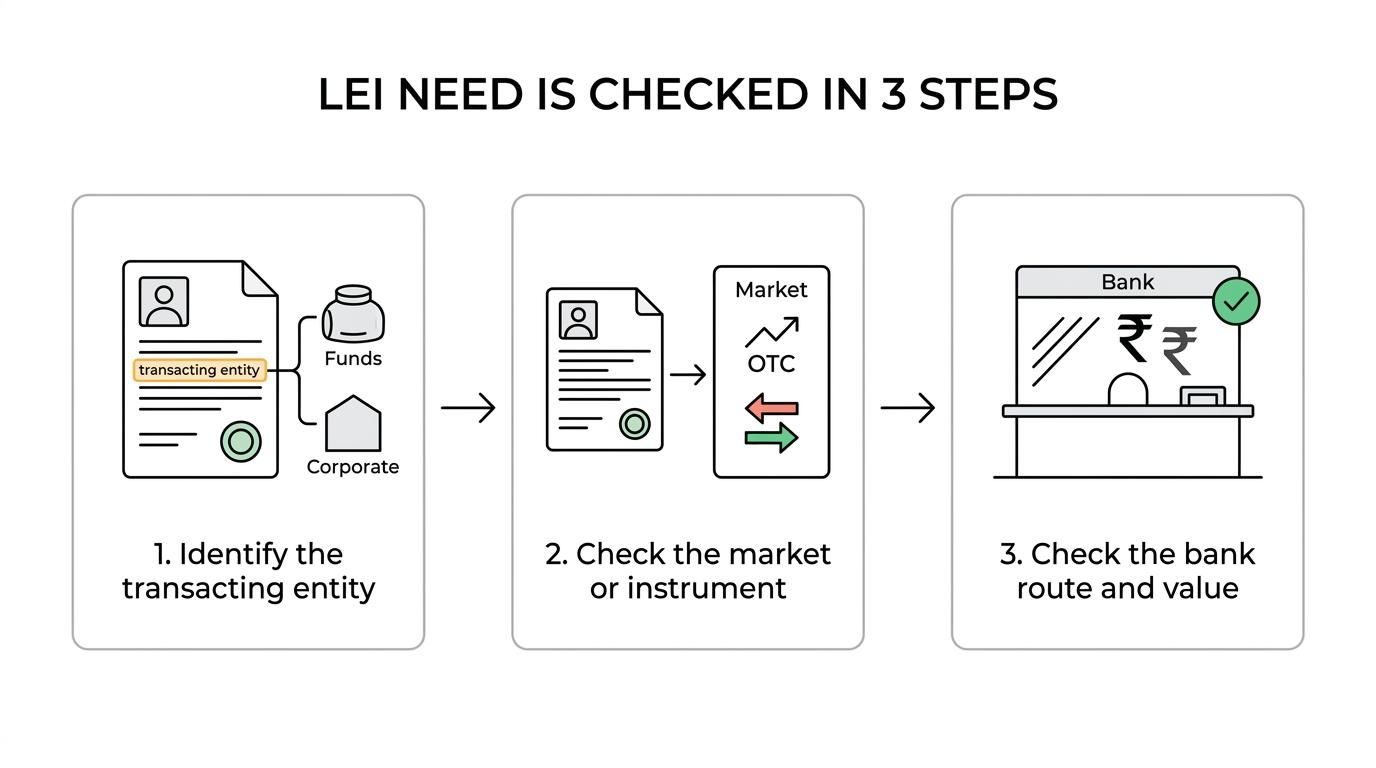
First, identify the legal entity that is actually transacting. If the investor is a non-individual FPI, the SEBI answer is already yes. If the activity is being done by a separate fund, SPV, or treasury entity, test that entity, not the group name.
Next, map the instrument and market. If the entity is entering RBI-regulated OTC derivatives or non-derivative forex workflows, review the RBI LEI framework for participants other than individuals. If the activity is only a passive holding with no such market participation, the relevant trigger may sit elsewhere.
Finally, check the banking route and value. If an AD Category I bank is processing a capital or current account transaction under FEMA, 1999, and the transacting party is a resident non-individual entity at ₹50 crore or above per transaction, LEI becomes a bank-side requirement. If the entity already has an LEI, keep using the same one in all covered transactions.
How is an LEI different from PAN, registration certificates, and other IDs?
An LEI is not a tax number or a local incorporation record. PAN, FPI registration data, and home-country company numbers all serve different purposes, and none of them automatically replaces LEI in India’s regulated financial workflows.
This distinction matters because many cross-border teams assume that one accepted identity document should satisfy every compliance process. Indian market infrastructure does not work that way. A PAN can support tax and account processes, while LEI supports standardised entity identification in regulated financial reporting and transaction controls.
- LEI: A global 20-character legal entity identifier under ISO 17442.
- PAN: An Indian tax identifier, useful for taxation and account opening, but not a substitute for LEI.
- FPI registration details: Proof of regulatory status, not a universal entity identifier across market infrastructures.
- Home-country company number: Proof of incorporation in one jurisdiction, not a globally standardised counterparty identity key.
How can a foreign entity get an LEI for India-facing transactions?
A foreign entity can obtain an LEI through a GLEIF-accredited Local Operating Unit or through a registration agent that submits to one. The real work is data validation, not form filling.
Start by applying in the name of the exact legal entity that will appear in market and banking records. The application usually asks for legal name, registered address, registration authority details, entity status, and an authorised contact or signatory. If your entity already has an active LEI, do not apply again because every LEI is unique to one entity.
Then the issuer or agent validates the data against official registries and public records. This is where delays happen. A small mismatch in legal name punctuation, address format, or entity status can stop issuance more often than missing narrative explanations.
Some applicants file directly with an accredited issuer, while others use an agent such as LEI Service to manage validation and submission. That route can be useful when the priority is speed, English-speaking support, or renewal administration across multiple entities.
"LEI Service handles validation and submission to GLEIF-accredited LOUs, with automatic renewal available and free entity data updates."
What documents and validation checks usually slow down LEI issuance?
Most delays come from entity-data mismatches, not from the LEI standard itself. GLEIF data quality rules and registry-based checks mean the legal name, address, and registration details must match the source records closely.
If a foreign investor wants faster turnaround, the best tactic is to prepare registry-clean data before applying. A practical tip is to copy the legal name exactly as shown in the official register, even if internal finance teams use a shortened trading name in emails and templates.
Common friction points include the following:
- Registered name mismatches
- Old registered addresses
- Wrong registration authority details
- Applying under the parent instead of the actual transacting entity
Parent and ownership reporting can also matter where applicable. If the fund, SPV, or corporate sits inside a larger structure, inconsistent group information can create follow-up questions. That does not mean every applicant must disclose the same ownership fields in the same way, but it does mean internal legal and operations teams should reconcile entity records early.
Do individuals, funds, and group entities follow the same LEI rules in India?
No, LEI rules attach to legal entities, not to economic groups or individuals as a class. SEBI and RBI both frame major LEI obligations around entities, which is why structure matters as much as investment intent.
Individuals are generally treated differently from non-individual entities in the RBI language cited for market participation. SEBI’s FPI mandate is also expressly for non-individual foreign portfolio investors. That means a foreign individual investor should not assume the same automatic LEI requirement that applies to a fund or corporate vehicle.
A common misconception is that one group LEI can cover everyone. It cannot. If a fund, its management company, and a treasury subsidiary are each separate legal entities and each appears in regulated workflows, each may need its own LEI. GLEIF’s own model is clear on this point: one LEI represents one entity only.
How should foreign investors handle LEI renewal, transfer, and ongoing reporting?
LEI compliance is ongoing, not one-time. Renewal keeps the record active, transfer changes the service provider without changing the code, and RBI reporting expectations continue once the entity has an LEI.
Renewal is normally annual because reference data must remain current. If an LEI lapses, the code does not disappear, but many market participants and counterparties treat a lapsed LEI as a practical compliance problem. If a corporate action, address change, or restructuring occurs, the LEI data should be updated promptly.
Transfer is useful when the existing provider is slow, costly, or hard to work with across time zones. The LEI itself stays the same; only the managing service route changes. If your operations team wants fewer missed renewals, automatic renewal can reduce administrative risk.
For India-specific workflows, keep one more RBI rule in mind. Once an entity has obtained an LEI, RBI says that LEI must be reported in all transactions of that entity, irrespective of transaction size. So if you have crossed into LEI-required territory once, treat the code as part of your standing transaction data, not as a document you produce only for exceptional trades.