6 Questions to Ask About 2-Hour LEI Processing Claims
Fast LEI turnaround matters when a trade, onboarding request, or borrowing deadline cannot wait. For Indian entities, that makes “2-hour LEI processing” a useful claim to assess carefully, and it is exactly the kind of timing question a registration agent like LEI Service is expected to answer with precision rather than marketing language.
TL;DR: Summary
- A 2-hour LEI processing claim can be genuine, but it usually means the provider can complete validation and submit a straightforward new LEI application quickly, not that every system will display the LEI instantly.
- LEI Service states that new LEI orders can be delivered in 2 hours if ordered before 19:00, yet its published validation window is 1 to 48 hours, which shows that validation complexity is the real timing driver.
- GLEIF’s Global LEI Index is updated on schedules, not continuously for every end user: Golden Copy Files are published three times daily, and issuers may upload updates up to ten times daily.
- RBI timing makes speed operationally important because non-individual borrowers with aggregate exposure of ₹5 crore and above need an LEI, and borrowers without one may face limits on new or renewed exposure.
- The best test is simple: ask about cut-off time, validation steps, registry matching, LOU submission timing, and when banks or brokers typically see the LEI after issuance.
The practical issue is that “issued”, “visible in the Global LEI Index”, and “accepted by your bank or broker” are related but not identical events. If you ask the right questions before applying, you can tell the difference between a realistic express workflow and a vague promise.
What does a 2-hour LEI processing claim actually mean?
A 2-hour LEI claim usually means the provider can complete a fast validation workflow and submit to a GLEIF-accredited LOU for a straightforward case. With LEI Service, the relevant point is not just the headline speed but the stated validation window behind it.
An LEI is not created in a vacuum. A Registration Agent collects the entity details, checks them against official records, and then submits the application to an authorized Local Operating Unit, or LOU. If the legal name, company number, address, or entity status matches public registry data cleanly, the process can move quickly.
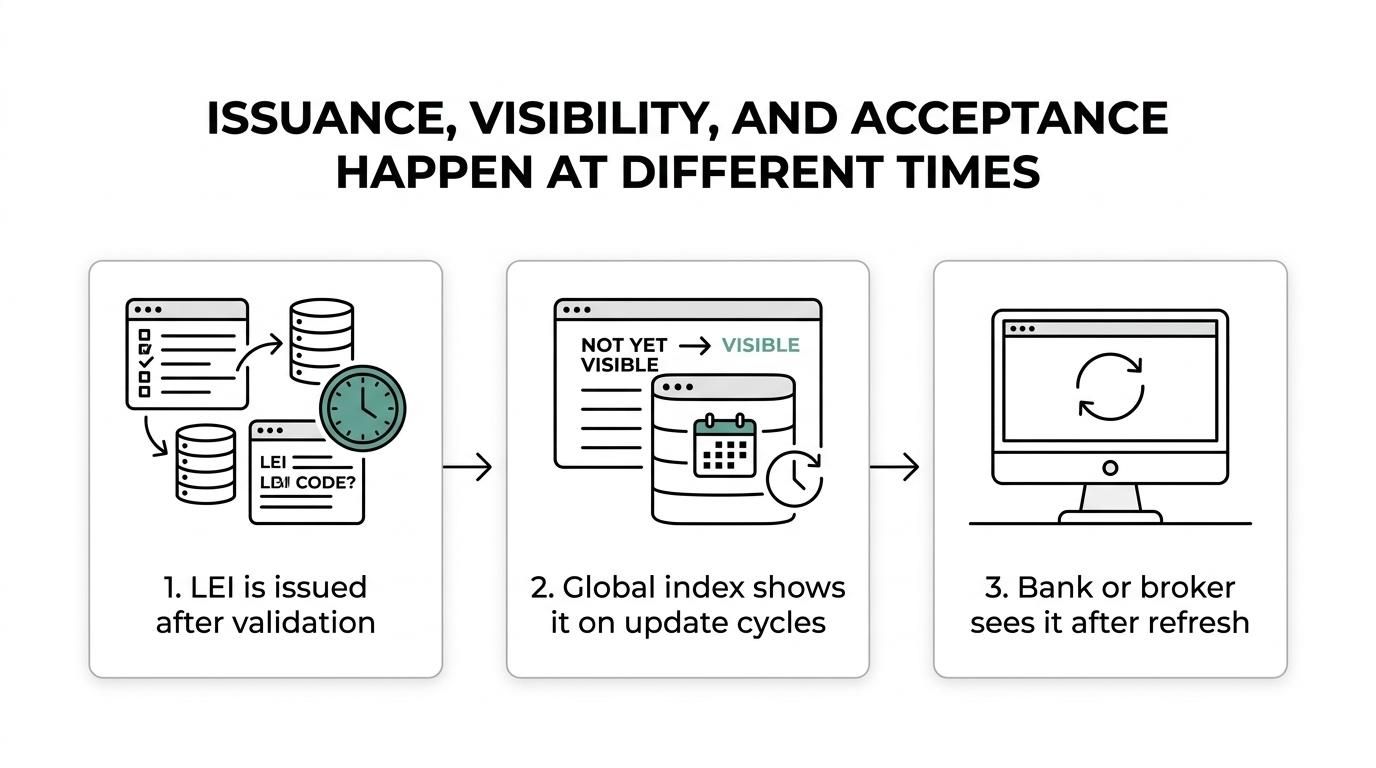
The key phrase is “straightforward case”. If the entity record is recent, incomplete, inconsistent across documents, or tied to a more complex legal structure, the clock slows because validation has to be resolved before issuance. A common mistake is to assume the online form time equals the issuance time. It does not.
“LEI Service says new LEI orders can be delivered in 2 hours if ordered before 19:00.”
So when you see a 2-hour promise, read it as a best-case operational claim tied to clean data, business-hour cut-offs, and successful validation. That is a sensible standard. A universal guarantee for every legal entity would be much harder to defend.
Is 2-hour processing the same as 2-hour visibility in the Global LEI Index?
No. LEI issuance and public visibility are connected, but they do not happen on the same clock.
This distinction matters because many users check the Global LEI Index or an internal bank system rather than the issuer confirmation itself. GLEIF states that its Golden Copy Files are published three times daily at 02:00 UTC, 10:00 UTC, and 18:00 UTC. GLEIF also states that issuers may upload updated files up to ten times daily, and its delta files identify newly issued LEIs and revisions compared with earlier files.
That means a provider can finish the issuance workflow before your counterparty’s systems refresh. In practice, your LEI may exist and be valid before a broker, custodian, or lending desk sees it in the view they use.
A common misconception is that if a search result is not visible immediately, the LEI was not issued. Often the real issue is downstream refresh timing. If timing is critical, ask two separate questions: “When is the LEI expected to be issued?” and “When do banks or brokers usually see it in their systems?”
What are the main checks behind genuine 2-hour LEI processing?
The main checks are registry matching, entity status, contact authority, document quality, and submission timing.
Before relying on any express promise, check what sits behind it. The fastest providers usually move quickly because the application is simple only when the validation inputs are clean.
- Registry match: Legal name, registration number, and registered address should match official records exactly.
- Entity status: The entity must be active and identifiable in the relevant business registry.
- Authorised contact: The person applying should be traceable to the entity or able to confirm authority if asked.
- Document quality: Recent, readable source documents reduce back-and-forth.
- Daily cut-off: A same-day express workflow depends on the order being placed before the provider’s published cut-off.
If one of these elements fails, then the provider may still complete the application quickly, but the LOU or validation team may not be able to issue the LEI in the same short window. Pro tip: the smallest mismatch, including punctuation or an outdated address, can create a delay that looks mysterious until you compare the application against the registry line by line.
How should you verify a provider’s cut-off time and validation workflow?
Verify it by asking for the exact operational sequence, not just the headline turnaround.
A strong answer should tell you what happens between your payment and the LEI becoming active. If the explanation stays vague, treat the speed claim as unproven. Ask these questions in order:
- Cut-off time: What is the latest time for same-day or 2-hour processing in India?
- Validation window: Is the 2-hour timing only for simple cases, and what triggers the longer 1 to 48 hour path?
- Submission route: Is the application sent to an authorized LOU after validation, or queued in batches?
- Visibility timing: When is the LEI usually searchable in the Global LEI Index or seen by banks and brokers?
Then ask one more practical question: what document or data field causes the most delays? That answer often reveals whether the provider actually runs a disciplined validation process or just advertises speed. Pro tip: if your case is time-sensitive, ask for confirmation of the cut-off in writing before you pay.
When does RBI borrower LEI timing become operationally critical?
RBI timing becomes critical when a non-individual borrower with aggregate exposure of ₹5 crore and above needs lending continuity, renewal, or enhancement.
The Reserve Bank of India requires non-individual borrowers with aggregate exposure of ₹5 crore and above from banks and financial institutions to obtain an LEI. RBI also clarifies that exposure includes fund-based and non-fund-based exposure, and the higher of aggregate sanctioned limit or outstanding balance is used.
That rule changes LEI speed from a convenience issue into an operational issue. RBI states that borrowers without LEI codes from an authorized LOU shall not be sanctioned new exposure or renewal or enhancement of existing exposure. If a credit committee decision, annual renewal, or facility increase is approaching, then even a one-day delay can become commercially significant.
A common mistake is to look only at outstanding borrowing. If the sanctioned limit is higher, RBI’s test uses the higher figure. That is why treasury teams and finance heads should check exposure classification early rather than waiting until the bank asks for the LEI at the last moment.
How do new LEI registration, renewal, and transfer timelines compare?
They differ materially. LEI Service treats new registration, renewal, and transfer as distinct workflows because each one has a different validation burden.
A new LEI registration usually takes the most checking because the entity is entering the LEI system for the first time. The validator must confirm the entity reference data against official sources, and any mismatch can slow issuance.
A renewal is often faster when nothing important has changed. If the legal entity data is already established and still current, the work is mainly to reconfirm status and extend validity. A transfer sits somewhere else entirely. The LEI already exists, but the record must move between service arrangements while keeping the code intact and current.
“LEI Service says the online application takes about 1 minute, while validation usually runs 1 to 48 hours.”
If your timing is tight, do not assume a transfer is always faster than a new registration, or that a renewal is automatic. If the entity changed name, address, or legal form, then the “simple renewal” can become a data-update exercise that needs extra review.
What should you submit first if you want the fastest LEI turnaround?
Start with exact registry-matching entity data, then add the contact details and supporting document most likely to settle validation immediately.
Speed depends less on the number of documents and more on whether the first set answers the validator’s core questions. Use a simple sequence.
Step 1: Pull the current official entity details exactly as recorded in the applicable registry. Use the same legal name, company number, and registered address without “cleaning up” abbreviations or punctuation.
Step 2: Add a valid contact who can answer follow-up questions quickly. If the validator needs confirmation and your team replies the next morning, your express window may disappear even if the provider was ready to process the same evening.
Step 3: Keep one recent supporting document ready if the registry record is not self-explanatory. The best document is the one that resolves ambiguity, not the one with the most pages.
Pro tip: do not rewrite your legal name into a brand name or trading style on the application form. If the registry says “Private Limited”, use that exact legal form. Small edits by the applicant are a frequent cause of preventable delay.
What should you do if your LEI is issued but your bank or broker cannot yet see it?
First confirm the issuance status, then check public index timing, then ask the institution what source and refresh cycle it uses.
Start with the provider’s issuance confirmation and the LEI code itself. If the code has been issued, the next question is where the bank or broker is looking. Some institutions check the Global LEI Index directly. Others rely on internal copies, vendor feeds, or overnight sync cycles.
Next, compare the timing with GLEIF’s publication schedule. If your LEI was issued close to one update window, it may appear in one environment before another. If the institution uses a vendor feed or internal compliance system, then the issue may be their refresh timing rather than the validity of the LEI.
If the transaction is urgent, ask the institution whether it can proceed based on the issued code and confirmation while its own systems catch up. If not, ask when its next data refresh occurs. That question is often more useful than repeatedly rechecking public search tools every few minutes.
A final misconception to avoid: “not yet visible everywhere” does not mean “not issued”. In tight market or lending timelines, that distinction can save hours of unnecessary escalation.