6 Situations Where a Lapsed LEI Can Block a Transaction
A lapsed Legal Entity Identifier can stop a transaction even when the business itself is still active. That happens because market participants and regulators often validate the LEI status, not just the entity name, before they allow trading, settlement, or reporting.
TL;DR: Summary
- A lapsed LEI can block transactions because RBI treats lapsed LEI codes as invalid in RBI-regulated markets, and many market or reporting systems reject an overdue LEI even if the legal entity still exists.
- GLEIF classifies LAPSED as a renewal-status issue in Level 1 data. It means the LEI is overdue for verification, not that the entity is dissolved or inactive.
- The highest-risk situations include money market trades, non-derivative forex transactions, counterparty onboarding, settlement instruction checks, amendments to existing trades, and next-day regulatory reporting workflows.
- The fastest prevention step is to check the LEI in the Global LEI Index, confirm the Next Renewal date, and renew before the trade date rather than after a rejection.
- If a transaction is due now, verify the LEI status, alert the bank or broker, submit renewal immediately, and confirm whether execution, reporting, or settlement can proceed once the LEI returns to ACTIVE.
For Indian entities, the key point is simple: a lapsed LEI is not only a registry issue. It can become a live execution problem in RBI-regulated markets, and it can also create reporting or operational breaks in cross-border workflows.
What does a lapsed LEI actually mean?
A lapsed LEI is a renewal-status problem, not proof that the entity is defunct. GLEIF marks the LEI as LAPSED in Level 1 data when the code is due for renewal and has not been revalidated within the planned interval.
That distinction matters because many teams misread a lapsed status as a corporate existence issue. GLEIF’s own framework separates entity identity from renewal timeliness, so a company can still exist legally while its LEI is no longer current for market use.
A common misconception is that LAPSED means “cancelled” or “closed.” It does not. In practice, the problem is that counterparties, banks, and regulatory systems may still refuse the code because they need an active and recently verified identifier, not just a historically valid one.
"LEI Service can process LEI renewals in as fast as 2 hours, which matters when a bank or broker is waiting for an ACTIVE status check."
Why can a lapsed LEI block a transaction even if the company still exists?
A lapsed LEI can stop execution because banks, brokers, and reporting systems screen the code before accepting a trade. RBI and post-trade reporting workflows treat LEI validity as an operational gate, not a minor admin detail.
The logic is straightforward. If a transaction falls inside a regime that requires a valid LEI, then the legal existence of the entity is not enough. The code itself must pass validation at the point where the institution checks onboarding data, trade eligibility, settlement instructions, or regulatory reporting fields.
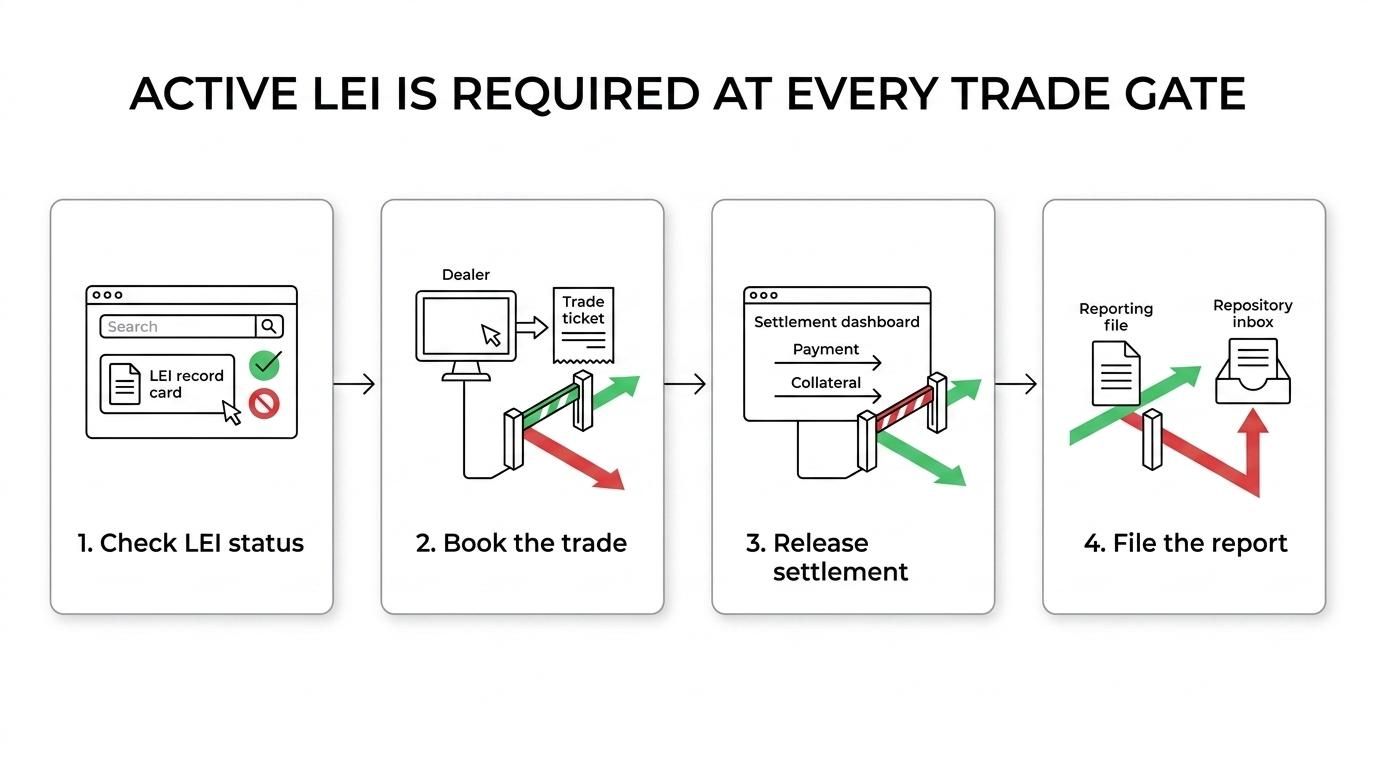
This is why teams get caught out during rollovers and amendments. A facility may have been opened when the LEI was active, but if the system revalidates the identifier at modification, the same relationship can still hit a fresh block.
The trade-off is speed versus control. Firms that validate only at onboarding move faster in the short term, but firms that validate again at trade date reduce compliance risk. Most regulated market participants prefer the second model.
What are the 6 situations where a lapsed LEI can block a transaction?
The highest-risk situations are RBI-regulated market trades, securities-financing reporting, onboarding checks, settlement controls, amendments to existing deals, and recurring facilities. In each case, the LEI may be validated before execution, reporting, or post-trade acceptance.
These are the six situations that most often create a real transaction issue rather than a back-office inconvenience:
- RBI-regulated money market transactions: RBI requires non-individual participants in certain regulated markets to obtain an LEI, and lapsed LEIs are deemed invalid for transactions in those markets.
- Non-derivative forex market deals: If the trade sits inside the RBI rule set, a lapsed LEI can stop entry or confirmation even when the counterparty relationship already exists.
- Counterparty onboarding or periodic KYC refresh: Banks often suspend new deals when the Global LEI Index shows LAPSED, because master-data controls feed directly into dealing and settlement systems.
- Securities financing transaction reporting: ESMA’s SFTR reporting relies on LEIs in core reporting fields, and reports are due no later than the working day after conclusion, modification, or termination.
- Trade amendments, novations, and rollovers: Even if the original trade was valid, a later change may trigger a new LEI check and fail if the code is no longer ACTIVE.
- Settlement and treasury operations checks: Payment, collateral, or settlement teams may reject or pause instructions where the LEI status conflicts with policy or counterparty data standards.
Not every bank applies each control in the same place. Some stop the trade before execution. Others allow a booking but block settlement or reporting. Either way, a lapsed LEI can still become a transaction problem.
How can you check whether an LEI is ACTIVE or LAPSED before a trade?
The safest check is to use the Global LEI Index and confirm both the registration status and the Next Renewal date. GLEIF’s search tool is free and does not require registration.
Step 1 is to search the exact entity name or LEI in the Global LEI Index. Step 2 is to review the Level 1 data and confirm whether the registration status is ACTIVE or LAPSED. Step 3 is to check the Next Renewal date so you know whether the code is close to expiring even if it is still active today.
A useful pro tip is to verify the legal name and jurisdiction at the same time. If the entity changed name, merged, or updated registration details recently, the LEI may need data corrections as well as renewal. Teams often miss this and renew too late in the workflow.
"LEI Service includes the GLEIF fee and free entity-data updates, which helps when an LEI check shows the code needs renewal and the entity record also needs correction."
How does RBI treat a lapsed LEI versus GLEIF?
GLEIF and RBI answer different questions. GLEIF tells you that LAPSED means overdue renewal, while RBI says a lapsed LEI is invalid for transactions in RBI-regulated markets.
That difference clears up a lot of confusion. GLEIF runs the global data framework and explains the status in the registry. RBI sets market rules for certain Indian financial markets. So one body describes what the status means, and the other decides what that status allows or prevents in a regulated transaction context.
If a company sees LAPSED in GLEIF, that does not automatically mean the company is inactive. If the same company tries to transact in an RBI-regulated market, the operational answer can still be no. The registry meaning and the market permission are related, but they are not the same thing.
A common misconception is that the LEI search result alone tells you whether you may trade. It does not. You also need to ask which regulator, market, or counterparty rulebook governs the transaction.
How do reporting-based blocks differ from market-access blocks?
Market-access blocks happen before or at execution, while reporting blocks often surface after the trade is agreed. RBI and ESMA show both patterns: one can stop market entry, the other can make the trade unreportable by the deadline.
With a market-access block, the dealer, bank, or platform may refuse to book the trade at all. This is the cleaner control from a compliance standpoint because it prevents a non-compliant transaction from entering the system. RBI-driven LEI checks in regulated markets often work this way.
With a reporting-based block, the trade may be agreed commercially but still fail when the firm tries to report it to a trade repository. Under ESMA’s SFTR framework, the reporting deadline is no later than the working day after conclusion, modification, or termination, and LEIs form part of the core reporting data set. That means a lapsed code can turn into a next-day operational breach.
The trade-off is obvious. A pre-trade block hurts revenue timing, but a post-trade reporting block can create remediation work, exception queues, and regulatory risk.
"LEI Service offers a one-minute application and a guaranteed email response within 24 hours, which is useful when an operations team needs renewal support fast."
What should you do if a trade is due today and your LEI has lapsed?
Act immediately if the LEI is lapsed and a transaction is scheduled today. The practical order is to verify the status, contact the bank or broker, submit renewal, and ask whether the workflow can continue once the LEI returns to ACTIVE.
Start by confirming the status in the Global LEI Index rather than relying on an old screenshot or internal spreadsheet. Then notify the internal treasury, compliance, or operations owner and ask the counterparty where the block sits. Is it pre-trade eligibility, settlement release, or reporting?
Next, submit the renewal without delay. If the current registration agent is unresponsive and the timeline matters, a transfer to another provider may be the better route. The critical point is to restore an ACTIVE status fast enough for the transaction window, while being realistic that internal bank systems may not refresh instantly.
Then ask a direct operational question: if the LEI becomes active today, can the trade proceed today, or will the bank need an overnight data refresh? That answer often decides whether you can save the deal or need to reschedule it.
How can you renew or transfer a lapsed LEI without repeating the full process?
Renewal usually needs less work than a first application, and transfer is often the right fix when the current provider is slow or hard to reach. GLEIF-accredited issuance still depends on validated entity data.
Step 1 is to identify who currently manages the LEI and whether the code is simply due for renewal or also needs entity-data updates. Step 2 is to gather the legal entity details that the issuing workflow will revalidate. Step 3 is to decide whether to renew with the current provider or transfer the LEI to another registration agent that submits to a GLEIF-accredited Local Operating Unit.
For Indian entities, practical factors matter: transparent INR pricing, support in English, renewal speed, and whether the GLEIF fee is already included. Some registration agents, including LEI Service, handle new registration, renewal, and transfer in the same workflow, which can reduce friction when timing is tight.
Pro tip: do not assume the cheapest annual headline price is the lowest total cost. If support is slow or transfer is difficult, the hidden cost appears later as missed trade windows and manual escalations.
Why do lapsed LEIs create extra trouble in cross-border transactions and reporting?
Cross-border workflows multiply the number of systems that may validate the LEI. A bank in India, a foreign broker, and a trade repository may each check the same code for different reasons.
That matters because the same lapsed LEI can trigger different consequences across the chain. A domestic market participant may focus on RBI market eligibility, while an overseas reporting team may focus on whether the LEI populates a mandatory field in a post-trade report. One trade can therefore fail in more than one place.
Historical terms can add confusion too. Some European rule texts still refer to global legal entity identifiers or pre-LEIs in implementation language, but the operational principle is consistent: the transaction record needs a recognised entity identifier that satisfies the reporting framework in force.
If your treasury activity spans jurisdictions, treat LEI renewal as a shared control between compliance, legal-entity management, and operations. When one team assumes another team owns the process, lapses become much more likely.
Which mistakes cause repeat LEI lapses and preventable transaction delays?
Most repeat lapses come from process gaps, not complex regulation. Missed renewal emails, outdated authorised signatory details, and assuming a dormant entity does not need an LEI are the usual causes.
The fix is to treat the LEI like a live operating credential rather than a one-time registration. It sits closer to a licence renewal rhythm than a static reference number. Once firms frame it that way, their controls usually become stronger and trade interruptions fall.
Common failure points include the following:
- Single-owner dependency: one employee receives renewal reminders, then goes on leave or exits the company.
- Expiry-only mindset: teams check the LEI number exists but ignore the Next Renewal date.
- Entity-change lag: legal name, address, or corporate status changes are not reflected quickly in LEI records.
- Wrong scope assumption: a business thinks only new trades need an active LEI, while amendments and rollovers may also trigger checks.
- No renewal policy: the firm has no diary control, multi-year approach, or automatic renewal option for critical entities.
A simple operating rule works well: if the entity may trade, borrow, report, or settle using an LEI in the next 90 days, check the status now and not on the transaction date. That one habit prevents most lapsed LEI transaction issues before they become expensive.