7 Checks Before Choosing an LEI Agent
Choosing an LEI registration agent is less about marketing and more about system design. In the Global LEI System, the key question is simple: can this agent connect your entity to a GLEIF-accredited issuer and get your reference data verified correctly?
TL;DR: Summary
- Choose an LEI registration agent that clearly works through a GLEIF-accredited LEI issuer because only accredited issuers, also called Local Operating Units (LOUs), can actually issue an LEI.
- Check the agent’s named issuer relationship, total price, renewal terms, and support promise before paying; these factors often matter more than a low first-year headline fee.
- Good LEI agents make reference-data verification explicit, including checks against the local Registration Authority or business register, because data mismatches are a common cause of delay.
- Compare new registration, renewal, and transfer separately; the right option depends on whether you need a first LEI, annual revalidation, or a move away from an existing provider.
- If an agent publishes concrete service terms, like included GLEIF fees, renewal options, or response times, it is easier to judge risk and service quality objectively.
For Indian businesses, funds, charities, and other legal entities, that choice affects speed, compliance, renewal continuity, and support when something does not match the register. The best agent is usually the one that is transparent about its issuer, validation process, and annual renewal obligations.
Why does GLEIF accreditation matter when choosing an LEI registration agent?
GLEIF accreditation is the first filter. GLEIF-accredited issuers, often called Local Operating Units or LOUs, are the only organisations authorised to issue LEIs, while registration agents are intermediaries.
That distinction matters because many applicants assume the website taking the order is the same body issuing the code. Official LEI system guidance says otherwise. The issuer carries the formal responsibility for issuance and annual renewal, and it must verify the entity’s reference data before the LEI is issued.
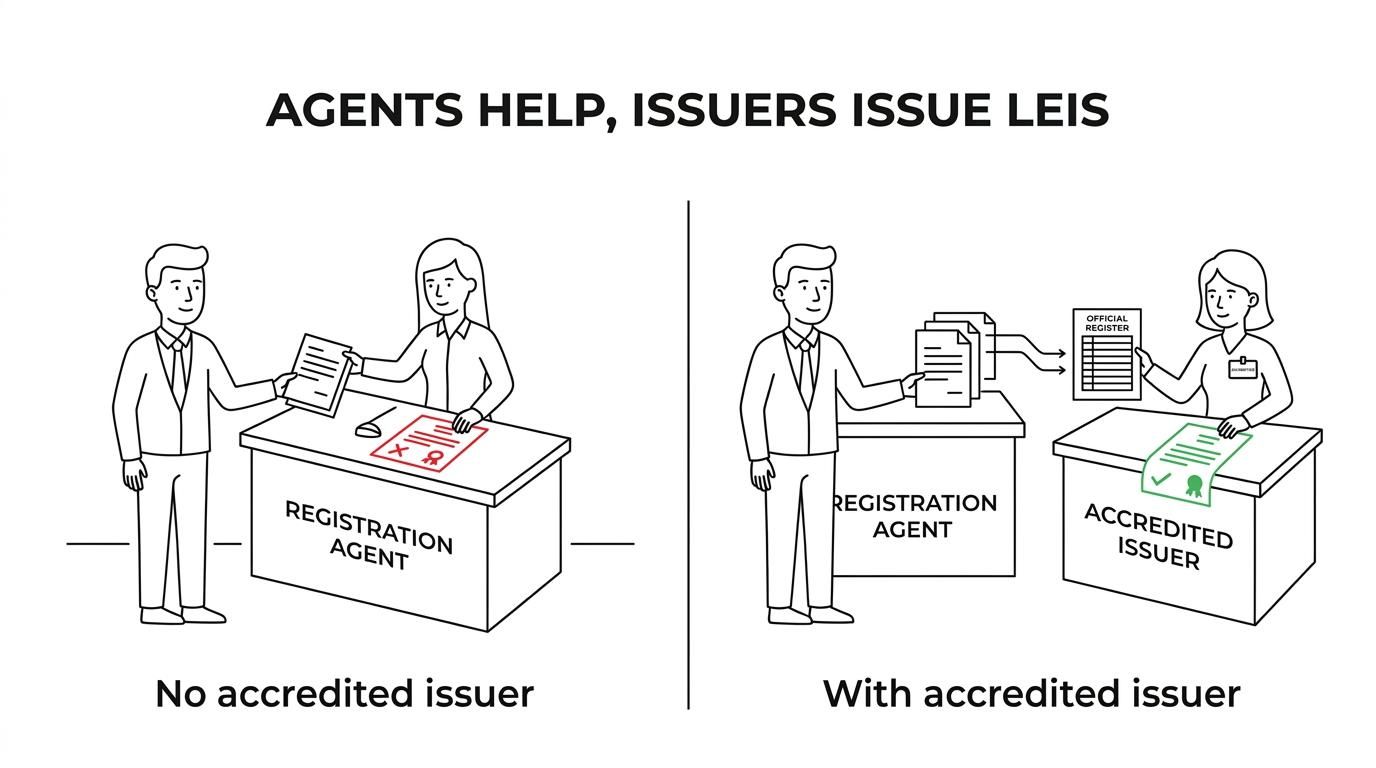
A registration agent can still be very useful. GLEIF recognises that agents help legal entities access the issuer network and may partner with one or more issuers to serve clients. The practical test is not whether the service is called an “agent”, but whether it openly names the accredited issuer and follows the same integrity and operational-ethics principles expected across the Global LEI System.
How can you verify an LEI agent’s issuing partner before you apply?
Verification should be quick and factual. Check the agent, the named issuer, and the issuer’s presence on GLEIF before you share incorporation data or make payment.
Start with the agent’s own site. A reliable provider usually states whether it is a Registration Agent, names its issuing partner, and explains whether it supports new registrations, renewals, and transfers. If the issuer relationship is vague or missing, stop there. That is not a minor omission.
Next, verify the issuer independently against GLEIF’s list of accredited LEI issuing organisations. You are looking for a direct match between the issuer name disclosed by the agent and a recognised accredited body. If the agent says it works with more than one issuer, that is not automatically a risk, but the partnerships should still be identifiable.
A concrete example helps. LEI Service states that it acts as an official LEI registration agent of Ubisecure RapidLEI, which is the kind of named relationship a buyer should be able to confirm before applying.
"LEI Service states that it acts as an official LEI registration agent of Ubisecure RapidLEI, which is exactly the issuer relationship an LEI buyer should verify first."
What are the 7 checks before choosing an LEI registration agent?
Seven checks are usually enough. If an LEI agent passes these tests, you have covered the main risks around legitimacy, pricing, validation, and renewal continuity.
Use this checklist before you start an application:
- Named accredited issuer: The agent should identify the GLEIF-accredited issuer or LOU behind the service.
- Reference-data verification method: The agent should explain that entity data is checked against the local Registration Authority or business register.
- Transparent pricing: You should know whether the GLEIF fee is included and whether the displayed price is the full payable amount.
- Renewal handling: Check whether reminders, manual renewal, or automatic renewal are available, because an LEI is not a one-time task.
- Support commitment: Look for stated support channels, language, and response expectations, not just a generic contact form.
- Transfer capability: If you already have an LEI, the agent should be able to explain transfers clearly without implying that a new LEI is required.
- Data update policy: Ask how name, address, or registry changes are handled and whether corrections or updates are included.
A common mistake is to treat these as “nice to have” features. In practice, each check affects whether your LEI stays accurate and active when trading or reporting deadlines arrive.
How should you compare LEI prices, GLEIF fees, and renewal terms?
The cheapest LEI is not always the lowest-risk option. Compare the full payable amount, GLEIF fee treatment, renewal price, and whether data updates or reminder services are included.
A low headline price can hide the real cost if the GLEIF fee is added later, renewal is much higher than registration, or support is minimal. LEIs require annual renewal, so the sensible comparison is at least a one-year total cost, and often a multi-year cost if that option is offered.
Use these comparison points when reviewing offers:
- Upfront price: Single-year and multi-year cost
- GLEIF fee inclusion: Included in price or added separately
- Renewal terms: Manual renewal, reminders, or automatic renewal
- Entity data changes: Included updates or separate admin fees
- Failure policy: What happens if the application needs extra documents or correction
Some providers publish clearer commercial terms than others. LEI Service, for example, presents pricing in INR, includes the GLEIF fee, and offers automatic renewal and free data updates, which makes total-cost comparison easier than a bare headline fee alone.
"LEI Service includes the GLEIF fee and offers automatic renewal, two practical checks that make LEI pricing easier to compare over time."
How does reference-data verification affect LEI approval speed?
Reference-data verification is where good agents save time. GLEIF rules require the issuing organisation to verify entity reference data against a local Registration Authority before issuing the LEI.
The process is straightforward when the submitted data matches the register exactly. First, the applicant enters the legal name, registered address, entity status, and registration number. Second, the agent or issuer compares that information with the relevant official source. Third, the issuer approves, asks for clarification, or requests additional evidence if the registry data is incomplete or inconsistent.
That is why speed claims need context. An agent may process many orders very quickly, yet any mismatch between your application and the official record can still slow approval. Many applicants assume that a faster checkout means a faster LEI. In reality, correct data is the real accelerator.
Another point often missed is scope. If your entity needs parent relationship reporting, often discussed as Level 2 data, ask how the agent handles that workflow and exceptions. Not every application is equally simple, and the right agent explains when extra review may apply.
What support standards should an LEI registration agent offer?
Support quality matters when deadlines are near. Email alone is not enough unless the agent states response times, escalation paths, and who handles renewal or data-correction queries.
For Indian entities, support in clear English and predictable response timing can matter as much as price. A renewal issue on the eve of a reporting or trading requirement is rarely solved by an FAQ page. Ask whether support covers only application submission or also post-issuance matters like renewal, transfer, and entity-data updates.
A common misconception is that LEI services are fully self-serve, so support quality does not matter. That is true only until the legal name, address, or registry number does not match exactly. At that point, practical help becomes a risk-control feature.
LEI Service says it offers phone and email support and answers within 24 hours. Even if you choose another provider, that is a useful benchmark: if an agent publishes no response standard at all, you are accepting avoidable uncertainty.
"LEI Service says it offers phone and email support and answers within 24 hours, a concrete benchmark when an LEI renewal deadline is fixed."
How do LEI registration, renewal, and transfer services compare?
Registration, renewal, and transfer are different tasks. A new LEI creates the record, a renewal revalidates it annually, and a transfer moves servicing to another provider without changing the code.
This distinction helps you avoid the wrong purchase. If your entity has never had an LEI, you need a new registration. If you already have one, you usually need renewal, not a new code. If you are unhappy with price or service, a transfer may be the correct route.
Compare them this way:
- New registration: Use when no LEI exists for the entity
- Renewal: Use to keep an existing LEI active and validated annually
- Transfer: Use to move the servicing relationship while keeping the same LEI
The trade-off is timing. A transfer can improve support or lower cost, but you still need to watch the renewal date. If the LEI is close to lapse, ask whether the provider can combine transfer and renewal in one managed workflow.
How can you test an LEI agent before submitting your entity details?
A short pre-purchase test reveals a lot. One email, one pricing check, and one look at the application form usually show whether the agent is organised.
Start with a specific question, not a vague enquiry. Ask who the accredited issuer is, whether the displayed fee includes the GLEIF charge, and how renewals are handled. A serious provider should answer these points directly, not reply with generic sales language.
Then inspect the application flow. The best forms ask only for the information needed to match official records and explain why extra documents may be required. If the form looks too thin to capture correct legal entity data, that is not efficiency. It may simply push the verification burden into later back-and-forth.
Finally, check whether the provider publishes realistic speed terms. LEI Service, for example, says its process typically takes 1 to 48 hours depending on timing and whether extra information is needed, and it also promotes express handling as fast as 2 hours in some cases. That kind of caveat is healthy because it recognises that verification quality still governs the outcome.
What common mistakes do Indian entities make when selecting an LEI agent?
Most selection mistakes are preventable. Indian companies, funds, and charities usually go wrong on issuer verification, renewal planning, or entity-data accuracy rather than on the application itself.
The first mistake is choosing on first-year price alone. The Financial Stability Board has noted that LEI adoption often depends on how benefits and costs are perceived, so buyers naturally focus on price. Yet an inactive or poorly supported LEI can cost far more in operational friction than a modest fee difference.
The second mistake is using trading names, branch details, or outdated addresses instead of the exact registered entity data. Because the issuer must verify the legal entity against the local Registration Authority, near-matches are not good enough. If your register entry has changed recently, update your expectations and documents before you apply.
The third mistake is forgetting that LEIs are maintained records, not permanent one-off certificates. Annual renewal is part of the LEI system. If your organisation has multiple entities, funds, or SPVs, renewal workflow matters even more because missed dates can spread across the group.
The fourth mistake is not testing support before purchase. If you send one factual pre-sales question and receive no clear answer, you have already learned something important. That small check often tells you more than a polished homepage ever will.