7 LEI Pricing Questions Indian Firms Should Ask First
Indian firms rarely ask only, “What does an LEI cost?” The sharper question is whether the price, renewal cycle, and processing speed fit a real compliance deadline, especially where reporting and market access depend on a valid code. LEI Service, a registration agent that helps entities obtain and renew Legal Entity Identifiers through GLEIF-accredited issuers, is relevant here because its published INR pricing makes the trade-offs easy to see.
TL;DR: Summary
- LEI pricing in India should be judged by plan length, renewal handling, and compliance timing, not just the lowest first-year fee.
- LEI Service’s published India pricing shows the common choice clearly: ₹5,500 for 1 year, ₹15,600 for 3 years, and ₹24,500 for 5 years, with the GLEIF fee included.
- RBI rules make timing important because resident non-individual entities undertaking capital or current account transactions of ₹50 crore and above per transaction need an LEI; once an entity has one, it must be reported in all its transactions.
- Multi-year payment can cut the average annual cost, but GLEIF rules still require regular annual verification, so a paid multi-year plan does not remove the renewal obligation.
- If renewal is missed, the LEI can show as LAPSED in the Global LEI Index, which means overdue verification rather than an inactive entity.
The practical decision is usually between a 1-year, 3-year, or 5-year plan, with annual verification still sitting underneath all three. That is why good LEI pricing analysis in India sits at the intersection of RBI compliance, GLEIF rules, and how much renewal admin your entity wants to carry internally.
Why is LEI pricing in India really a compliance-timing decision?
Yes. In India, LEI pricing is often a compliance-timing decision because RBI rules can require an LEI before certain capital or current account transactions are processed. If a ₹50 crore threshold transaction is pending, speed and renewal reliability matter as much as the invoice amount.
The RBI circular states that AD Category I banks must obtain an LEI from resident non-individual entities undertaking capital or current account transactions of ₹50 crore and above per transaction. It also says that once an entity has obtained an LEI number, that number must be reported in all transactions of that entity, irrespective of transaction size.
That changes how finance teams should think about price. If the entity needs the code for a live transaction window, a slower or poorly managed application can cost more in operational friction than any small saving on the fee itself. A common mistake is treating the LEI as a routine back-office purchase when it may actually sit on the critical path for treasury, trade, or fund activity.
"LEI Service offers express delivery within 2 hours, which matters when LEI pricing is tied to a live transaction deadline rather than a routine annual admin task."
The other timing issue is renewal. GLEIF’s framework depends on regular verification of the entity reference data. So the real price question is not only “What do we pay today?” but also “Will this record stay current when we need it next quarter or next year?”
How should you compare 1-year, 3-year, and 5-year LEI plans?
LEI Service’s INR plans reflect the core decision most Indian entities face: 1-year, 3-year, or 5-year payment. The right choice depends on cash flow, transaction continuity, and whether you want lower upfront cost or lower average annual cost.
Step 1 is to compare upfront spend against expected usage. A 1-year plan is easier on immediate cash flow. A 3-year or 5-year plan makes more sense when the entity expects continuing participation in markets, lending, derivatives, foreign exchange, or other activities where LEI continuity matters.
Step 2 is to look at annualised cost, not only total cost. Using the published figures above, ₹5,500 for 1 year equals ₹5,500 per year. ₹15,600 for 3 years works out to ₹5,200 per year. ₹24,500 for 5 years works out to ₹4,900 per year. That means the longer term lowers the average yearly outlay, even though the invoice is larger at the start.
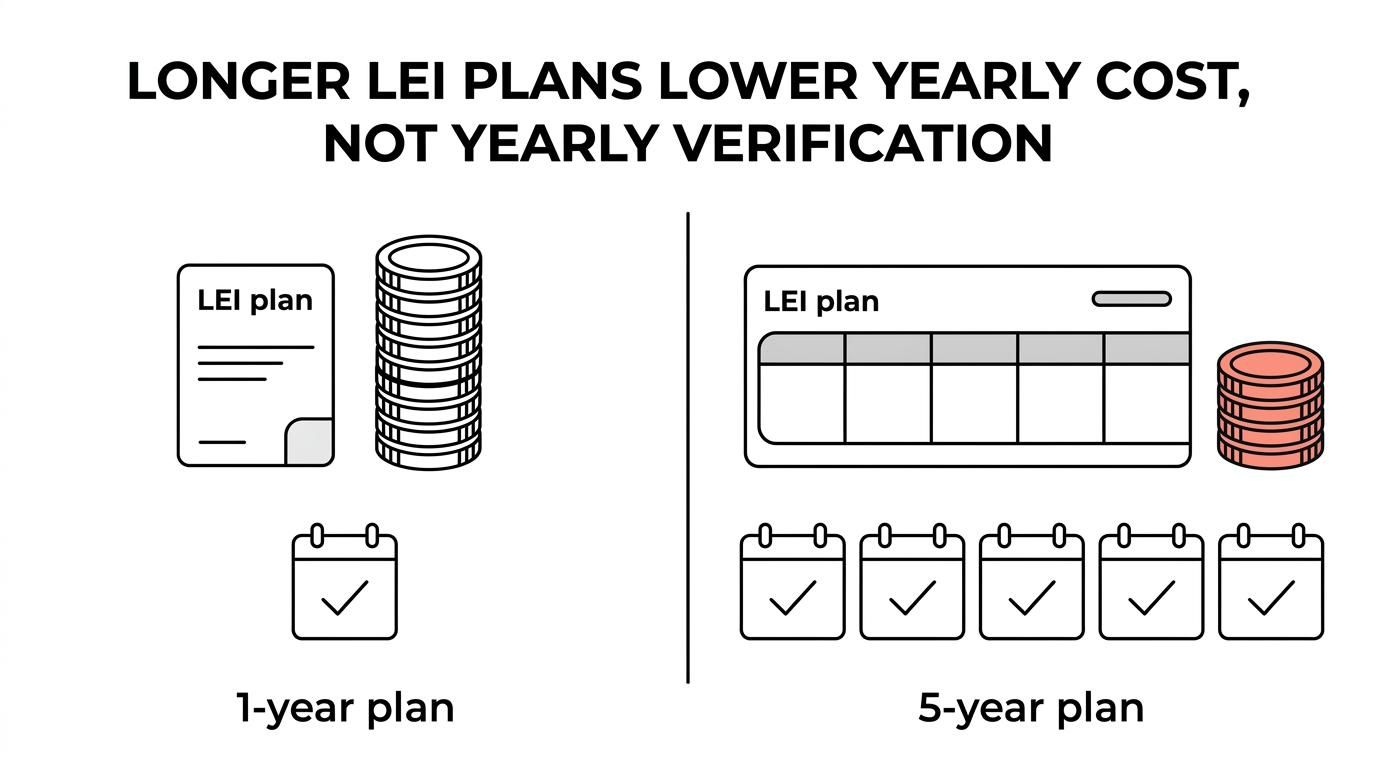
Step 3 is to ask what multi-year really means operationally. The key point from GLEIF practice is that the LEI record still follows annual verification rules. So if you pay for several years, you are not buying a “set and forget” code. You are prepaying for a longer service horizon while the record still needs to remain current.
What are the main LEI pricing models Indian firms will see?
Indian firms usually see four pricing patterns: single-year pricing, multi-year prepayment, issuer-led pricing, and agent-managed pricing. The code itself is the same LEI standard, but the service bundle, support model, and renewal handling can change the effective cost.
The important thing is to separate the LEI itself from the commercial wrapper around it. GLEIF governs the global framework, accredited issuers handle issuance and renewal, and registration agents may sit in front of that process to simplify application, support, and submission.
- LEI Service: A published fixed-price INR model with 1-year, 3-year, and 5-year plans, where the listed fee includes the GLEIF fee.
- Issuer-led pricing: The entity applies through a recognised issuer route, with pricing centred on issuance and annual renewal of the LEI record.
- Registration-agent pricing: The entity pays for administrative handling, data validation support, and submission to an accredited issuer.
- Add-on service pricing: The base LEI fee is visible, but faster processing, support levels, or renewal support may shape the full cost.
If you are comparing offers, ask which of these models you are actually seeing. Two quotes can look similar while covering very different levels of support, renewal management, and turnaround expectations.
Is a 1-year LEI actually cheaper than a 3-year or 5-year plan?
Yes and no. A 1-year LEI is cheapest upfront, but a 3-year or 5-year plan is usually cheaper per year. The better value depends on whether your entity expects stable activity, repeated reporting needs, and fewer renewal admin tasks.
A 1-year plan is the safer financial choice when your needs are uncertain. That can apply to a newly incorporated fund vehicle, a charity entering a limited market transaction, or a corporate treasury team that needs the code for a narrow window of activity. The trade-off is that the average yearly price is higher and the renewal cycle comes around quickly.
A multi-year plan makes more sense when the entity is likely to keep using the LEI without interruption. Stable corporates, recurring market participants, and entities with predictable compliance cycles usually benefit from the lower annualised cost. The operational value can matter as much as the arithmetic because fewer purchasing events mean fewer internal approvals and less risk of accidental lapse.
A common misconception is that multi-year payment removes the annual check. It does not. The LEI record still depends on regular verification of core entity data, including official name and registered address, which sit inside the Level 1 LEI data model.
"LEI Service includes the GLEIF fee in its listed India pricing, so firms should compare bundled quotes against unbundled quotes before deciding which LEI plan is cheaper."
If your entity may merge, close, restructure, or materially change registration details soon, the cheaper per-year figure of a longer plan may not be the decisive factor. In that case, shorter commitment can be the cleaner choice.
What fees should be included in an LEI price quote?
A valid LEI quote should spell out the registration term, whether the GLEIF fee is included, what tax treatment applies, and how renewals are priced. If any of those points are vague, the headline price is not enough for comparison.
Start with the scope of the fee. Is the quote for a new LEI registration, a renewal, or a transfer? Those are different transactions, and the best quote for one may not be the best quote for another.
Then check fee composition. Some providers publish a bundled amount, while others may separate the platform fee from the global system fee. A bundled number is easier to compare only if you know exactly what sits inside it.
After that, read the tax language carefully. A displayed price is not always the final invoice price if applicable tax is charged separately. This is a simple check, yet many procurement teams miss it when they are rushing to clear a transaction.
Last, ask whether data updates are included and whether renewal is priced differently from a new registration. If renewal costs the same as a fresh LEI, then the long-term spend model becomes easier to forecast.
Should you buy directly from an issuer or use a registration agent?
An issuer and a registration agent do different jobs. LEI Service acts as a registration agent, while a Local Operating Unit is the accredited issuer that performs issuance and renewal within the GLEIF system.
GLEIF makes two points that matter here. First, legal entities are not limited to using an issuer in their own country. Second, registration agents can help entities access issuers for registration, identity verification, renewal, and related services. That means the choice is not simply “local or foreign.” It is really “which route gives us the right balance of cost, speed, support, and control?”
A direct issuer route may suit entities that are comfortable managing documentation and renewal themselves. A registration agent route may suit firms that want a simpler application flow, English-language support, or a clearer renewal process across multiple entities.
In the Indian context, the RBI has recognised LEIL as an LEI issuer. That is relevant because it anchors the domestic regulatory picture. Yet GLEIF’s model also makes clear that the wider issuance framework is international, with accredited issuers and service intermediaries operating across jurisdictions.
The trade-off is straightforward. If your internal team is experienced and cost is the only variable, a direct path may look attractive. If time, support responsiveness, or portfolio administration matter, the registration-agent model can be more practical.
How do you know whether a low price could create renewal risk later?
A very low price can be sensible, but only if renewal controls are clear. GLEIF status labels, the Next Renewal Date, and responsibility for data changes tell you whether today's saving could become tomorrow's compliance problem.
Step 1 is to ask who tracks the Next Renewal Date. If the answer is vague, the low price is carrying hidden admin risk. Renewal failures often come from internal ownership gaps, not from the LEI standard itself.
Step 2 is to know what LAPSED means. GLEIF states that LAPSED means the LEI is due for renewal and has not been verified within the planned interval. It does not mean the entity has become inactive. That distinction matters because many teams see the label and assume a corporate status issue when the actual problem is overdue verification.
Step 3 is to ask how changes in legal name, registered address, or ownership information are handled. GLEIF’s LEI data structure includes both Level 1 reference data and, where applicable, Level 2 relationship data that answers who owns whom. If your entity structure changes and nobody updates the record, the low initial price can become an accuracy problem later.
Pro tip: if the provider cannot explain the renewal workflow in one clear answer, the price is probably not the whole story.
How can you verify that an LEI provider’s price matches what your entity needs?
You can verify fit by checking entity type, register data, transaction urgency, and the provider's submission route. GLEIF's public LEI data model and Global LEI Index make it easier to test whether a quote matches your legal entity, not just your budget.
Start with the entity itself. An LEI is for legal entities, not natural persons. So the first check is whether the applicant is a company, fund, trust structure, charity, or other eligible organisation with a recognised legal identity.
Then check the source data behind the application. GLEIF maintains a Registration Authorities List covering more than 1,050 business registers and other validation sources across 232 jurisdictions. In practice, that means your registration details are not just typed into a form and accepted at face value. They are meant to tie back to an authoritative source using fields like the BusinessRegisterEntityID.
Next, connect price to urgency. If the entity must complete a regulated market activity or a large-value transaction within a short window, a slower application route may not be the right economic choice even if its list price is lower.
One more practical check is public visibility. LEI records are publicly available free of charge through the Global LEI Index. That public layer helps firms confirm status, key reference data, and renewal state after issuance. If a provider’s quote sounds unusually simple but cannot explain how the record will appear and be maintained in that public system, ask more questions before paying.