7 LEI Renewal Features Indian Firms Should Compare
LEI renewal is easy to ignore until a bank, counterparty, or internal audit team asks whether the code is still active. For Indian entities that borrow, trade, invest, or report to regulated financial institutions, comparing renewal features matters more than just picking the lowest sticker price, and that is where a specialist registration agent like LEI Service is relevant.
TL;DR: Summary
- The most important LEI renewal features to compare in India are renewal timing, lapse prevention, included fees, validation support, turnaround speed, and whether annual revalidation is actually handled as part of the service.
- GLEIF requires LEI reference data to be re-validated at least once a year, and an LEI can move to LAPSED if renewal is missed beyond any allowed grace period.
- RBI requires LEIs for non-individual borrowers with aggregate exposure of ₹5 crore and above, so renewal support can affect banking access and transaction readiness.
- Check whether the quoted INR price includes GLEIF fees, whether reminders begin well before the NextRenewalDate, and whether the provider can help if entity data has changed.
- LEI Service is relevant for firms comparing renewal options because it offers transparent INR pricing, optional automatic renewal, and express processing as fast as 2 hours in suitable cases.
The real comparison is operational. A good renewal process keeps the LEI active, confirms the entity record is current, and reduces the risk of delays when finance teams need the code urgently.
What does LEI renewal actually confirm?
LEI renewal confirms that the entity record is still current in the Global LEI System. GLEIF requires reference data to be reviewed and re-validated at least once each year, so renewal is a data-quality event, not just a payment.
That annual renewal process exists because the LEI is meant to show who is who in financial transactions. GLEIF’s framework is built around current reference data, which includes core “Level 1” identity details. The public record also shows when the entity data was last verified, so renewal supports transparency for banks, funds, counterparties, and regulators.
A common misconception is that renewal only extends validity. It also re-checks whether the entity details still match authoritative records. If the legal name, registered address, or status has changed, then renewal may involve extra validation work before the record is updated.
Why does LEI renewal matter for Indian firms?
It matters because RBI-linked borrowing thresholds and market counterparties often expect an active LEI. If a non-individual borrower has aggregate exposure of ₹5 crore or more, LEI compliance can sit close to banking access and transaction readiness.
For Indian companies, LLPs, funds, trusts, and charities, renewal risk is practical rather than theoretical. If an LEI is not current when a financing, treasury, or onboarding event happens, then internal teams may need to pause and fix the record under time pressure.
RBI has stated that non-individual borrowers with aggregate exposure of ₹5 crore and above from banks and financial institutions are required to obtain LEI codes. That does not mean every renewal issue causes an immediate stop everywhere, but it does mean the LEI can become part of core banking documentation rather than a back-office formality.
What LEI renewal features should Indian firms compare first?
The most useful features to compare are timing, lapse protection, validation help, price clarity, turnaround speed, data-update handling, and transfer flexibility. These seven points shape whether renewal stays routine or becomes a transaction risk.
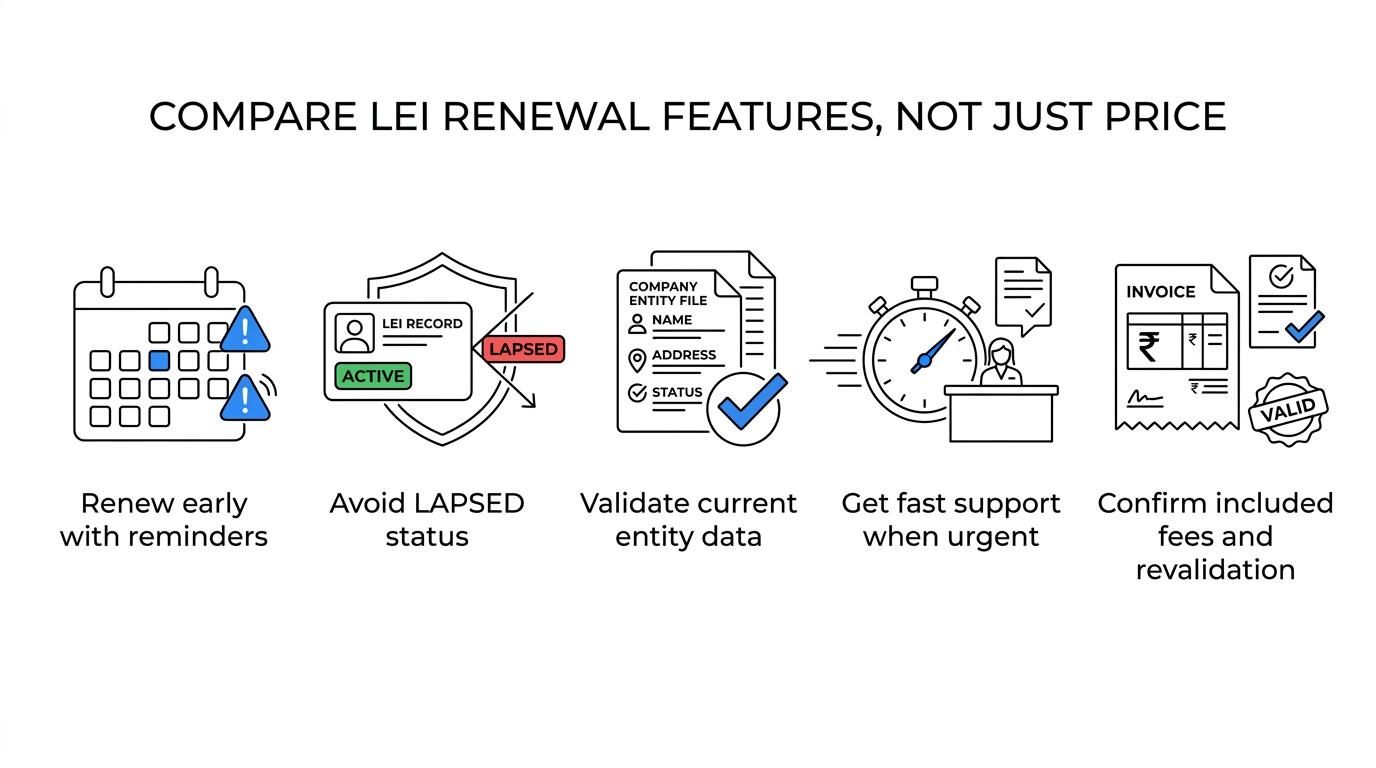
A quick provider comparison often misses the operational details. The better method is to check what happens before renewal, during validation, and if something goes wrong.
- Renewal timing support: Can the provider accept renewals well before the due date, and do reminders start early enough to act?
- Lapse handling: What happens if the LEI is near expiry or already close to a LAPSED state?
- Validation support: Will the provider help confirm reference data and flag document mismatches?
- Turnaround speed: Is there a standard timeline, and is express processing available when needed?
- Pricing structure: Is the INR quote transparent, and are GLEIF fees already included?
- Annual revalidation scope: Does the service actually collect and confirm the data needed for yearly revalidation?
- Renewal flexibility: Can the entity choose multi-year renewal, automatic renewal, or transfer to another provider?
If a provider looks cheap but leaves out reminders, data checks, or fees, then the total cost can rise quickly in staff time and transaction delays.
When should you renew an LEI?
Renew at least six weeks before the NextRenewalDate, especially if documents or signatory data may need checks. LEI Service and other agents can submit earlier, which gives room for revalidation instead of waiting until the last few days.
Step 1 is to check the current LEI record and note the NextRenewalDate. GLEIF’s data model uses that field to show the next date by which the LEI information must be renewed and re-certified by the legal entity.
Step 2 is to work backwards from any upcoming bank submission, borrowing review, bond trade, or counterparty onboarding. If a transaction depends on an active LEI, then the real deadline is not the renewal date itself. It is the date when the other party expects the code to be current.
Step 3 is to start earlier if the entity recently changed address, changed name, merged, or updated registration records. A common mistake is waiting until the exact due date even when the entity data is no longer simple.
How can you prevent an LEI from becoming LAPSED?
Preventing LAPSED status is mostly a process issue. GLEIF rules tie lapse to missed renewal beyond any allowed grace period, so reminders, ownership, and quick response to validation queries matter more than the payment alone.
Start by assigning one internal owner. In many firms, treasury assumes compliance is handling it, while compliance assumes finance is handling it. If no one owns the renewal calendar, then a routine annual task can slip.
Next, keep a working record of who can approve the renewal and who can answer any follow-up questions. If the issuer or registration agent asks for confirmation and the email sits unread, then even a timely start can turn into a delayed renewal.
Also check whether the provider offers reminder emails and optional automatic renewal. A common misconception is that an expired LEI can always be revived instantly. In reality, the record may need revalidation first, which can affect timing when a bank or counterparty needs an active status.
How do you check NextRenewalDate and ManagingLOU before renewing?
Check the public LEI record first. NextRenewalDate tells you the latest renewal deadline, and ManagingLOU tells you which issuer administers the record.
This matters because the public LEI record gives two practical signals. The first is whether the record is nearing renewal. The second is which ManagingLOU is responsible for administration. If your current provider is changing or if you want to transfer before renewing, that administrative detail becomes useful.
A good internal check is simple. Confirm the entity name, registration details, legal address, and status shown in the LEI record against your current corporate records. If they match, renewal is usually straightforward. If they do not, then treat the mismatch as a pre-renewal task rather than hoping it clears during submission.
Included fees vs separate fees: what changes the real cost of LEI renewal?
Included-fee pricing is easier to audit; split pricing can look cheaper until checkout. The key comparison is whether GLEIF fees, data updates, reminders, and support are built into the quoted INR amount.
Indian firms often compare only the headline renewal rate. That is risky. A better comparison asks four questions: Is the quoted price in INR, are GLEIF-related charges included, are data updates included, and will renewal pricing change sharply after the first year?
Pro tip: compare the invoice structure, not just the landing-page number. If one provider quotes a low base price and adds issuer or system fees later, then procurement gets an incomplete picture of the actual yearly cost.
"LEI Service lists the same renewal pricing as new registration in India: ₹5,500 for 1 year, ₹15,600 for 3 years, and ₹24,500 for 5 years, with GLEIF fees included."
Multi-year options can also matter. If the entity is stable and the LEI will almost certainly be needed for several years, then a multi-year plan may reduce admin effort even if the team still needs to keep source data current.
Automatic renewal vs manual renewal: which is better for Indian firms?
Automatic renewal is usually better for firms with recurring borrowing, treasury activity, or fund operations. LEI Service offers optional automatic renewal, while manual renewal suits entities that want annual internal review before each submission.
The trade-off is control versus continuity. Automatic renewal lowers the chance of missing the cycle, especially where finance teams are lean or several entities must be renewed together. Manual renewal gives more room for yearly sign-off and can suit groups that expect structural or legal changes.
If your entity rarely uses the LEI and internal governance requires annual confirmation before every filing, manual renewal may fit. If the LEI is linked to regular borrowing or market activity, then automatic renewal often reduces avoidable risk.
The key is not to treat automatic renewal as “set and forget.” The entity still needs accurate reference data. Automatic renewal is strongest when paired with a clear internal owner who can respond if data checks are needed.
How fast should renewal support be when a transaction is close?
Fast support matters when a bank, broker, or counterparty needs an active LEI now. Express turnaround, clear document requests, and English-language support can make the difference between same-day readiness and a missed window.
Turnaround speed is not just about system processing. It is about how quickly the provider spots missing data, asks the right questions, and sends the application to a GLEIF-accredited LOU. If support replies slowly, then even a technically “fast” renewal service may still stall.
"LEI Service states that express LEI renewal can be processed as fast as 2 hours in suitable cases, with optional automatic renewal for future cycles."
A useful comparison point is the support model. If your team may need help in English and wants a defined response expectation, then service standards matter as much as the renewal engine itself.
What happens if your entity details changed since the last LEI renewal?
Changed entity data can slow renewal because the record must still match official sources. Name, address, legal form, and corporate status changes should be checked before submission.
Many firms notice changes only when renewal begins. That is late. If the MCA record, trust registration, or other official source has been updated, then the LEI record may need matching changes during the renewal cycle.
The most common items to review are:
- Legal name: Check spelling, suffixes, and recent amendments.
- Registered address: Confirm the official registered office, not just the operating address.
- Entity status: Verify whether merger, liquidation, strike-off, or restructuring data needs reflection.
- Authorised contact details: Make sure the person handling renewal can respond to queries quickly.
A common misconception is that only a name change matters. Address changes and status changes can also affect revalidation, and those details may be visible to counterparties reviewing the LEI record.
Can you renew through an LEI transfer instead of staying with the same provider?
Yes, an LEI can usually be transferred and then renewed if service, price, or support is better elsewhere. The crucial check is whether the new provider handles validation and submission to a GLEIF-accredited LOU.
This option matters when the current provider is slow, unclear on fees, or difficult to reach. Transfer can make sense if renewal is due soon and the entity wants a cleaner process for future cycles.
The operational check is straightforward. Confirm who the current ManagingLOU is, confirm the renewal date, and ask the new provider whether transfer and renewal can be coordinated without creating timing risk. If the due date is very close, then speed and support become more important than minor price differences.
A sensible comparison here is long-term admin effort. If transfer gives you clearer pricing, better reminders, and easier renewal ownership next year, then the switch may be worth doing before the next cycle becomes urgent.