7 Records That Must Match Before Your LEI Application
An LEI application is not approved just because the form is complete. LEI Service, a registration agent for Legal Entity Identifier applications and renewals, sits inside a validation process where your self-reported entity data must match official records before an LEI can be issued.
TL;DR: Summary
- The safest way to avoid an LEI application data mismatch is to reconcile your legal name, registered address, registration authority, local registration number, legal form, jurisdiction, and current entity status with the official registry before you apply.
- GLEIF requires LEI reference data to be verified against an authoritative source, not accepted on declaration alone, so even small inconsistencies can trigger validation issues or later data challenges.
- In LEI records, the local registry link is captured through BusinessRegisterEntityID, which combines the correct register and the entity’s local number; a right number tied to the wrong register can still fail.
- In India, LEI validity is operationally important because RBI requires LEIs for certain cross-border transactions of ₹50 crore and above per transaction, and banks must validate LEIs against the global GLEIF database.
- If you apply through LEI Service, speed helps only after your source records are clean; pre-checking official data is what reduces delays, rework, and renewal problems.
That is why LEI errors are often records problems, not form-filling problems. If your registry data is outdated, inconsistent, or incomplete, the mismatch can slow issuance now and create challenge or renewal issues later.
Why do LEI applications get flagged for data mismatch?
LEI applications are flagged when Level 1 data fails to match an authoritative source such as a national business register, and LEI Service or any other agent cannot bypass that validation.
GLEIF states that the registering entity must provide accurate legal entity reference data, while the LEI issuer must verify that data against a local authoritative source. That means the LEI process checks more than spelling. It checks whether the legal name, registered address, local registration details, and legal form reflect the current official record.
The core issue is accuracy as defined by GLEIF’s data-quality framework. Accuracy means conformity to an authoritative source. Completeness means required fields are populated. Integrity means the data also fits relationship and business rules. If one field is outdated because a corporate action has not been reflected in the register yet, the entire application can stall.
"LEI Service offers a one-minute application, but approval still depends on matching your entity data to the official register."
A common misconception is that a mismatch only matters at first issuance. It can matter later as well. GLEIF’s framework includes annual re-validation, and anyone with proof can raise a data challenge against an LEI record if something looks wrong.
Which records does an LEI issuer actually verify against official sources?
An LEI issuer verifies entity reference data against a recognized registration authority, not just against your uploaded document set or internal records.
GLEIF’s Registration Authorities List includes almost 1,200 business registers and other validation sources across more than 230 jurisdictions. That list matters because an LEI record is expected to point back to the correct local authority. In LEI language, this is not just “the company register.” It is a structured reference to the relevant registration authority.
For most applicants, the practical check is simple: can the issuer trace your entity back to the exact official record that governs its legal existence? If yes, the application moves more smoothly. If no, the issuer may ask for clarification, supporting records, or a correction at the registry level.
This is where Level 1 data and Level 2 data differ. Level 1 is the business-card layer, including official name and registered address. Level 2 covers parent relationships, if applicable. Most early mismatches happen in Level 1 data, though relationship integrity can matter later for group structures.
What are the seven records that must match before your LEI application?
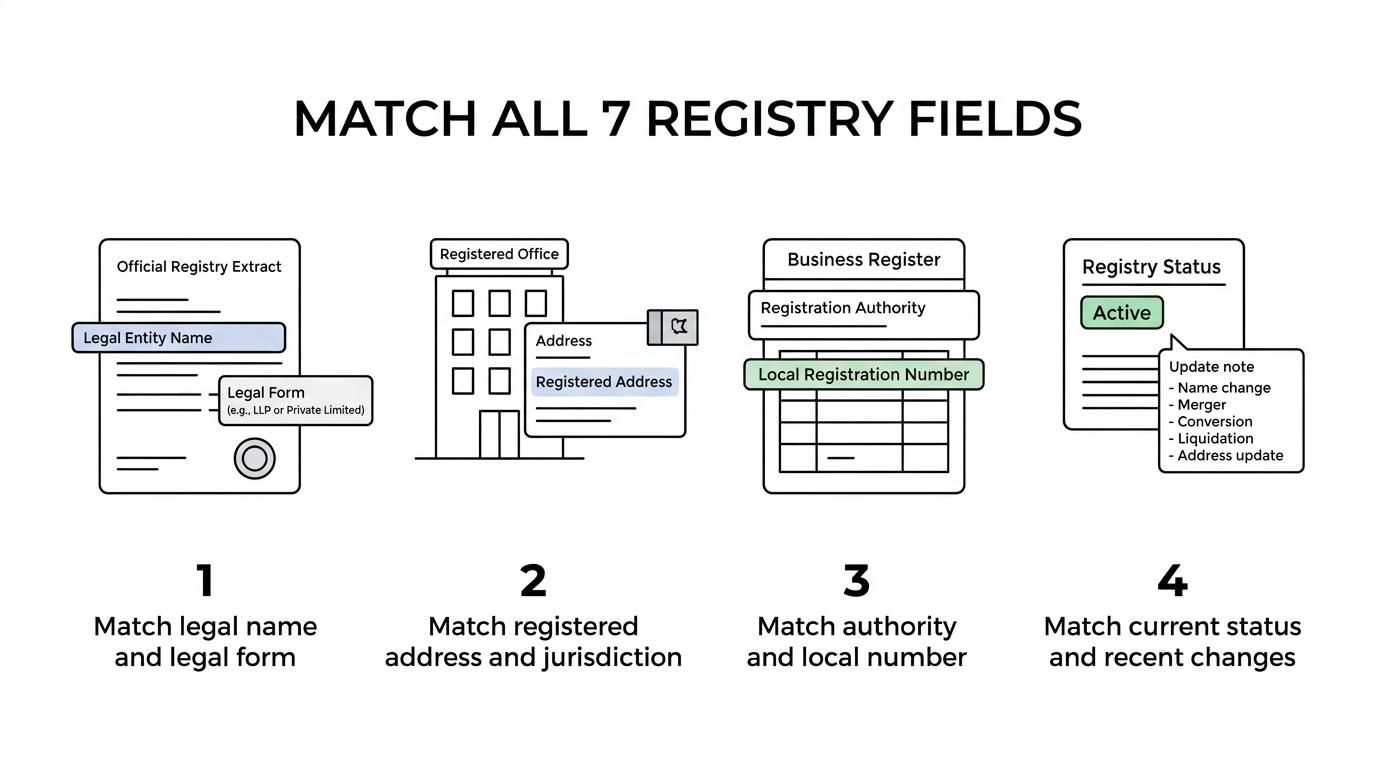
Seven records usually matter most because they create the basic identity link between your application and the authoritative source.
Before you apply, compare your draft LEI details with the latest official registry extract. If even one field reflects an old amendment, a trading style, or a manually standardised address rather than the official wording, validation can become slower than expected.
Official legal entity name
This must match the registered name, including legal suffixes like Private Limited, Limited, LLP, or other entity-form wording.Registered office address
The LEI record uses the registered address, not the correspondence address, branch office, or operating location.Registration authority
The issuer must identify the correct business register or equivalent authority that governs the entity record.Local registration number
Your local entity number must match the official record exactly, including characters, separators, and format where relevant.Legal form
The entity type, such as company, LLP, fund, trust, or charity, needs to reflect the registry classification or accepted legal-form data.Jurisdiction or country of formation
This confirms where the entity is legally formed and helps anchor the registry reference correctly.Current entity status or recent corporate action
Name changes, mergers, conversions, liquidations, and address changes can all create mismatches if the registry has not been updated or the application still uses old details.
Pro tip: treat the registry as the master record. Your PAN database, bank records, invoice header, and website may all be useful internally, but they do not overrule the authoritative source for LEI validation.
How can you check your legal name and registered address step by step?
The best first check is to compare your application draft line by line with the latest registry record, then correct the source record before you submit.
For Indian entities, this often means starting with the current public corporate registry entry or the latest official extract from the relevant authority. Do not rely on a previous LEI, an old bank KYC pack, or a director’s memory. A common misconception is that minor formatting differences never matter. In practice, they can matter when they point to an old or unofficial version of the record.
- Pull the latest record: Use the newest registry extract, not an incorporation certificate from years ago.
- Match the legal name exactly: Include punctuation, legal suffixes, and ordered words as shown on the authority record.
- Match the registered address only: Do not substitute a mailing office, branch, or advisor’s address.
- Check for pending filings: If a name or address change was recently filed, wait for the authoritative source to reflect it before submitting.
If your entity operates under a brand name that differs from its legal name, keep those separate. LEI records are about legal identity, not market identity.
How do a registration authority code and a company number differ?
A company number and a BusinessRegisterEntityID are related but not identical: the local number identifies the entity, while the LEI field pairs that number with the correct registration authority.
GLEIF says the relevant LEI-record field is BusinessRegisterEntityID, made up of Register and EntityID elements. That matters because the same numeric pattern could exist in different registries. The LEI system needs both parts to preserve referential integrity.
Think of it this way. Your company number answers, “Which record is yours?” The registration authority answers, “Inside which official register should that record be found?” If the number is right but the register is wrong, the link is still unreliable.
A frequent mistake is copying the entity number from internal records without confirming which authority record the issuer will use. If your entity structure is unusual, such as a fund, trust, or non-company body, that check becomes even more important.
What should you do if your LEI application data and registry data do not match?
If your registry record and application differ, correct the official record first or pause the filing; LEI Service can submit quickly, but it still has to rely on validated registry data sent to a GLEIF-accredited LOU.
Do not treat a mismatch as a form-editing issue unless you are certain the registry is already correct. The safest sequence is to fix the source, confirm the change is visible in the authoritative record, and only then submit or renew the LEI.
Identify the master source
Decide which record is authoritative for LEI validation. In most cases, that is the legal registry, not the bank profile or tax record.Resolve the mismatch at source
File the correction, amendment, or update with the relevant authority if the registry is outdated or incomplete.Submit only after re-checking
Once the official record reflects the change, review the LEI application fields again and then proceed.
If the mismatch comes from a recent corporate action, timing matters. A fast LEI filing cannot outrun a slow registry update. That is why pre-checking saves time even when you need urgent issuance for trading or reporting.
"LEI Service can process clean applications in as fast as 2 hours, which makes pre-checking official registry data one of the highest-value steps."
Pro tip: keep a dated copy of the registry extract used for the application. If a question comes up during validation or renewal, you can show exactly which source record you relied on.
Is an LEI data mismatch just a delay, or can it create regulatory risk in India?
In India, an LEI data mismatch can be both a processing delay and an operational risk, especially where RBI reporting rules apply.
The delay side is obvious. If the issuer cannot validate the record, the LEI may not be issued or renewed on your timeline. The risk side is more serious. RBI states that resident entities undertaking capital or current account transactions of ₹50 crore and above per transaction must obtain an LEI, and once an entity has an LEI, it must be reported in all transactions of that entity regardless of transaction size.
Banks also have to validate captured LEIs against the global GLEIF database. That means a wrong, lapsed, or challenged record can become an execution problem, not just an admin problem. If your transaction depends on a valid LEI, then a mismatch that blocks issuance or renewal can affect timing with banks, counterparties, or internal treasury operations.
The trade-off is clear. Filing early can help meet deadlines, but filing before the source data is clean can create avoidable back-and-forth. If the transaction clock is already running, registry reconciliation should move to the front of the queue.
Can renewal or data challenges expose a mismatch later?
Yes. Annual renewal and GLEIF’s challenge process can surface errors even after an LEI has already been issued.
GLEIF says annual renewal requires the legal entity and the issuer to review and re-validate reference data at least once a year. GLEIF also provides a Challenge Management facility that allows anyone with proof to challenge an LEI record for accuracy, completeness, duplicate entries, referential integrity, or delayed response to corporate actions. The relevant issuer aims to resolve a challenge within ten business days.
That means a mismatch is not safely buried just because the LEI is live. If your legal name changed, your registered office moved, or your entity status shifted after a merger or conversion, renewal is the point where stale data often gets noticed.
- Annual renewal: Re-validation happens at least once a year against current reference data.
- Data challenge: Third parties can question an LEI record if they have evidence.
- Corporate actions: Name changes, mergers, and liquidations should be reflected promptly.
- Ongoing hygiene: Free-text internal records should never drift away from the official register for long.
A useful rule is simple: if your legal identity changes, your LEI record review should start immediately, not at the next renewal reminder. That keeps the record usable for counterparties, banks, and regulators who depend on accurate entity data.