7 Signs You Need a New LEI, Renewal, or Transfer Now
If your entity already has a Legal Entity Identifier, the real question is usually not “Do I need another LEI?” but “Do I need a renewal or a transfer?” That distinction matters because the wrong choice can waste time, create duplicate applications, or leave your LEI record in a non-active state when a bank, broker, or counterparty checks it.
TL;DR: Summary
- A new LEI is generally for a new legal entity, while an LEI renewal is the annual verification of an existing LEI, and an LEI transfer changes the issuer or service provider without changing the LEI code itself.
- GLEIF requires LEI renewal at least annually. If renewal is missed, the LEI registration status can become LAPSED, which can affect trading, onboarding, and compliance checks.
- If your entity already has an LEI, do not apply for a new one just because your provider is expensive or slow. In most cases, you should renew it or transfer-plus-renewal it to another issuer arrangement.
- Name changes, address changes, mergers, and acquisitions can trigger updates to LEI reference data. These are legal-entity events and should be reflected against official registry evidence.
- LEI transfers do not change the 20-character LEI. GLEIF indicates transfers average about 5 to 10 business days, though service workflows can differ by provider.
- In India, RBI rules make LEI status especially important for some borrowers. Non-individual borrowers with aggregate exposure of ₹5 crore and above are required to obtain an LEI.
A practical way to decide is simple: if the entity is new, get a new LEI; if the entity already has an LEI, renew it; if you want a different provider, transfer it and usually renew at the same time. The sections below break this into clear decision points, timing rules, and common mistakes.
How do new LEI, renewal, and transfer differ?
A new LEI is for a new legal entity. A renewal keeps the same LEI active after annual verification. A transfer moves the LEI to another Local Operating Unit or service arrangement, but the LEI code itself does not change.
Think of these as three different lifecycle actions. A new registration creates the first LEI record for an entity. A renewal confirms that the existing Level 1 data, the “who is who” reference data, is still accurate or updates it if something has changed. A transfer changes who administers the record, not the identity of the entity.
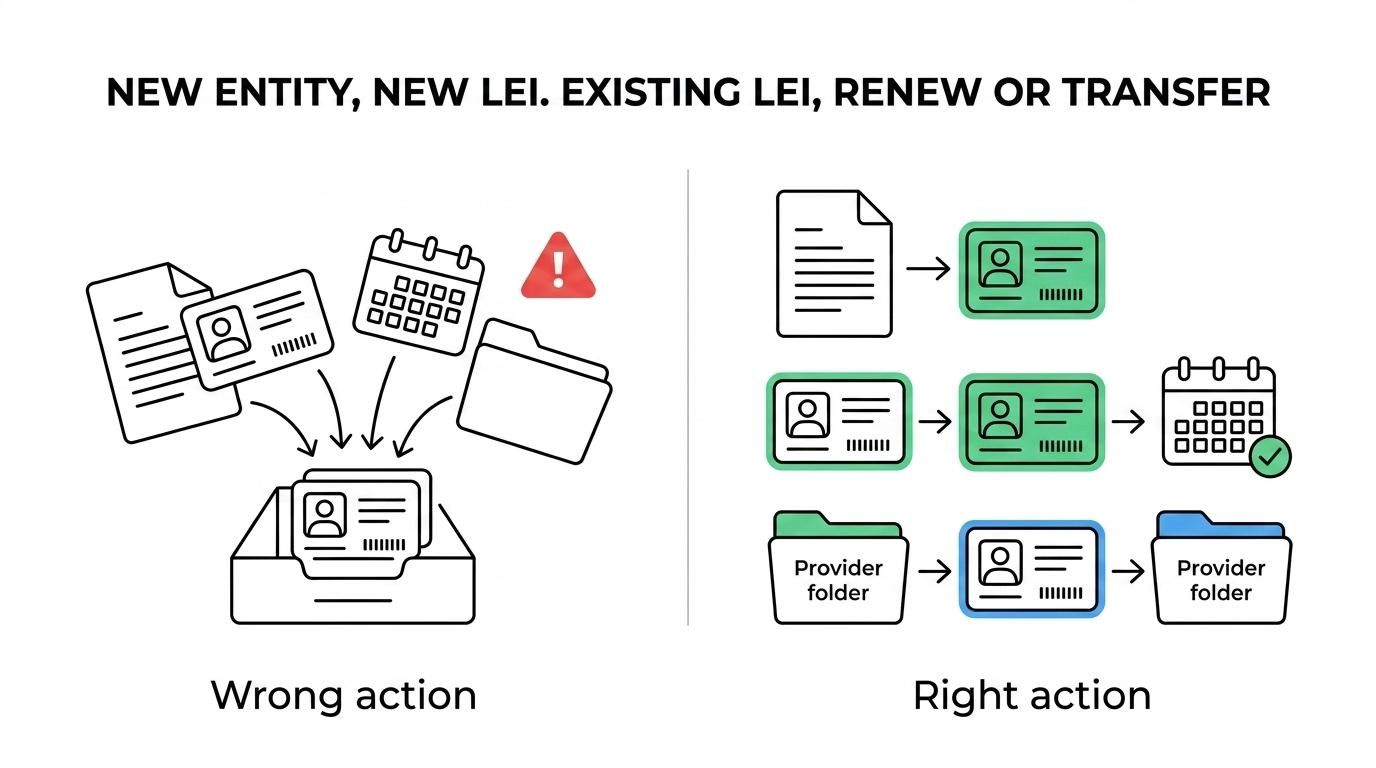
GLEIF’s operational rules are clear on two points. First, renewal must be facilitated at least once a year. Second, a transfer is an administrative move between LEI issuers or Local Operating Units, with required handoff steps on both sides.
“LEI Service offers express LEI processing in as fast as 2 hours, with the GLEIF fee included.”
A useful rule is this: if the legal entity remains the same, the LEI normally remains the same. Many applicants assume a new provider means a new code. It does not.
When do you need a brand-new LEI?
You need a new LEI only when the legal entity itself is new. A Private Limited Company, LLP, trust, fund, or charity that has never had an LEI should apply for first-time LEI registration.
This is where many errors start. If your company already has an LEI, even if it is old, expired in practice, or held with another provider, you usually should not request a fresh LEI. The next step is renewal, transfer, or both.
A common misconception is that a name change or registered office change requires a brand-new LEI. In most cases, it does not. Those events update the LEI reference data for the same entity, provided the underlying legal entity still exists and registry evidence supports the change.
If a merger, acquisition, or restructuring creates a genuinely new legal person, the answer can change. In that case, one LEI may be retired and another may be created, depending on the legal outcome recorded in official registries.
What are the clearest signs you need a new LEI, renewal, or transfer now?
The fastest way to decide is to match your situation to the trigger. Most entities fall into one of seven obvious cases.
- Your current provider no longer suits you: If pricing, support, or turnaround is poor, a transfer to another service, including LEI Service, may be the right move instead of buying a new LEI.
- Your Next Renewal Date is close: If the annual deadline is approaching, you need renewal now to keep the record current.
- Your LEI status is already LAPSED: You usually need a renewal, and sometimes a transfer-plus-renewal if you want a different issuer arrangement.
- Your entity has never had an LEI: A new company, fund, trust, or society needs a first-time LEI registration.
- Your official entity data changed: Name, address, merger, or acquisition events should trigger an LEI data review and update during renewal.
- A bank, broker, or counterparty asked for an active LEI: If the request is tied to onboarding or trading, time matters and a lapsed record can hold up the process.
- RBI exposure rules apply to your organisation: If you are a non-individual borrower with aggregate exposure of ₹5 crore and above, LEI readiness should not be delayed.
If you see signs 2, 3, 5, and 6 at the same time, do not split the job into separate actions unless necessary. A single renewal workflow can often restore status and update entity data together.
How do you renew an LEI step by step?
LEI renewal is an annual validation process. GLEIF requires the legal entity to apply for renewal, confirm whether prior-year data remains valid, or submit changed data.
The cleanest renewal process usually looks like this:
- Check the renewal date: Review the Next Renewal Date before a bank, broker, or treasury team asks for it.
- Confirm entity details: Verify legal name, registered address, registry number, and authorised contact.
- Declare changes if any: If data has changed, provide the updated details and supporting registry evidence.
- Submit the renewal request: The issuer or registration agent validates the record and submits it onward.
- Verify the updated status: Make sure the LEI record shows renewed, current data after processing.
GLEIF states that the LEI issuer must notify the legal entity at least six weeks before the renewal date. That reminder helps, but it is not a safe reason to wait until the last day. Registry mismatches, signatory issues, and incomplete records can slow approval.
“LEI Service offers automatic renewal and a guaranteed email response within 24 hours.”
Pro tip: renew before a compliance deadline, not after it. An LEI can be essential at the exact moment a transaction, exposure renewal, or counterparty check happens.
How do you transfer an LEI step by step?
An LEI transfer keeps the same LEI code. The change is administrative, moving the record from one issuer relationship to another.
A transfer normally follows these steps:
- Choose the receiving provider or registration agent.
- Authorise the transfer request for the existing LEI.
- Let the receiving and sending Local Operating Units complete the required handoff.
- Renew the LEI at the same time if the renewal date is near or overdue.
GLEIF materials indicate that LEI transfers average about 5 to 10 business days. A separate GLEIF service standard states that the sending Local Operating Unit performs its transfer role within 4 LOU business days. Real-world timing depends on whether data corrections, identity checks, or renewal tasks are bundled into the same request.
“LEI Service states that LEI transfer itself is free for the customer, and the customer pays only for renewal.”
A smart move is to combine transfer and renewal when the LEI is close to expiry. That avoids repeated handling and gives you one clean record update cycle.
How do you choose between LEI renewal and LEI transfer?
Choose renewal when you want the same LEI and are satisfied with the current setup. Choose transfer when you want the same LEI but a different provider, support model, or pricing arrangement.
The main decision criteria are practical, not legal. If your only issue is that the record is nearing expiry, renewal is enough. If you want INR pricing, faster responses, English-speaking support, or a simpler workflow, transfer becomes relevant.
A common mistake is to treat transfer as a technical reset. It is not. Transfer does not erase your history, create a new identifier, or change the entity behind the record. It changes who manages the administrative side.
If speed is the only concern, a straight renewal is often simpler than a transfer. If service quality is the concern and the renewal is due anyway, transfer-plus-renewal is often the cleaner choice.
What legal-entity events require LEI data updates?
Name changes, address changes, mergers, and acquisitions can require LEI data updates. GLEIF treats these as legal-entity events that affect LEI reference data.
This matters because LEI data is not just a code. It is a public reference record that should match official sources. GLEIF policy ties those updates to registry evidence, so the LEI remains reliable for counterparties, lenders, and regulators.
Here is the practical rule. If the entity is still the same legal person, the LEI usually stays and the data changes. If the legal person ceased to exist or a new one was created, the LEI outcome may be retirement, succession treatment, or a new registration.
A pro tip here is not to wait until the next annual cycle if the change is material and time-sensitive. If a merger or renamed entity is already being checked by a lender or market participant, outdated reference data can create friction.
What happens if your LEI becomes LAPSED in India?
A LAPSED LEI is not current. GLEIF rules state that if the LEI record is not renewed in due time, the registration status is set to LAPSED.
LAPSED does not usually mean the identifier vanished. It means the annual validation is overdue. In many cases, the fix is straightforward: renew the LEI, update any changed reference data, and restore current status.
In India, the risk can be more than administrative. RBI has stated that non-individual borrowers with aggregate exposure of ₹5 crore and above are required to obtain LEI codes. RBI also states that borrowers who fail to obtain LEI codes shall not be sanctioned new exposure and shall not be granted renewal or enhancement of existing exposure.
The practical takeaway is simple. If your lender, NBFC, co-operative bank, treasury desk, or broker expects an active LEI, a LAPSED status can become a real operational problem. A common misconception is that “lapsed” is the same as “retired.” It is not. A lapsed LEI can often be brought back into good standing through renewal.
How do you apply for a new LEI step by step?
A new LEI application starts with verified entity data. The provider checks the legal name, registry details, address, and authorised applicant information before submission to a GLEIF-accredited LOU.
A practical first-time application usually includes these steps:
- Collect core details: Legal name, entity type, registration number, registered address, and headquarters address if different.
- Identify the applicant: Provide the authorised contact or signatory information.
- Submit the application: The registration agent or issuer validates the data against official records.
- Review parent reporting if relevant: Some entities may also need to consider Level 2 relationship data or reporting exceptions.
- Receive the LEI: Once validated and issued, the LEI becomes searchable in the Global LEI System.
The smoother your registry data is, the faster this goes. Entities with exact registry matches usually move more quickly than those with pending name changes, inconsistent address formats, or unclear authorisation documents.
“LEI Service uses a one-minute application and guarantees an email response within 24 hours.”
If your entity is newly incorporated and a trading, banking, or borrowing deadline is close, gather the official registry extract before you start. That small step often removes the biggest cause of delay.
How fast can new LEI registration, renewal, and transfer happen?
Renewal is often the fastest path, new registration can also be quick, and transfer is usually slower because it involves more parties. GLEIF and provider workflows both affect timing.
A straightforward renewal with no data changes can be the simplest case. A new LEI can also move fast when the legal entity is clearly registered and the applicant details are complete. Transfer tends to take longer because the receiving side and sending Local Operating Unit must complete a controlled handoff.
The timing gap matters when you are dealing with a trade settlement, bank onboarding, or RBI-related lending action. If the LEI already exists, ask one question first: “Can this be solved by renewal today?” If yes, that is often the shortest route. If no, decide whether a transfer adds enough service value to justify the extra days.
One final practical check helps. Before submitting anything, search the Global LEI System for the entity name and registry details. If an LEI already exists, you are almost certainly choosing between renewal and transfer, not a brand-new LEI.