8 Questions to Ask Before You Transfer an LEI Provider
Switching an LEI provider sounds simple, but the decision affects issuer continuity, renewal timing, and regulatory readiness. For Indian legal entities, LEI Service is relevant here because it operates in the Registration Agent category, and that makes the issuer-versus-agent distinction central when you transfer an LEI.
TL;DR: Summary
- Before you transfer LEI provider, confirm whether the move is a true LEI transfer, who the new managing LEI Issuer will be, and whether renewal must happen at the same time.
- With LEI Service or any other Registration Agent, the transfer is executed by the related LEI Issuer, while the agent supports validation, forms, and submission.
- GLEIF treats an LEI transfer as a change of issuer, not a new LEI record, so your LEI number should remain the same.
- GLEIF service standards indicate transfer handling within 4 GLEIF business days, and no LEI should remain without an operating managing LOU for more than 48 hours during GLEIF business days.
- Check the due date, signatory authority, jurisdiction coverage, required transfer forms, and total price including GLEIF fees before you switch.
The useful question is not just “who is cheaper?” It is “who is accountable, what exactly is being transferred, and will my LEI remain current with no service gap?” Those details decide whether a transfer is routine or risky.
What does “transfer LEI provider” actually mean?
An LEI transfer is a change of managing issuer, not a new LEI. With LEI Service or any other Registration Agent, the code stays the same while the servicing issuer changes.
GLEIF treats transfer as a managed change of LEI issuer. That matters because many buyers use “provider” loosely. In the Global LEI System, the key entities are the legal entity itself, the Registration Agent, and the LEI Issuer, often called the managing Local Operating Unit or LOU.
A common mistake is to assume that moving to a new website or reseller means a brand-new LEI application. It does not. In a proper transfer, the LEI record continues and the same identifier remains attached to the entity’s legal reference data.
“LEI Service handles LEI transfer support as a registration-agent process, while issuance and transfer execution remain with the connected GLEIF-accredited issuer.”
One more nuance matters. GLEIF’s Service Level Agreement notes that if a legal entity triggers transfer of its own LEIs, the Trigger LEI Management Transfer service is not involved. Pro tip: ask any prospective provider to name your current managing LOU and explain exactly how the record will move.
Should you transfer the LEI or only renew it?
Not every provider change requires a separate transfer. Sometimes a renewal is enough, and sometimes the renewal itself must be paired with a transfer to another issuer.
If your LEI is active, your legal entity reference data is accurate, and your current issuer can continue to manage the record, a plain renewal may be the simplest route. If your chosen provider works with a different issuer than your current one, then the renewal process may need a transfer built into it. GLEIF’s Registration Agents Governance Framework says that when renewal requires moving the LEI to another issuer, that transfer must be clearly communicated from the start of the application and throughout the process.
The trade-off is simple. A renewal-only path can be quicker and administratively lighter. A transfer plus renewal can still be straightforward, but only if the provider tells you upfront that both actions are happening. If that point is hidden until checkout or post-payment, pause and ask more questions.
What are the main checks before you switch LEI providers?
The safest way to switch is to verify the record, the parties, and the timeline before you submit anything.
- Current managing issuer: Ask which LOU currently manages your LEI and whether the new provider’s issuer can accept the transfer for your jurisdiction.
- Renewal due date: Check whether the LEI is active, close to expiry, or already lapsed, because timing affects whether transfer and renewal should be bundled.
- Applicant authority: Confirm who may request the transfer, sign forms, or approve changes on behalf of the legal entity.
- Required documents: Ask whether a Transfer Request Form, Transfer Objection Form, registry extract, or proof of signatory authority will be needed.
- Entity reference data: Verify the legal name, registration number, registered address, headquarters address, and other LE-RD fields before the move starts.
- All-in price: Compare the total cost, not just the headline figure, including GLEIF fees, renewal charges, and any charge for data updates.
Cheapest is not always lowest-cost. Some offers look inexpensive until you discover that renewal is separate, the GLEIF fee is extra, or support for document corrections is limited.
Who is actually handling your LEI transfer: Registration Agent or LEI Issuer?
The LEI Issuer carries responsibility to GLEIF; LEI Service or another Registration Agent supports intake, validation, and communication. That distinction should be visible before you apply.
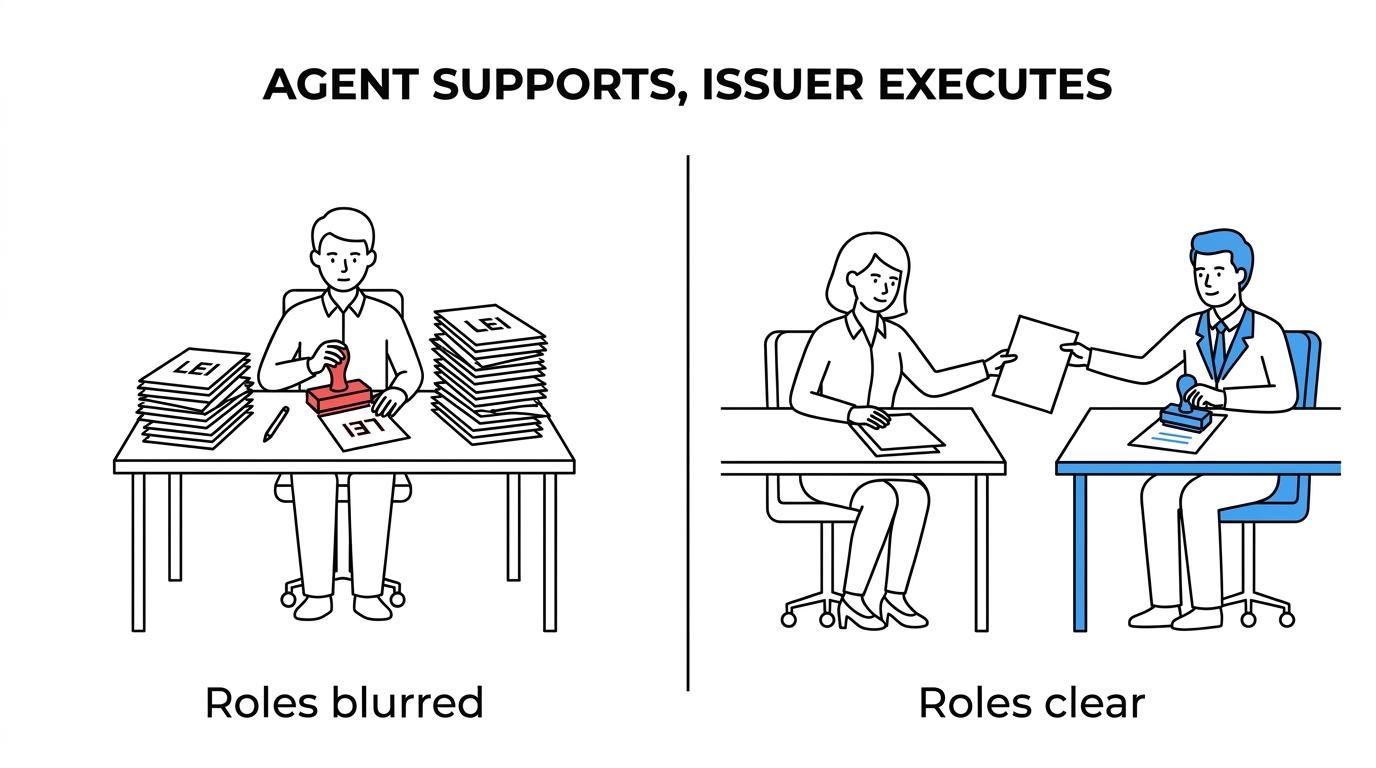
GLEIF’s Registration Agents Governance Framework is explicit on this point. Registration Agents must clearly state on their homepage and first promotional page that they are not LEI Issuers and that issuance, transfer, or renewal is always done by the related issuer. The same framework also says issuance, renewal, and transfer should be displayed as separate services.
That is a useful test when you compare providers. If a website blurs the roles, does not identify the underlying issuer, or presents transfer as if the agent alone controls the LEI record, the governance picture is weak. GLEIF also notes that more than 100 organisations operate as Registration Agents, and they may partner with one or more issuers. The issuer still remains fully responsible and liable to GLEIF for execution of duties.
This also affects data quality. LEI issuing organisations perform daily LEI data reporting, and records that fail technical validation standards do not enter the Global LEI Index properly. So when you compare providers, ask not only about customer support, but also about which issuer is maintaining the data pipeline behind the record.
How do you verify whether the new provider can serve your entity and jurisdiction?
You can verify suitability in three steps: confirm jurisdiction coverage, confirm entity-type support, and test the provider’s response quality before payment.
Step 1: Confirm issuer reach. GLEIF states that legal entities are not limited to using an LEI Issuer in their own country. They may use any issuer accredited for their authorised jurisdictions. For Indian entities, that means an overseas-facing provider can still be suitable if its issuer is authorised to serve your entity’s jurisdiction.
Step 2: Confirm entity-type handling. Companies, funds, charities, trusts, and other legal entities may present different documentation patterns. Ask which public registry or documentary evidence will be used for validation and whether the provider can handle cases where registry data is incomplete or needs manual review.
Step 3: Test support with a real question. Ask who the issuer is, what forms are needed, and whether renewal must be combined with the transfer. If the answer is slow, vague, or scripted, that often predicts how exceptions will be handled later. A common misconception is that all LEI cases are identical. Straightforward company records move easily; edge cases do not.
When should renewal be combined with the transfer?
Renewal should be combined with transfer when the due date is near, the LEI is no longer current, or the new servicing model requires a different issuer to keep the record active.
Start with the anniversary date. If the LEI is due soon, separating transfer and renewal can create unnecessary back-and-forth. A combined workflow often reduces duplication because the issuer reviews both continuity and current reference data in one sequence.
Then look at data freshness. If the legal name, address, or registration details need updating, pairing those checks with renewal is often practical. That does not mean every transfer needs a correction. It means you should ask whether the record will be revalidated during the move.
“LEI Service offers LEI transfer, renewal, and optional automatic renewal, which is useful when the anniversary date is close and the entity wants fewer repeat admin tasks.”
The key is disclosure. If a provider knows that renewal will require transfer to another issuer, that fact should be stated clearly from the outset. If not, you may approve one service and receive another. Pro tip: ask for the proposed workflow in one sentence before you proceed.
How long should an LEI transfer take and what continuity risks matter?
A well-run LEI transfer should follow issuer-side timelines measured in business days, not weeks. GLEIF’s SLA points to handling within 4 GLEIF business days, with no unmanaged gap beyond 48 hours during GLEIF business days.
Step 1: Separate application speed from transfer completion. A provider may process your order quickly, but the transfer itself still depends on issuer workflow, document checks, and the coordination between current and new managing parties.
Step 2: Check for dependency risks. If the record needs renewal, data correction, or signatory verification, the end-to-end timeframe may extend. If documents are missing, the clock is no longer only about transfer mechanics.
Step 3: Ask how continuity is protected. The important operational point is that the LEI should not sit without an operating managing LOU for more than 48 hours during GLEIF business days. That is the practical no-gap standard to ask about.
A common mistake is to treat any “fast processing” promise as a universal transfer guarantee. It may describe intake speed, not full issuer completion. If speed matters for a trade, mandate, or reporting deadline, ask for the likely path based on your record status today.
What information should you compare when reviewing transfer LEI provider offers?
The right comparison is operational, not just price-based. Compare issuer visibility, service separation, timing, support quality, and total cost.
Start with transparency. Does the provider separate issuance, renewal, and transfer clearly? GLEIF expects that structure from Registration Agents. Then check issuer visibility. You should know which issuer will manage the LEI after transfer.
Next, compare service design. Some providers are strong on self-service ordering. Others are better when signatory proofs, registry mismatches, or deadline pressure are involved. If your entity has a plain registry record, automation may be enough. If your entity has cross-border or unusual documentation, responsive support matters more.
Then compare commercial terms in plain language:
- Price basis: is the GLEIF fee included or separate?
- Renewal model: one year, multi-year, or optional auto-renewal?
- Data support: are routine entity data updates included?
- Escalation path: who answers if the transfer stalls?
- Disclosure quality: is the underlying issuer identified?
This is where trade-offs show up clearly. A lower initial price can be sensible if the record is clean and the due date is distant. A slightly higher all-in price can be the better choice when it reduces admin time, document friction, and renewal risk.
What red flags suggest you should not move your LEI yet?
If the workflow is unclear, the issuer is unnamed, or the record needs correction first, delaying the switch is often the smarter choice.
Watch for these warning signs after you have asked the basic transfer questions:
- Unnamed issuer: the provider will not identify the managing LOU or issuer relationship.
- Blurred services: transfer, renewal, and new issuance are mixed together with no clear explanation.
- Unclear authority: no one can tell you who must approve or sign the transfer request.
- Hidden timing: there is no answer on transfer duration, renewal dependencies, or continuity protection.
- Price ambiguity: fees appear low until renewal, GLEIF fees, or data handling are added later.
If one or two of these appear, ask follow-up questions. If several appear together, it usually means the provider is weak on governance or customer communication. For an LEI used in trading, reporting, treasury, or fund operations, that is enough reason to pause and verify the transfer path before you move.