Can a Sole Proprietorship Get an LEI in India?
A sole proprietorship often sits in an awkward place in regulation. It is not a company, yet it is more than just a person making informal transactions. That is exactly why many business owners in India ask whether an LEI is even available to them.
The short answer is yes. An Indian sole proprietorship can get a Legal Entity Identifier, and the rules do not treat it as a natural person applying in an individual capacity. That distinction matters for market access, banking compliance, and certain high-value transactions.
It also clears up a common confusion. Many people assume LEIs are only for companies, LLPs, banks, or funds. Indian guidance and global LEI validation rules point in a different direction: sole proprietors are a recognised entity category for LEI issuance.
LEI eligibility for sole proprietorships in India
Indian LEI guidance has expressly included sole proprietorships among the entity types that may apply for an LEI. This is a strong and direct answer to the eligibility question. It means a proprietor running a registered business is not excluded merely because the business is unincorporated.
At the same time, LEI rules draw a firm line between a business entity and a person acting only in a natural capacity. An individual as an individual is outside the present LEI scope. A sole proprietorship, by contrast, can be issued an LEI as its own eligible category under the relevant validation structure.
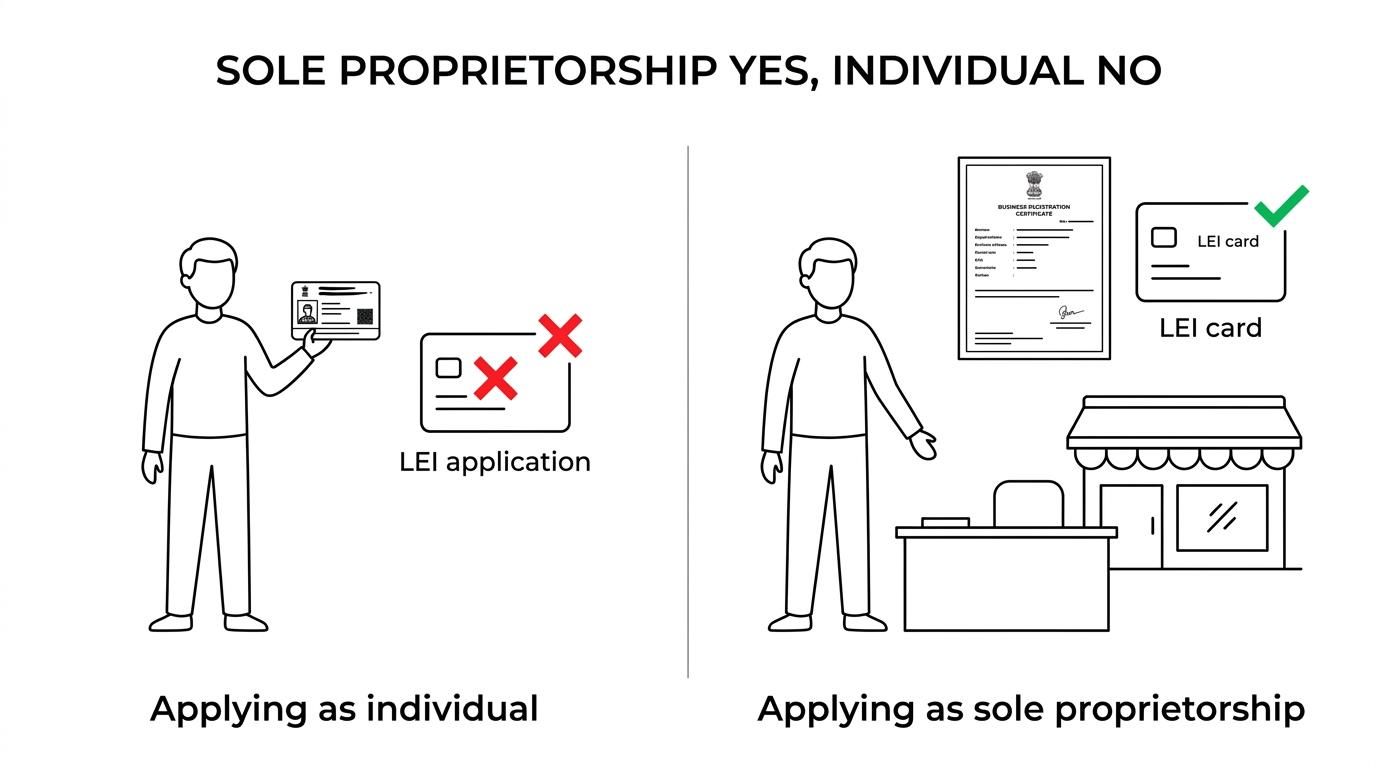
That position is supported by both Indian and global rule sets.
- India eligibility position: Sole proprietorships are listed among the entity types eligible to apply for an LEI in India.
- Natural person distinction: An individual acting only in a natural capacity is out of scope for LEI issuance.
- Global validation rule: LEI issuers use a dedicated entity category for sole proprietors rather than treating them as ordinary individuals.
Why a sole proprietorship is different from an individual for LEI purposes
This is where many applications go wrong. From a legal and tax perspective, a sole proprietorship is closely tied to its owner. Yet for LEI issuance, the business is assessed through an entity-specific validation framework. That is why the issuer checks registration evidence, validates the relevant entity category, and creates a record that follows the sole-proprietor rules applicable in India.
The distinction is practical, not academic. If a bank or counterparty needs a unique identifier for a transaction, it cannot rely on guesswork around trade names, proprietor names, or multiple registrations. The LEI creates one globally recognised reference point.
| Category | LEI position in India | Key point |
|---|---|---|
| Individual acting personally | Not in scope | A natural person does not apply for an LEI simply as an individual |
| Sole proprietorship | Eligible | Treated as a separate entity category for LEI issuance |
| Company / LLP / trust / fund | Eligible, subject to applicable rules | Standard legal-entity LEI path |
There is another India-specific point worth keeping in mind. Validation rules for Indian sole proprietors state that even if the proprietor has multiple GST numbers, only one LEI should be issued. So the system aims to identify the business consistently, not multiply records across registrations.
When RBI LEI rules affect sole proprietors in India
LEI eligibility is one question. LEI necessity is another. A proprietor may be allowed to obtain an LEI long before a specific bank, market, or transaction makes it mandatory.
The Reserve Bank of India has introduced LEI requirements across several areas over time. These have included participants in OTC derivative markets, large corporate borrowing, and large-value transactions in centralised payment systems. RBI has also required LEIs for all participants other than individuals in certain government securities, money market, and non-derivative forex market segments, subject to the applicable timelines and scope.
A particularly relevant RBI circular states that authorised dealer category I banks must obtain LEI numbers from resident entities classified as non-individuals when they undertake capital or current account transactions of ₹50 crore and above per transaction. For a sole proprietorship, that can become very relevant very quickly if the business is dealing with large import, export, borrowing, remittance, or treasury-related flows.
Common situations where a proprietor may be asked about LEI include:
- large capital account transactions
- large current account transactions
- certain forex market dealings
- bank compliance reviews
- counterparty onboarding for financial transactions
One more detail matters here. RBI guidance has also clarified that transactions on recognised stock exchanges are outside the purview of one of these market-specific LEI requirements. So the need for an LEI depends on the exact transaction type, the regulator’s scope, and the bank or market infrastructure involved.
How LEI validation works for an Indian sole proprietorship
An LEI is not just a number issued on request. It is a validated record. For a sole proprietorship, the issuer must confirm that the entity is registered with a registration authority and that the application data matches the accepted record structure.
Global validation rules use specific fields and classifications for this. The entity category must reflect the sole-proprietor status. The legal form used in the LEI record must also be one that is applicable to sole proprietors in the relevant jurisdiction, which in this case is India.
A very useful India-specific rule addresses names. The trade name of the sole proprietorship should not be used as the legal name in the LEI record.
 That can surprise business owners, especially when the market knows the firm by a shop name or brand name. LEI records depend on validated legal and registration data, not just on the name printed on invoices or signage.
This is why document matching matters. If the proprietor’s registration evidence, tax records, or authority records show one naming format, while the application shows only the trade name, the application can slow down or be sent back for correction. A clean submission usually depends on getting the legal name, registration authority information, and identification fields right at the start.
Self-registration has traditionally been the standard route in India. Current practice also allows application through a Validation Agent, which can help with data checks and submission flow. That can be useful when the entity wants to avoid delays caused by mismatched records.
Details usually needed for a sole proprietorship LEI application
The precise document set can vary depending on the issuer, the registration route, and how the business is evidenced in public or official records. Still, most proprietors should expect the application to be driven by verifiable business identifiers rather than informal proofs.
That is why it is wise to gather the core business information before starting. A one-minute form sounds simple, but the actual speed depends on whether the underlying records can be validated quickly.
Typical details checked in a sole proprietorship LEI application include:
- Proprietor and entity name data: Information must match the accepted legal and registration format, not merely the trade name used in the market.
- Registration evidence: The issuer needs proof that the sole proprietorship is registered with a recognised registration authority.
- PAN and tax-linked details: These may be used as part of the validation trail, depending on the route and the evidence available.
- GST-related records: GST data may help validate the business, though multiple GST numbers do not mean multiple LEIs.
- Business address: The registered or principal address must be consistent with documentary evidence.
- Authorised contact details: Email and contact information are needed for verification, approval, and renewal reminders.
In practice, many delays come from something small: a spelling mismatch, an old address, or the use of a brand name where the LEI record needs a validated legal name structure.
Common mistakes in a sole proprietorship LEI application
Most problems are avoidable, especially when the proprietor knows that LEI validation is stricter than a typical online sign-up.
The most common issue is assuming that the business’s trading style is enough on its own. It usually is not. The record needs to reflect the applicable legal and registration evidence used for LEI issuance in India.
A few mistakes show up again and again:
- Using only the shop name or brand name instead of the validated legal name structure.
- Applying for more than one LEI because the business has multiple GST registrations.
- Treating the application as a personal LEI request rather than an entity-category request for a sole proprietorship.
- Submitting records with inconsistent addresses, tax details, or contact information.
These errors can lead to avoidable back-and-forth, which matters most when a bank is waiting for the LEI before processing a large transaction.
Choosing a practical LEI registration route in India
A sole proprietor in India usually has two broad routes: apply directly through the accepted channel, or use a registration partner that handles data validation and submission support. The best choice depends on urgency, record quality, and how confident the business is about the entity details.
Where timing matters, it helps to choose a provider that gives transparent INR pricing, clear renewal terms, and support in English. Automatic renewal can also be valuable, because an LEI is not a one-time lifetime document. It must remain active, and a lapsed LEI can create friction when a transaction is time-sensitive.
Some registration agents also offer express processing, multi-year plans, included GLEIF fees, and free updates to entity data. That kind of support can suit sole proprietors who want speed without spending time interpreting validation rules on their own.
For a proprietor facing an imminent bank deadline, the practical goal is simple: use the correct entity category, submit matching records the first time, and keep the LEI active once issued. When those basics are in place, a sole proprietorship can meet LEI requirements in India just as effectively as many incorporated entities.