Can One Company Hold Multiple LEIs? Rules Explained
A short answer comes first: no, one legal entity should not hold more than one LEI.
Under the Global LEI System, an LEI is meant to be a unique identifier for one legally distinct entity, and that rule works both ways. One LEI points to one entity, and one entity can have only one LEI. If a duplicate is created by mistake, the records are corrected so that one registration survives and the extra one is marked as the duplicate.
That sounds simple, but confusion still happens, especially when a company changes service provider, operates across markets, or has multiple branches and registrations. The key is to separate the idea of having an LEI from the idea of who maintains it.
What the official LEI rules say about multiple LEIs
The official position is clear. GLEIF states that every LEI is unique and can represent only one entity. It also states that a legal entity can have only one LEI code. The LEI Regulatory Oversight Committee, or ROC, says the same thing in policy language: a legal entity that has obtained an LEI cannot obtain another one.
This rule is often described using the term exclusivity. In LEI language, exclusivity means the same legal entity must not be associated with multiple active LEIs. That matters because the entire system is built to create a reliable public identity record for entities active in financial transactions.
If a company could hold several LEIs at the same time, reference data would become weaker. Counterparties, banks, regulators, and market participants would have a harder time knowing which record is the valid one.
Why the one-company-one-LEI rule matters in practice
An LEI is not just a code added to a form. It is linked to reference data about the entity, including legal name, registered address, country of formation, and status. In many cases, it also connects to relationship data about parent entities.
When markets, banks, and reporting systems use LEIs, they rely on that record being stable and unique. If the same company had two or three active LEIs, even basic tasks would become less reliable. Trade reporting could split activity across codes. Risk teams could miss exposure. Compliance reviews could slow down.
This is why duplicate prevention is built into the Global LEI System. During issuance, new applications are checked against available records. GLEIF has also said that new records are compared against the LEI Index and even against records that other issuers have not yet issued, which helps stop duplicates before they become active.
Situations where a company may think it needs more than one LEI
The confusion usually comes from corporate structure or administration, not from the rules themselves.
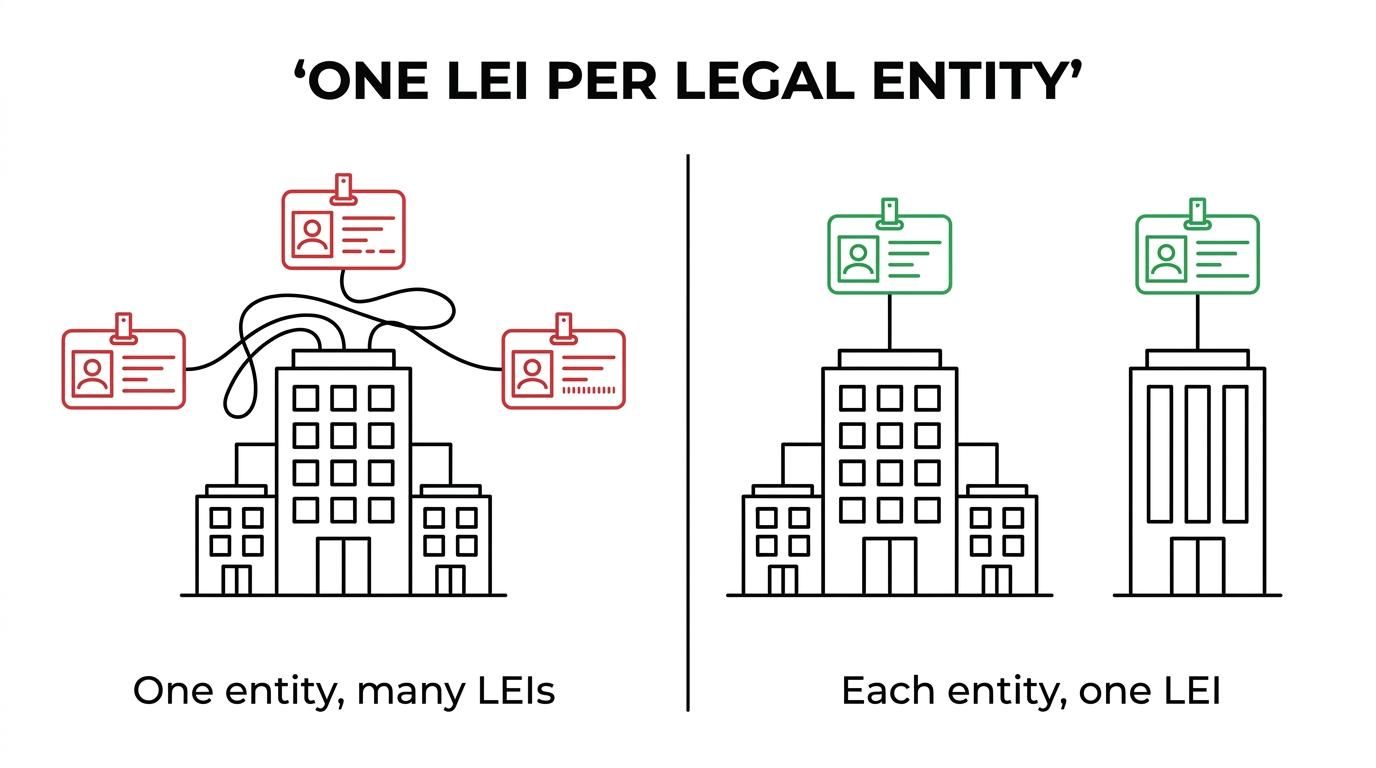
A company may have subsidiaries, branch offices, business divisions, or operations in several countries. That does not mean the same legal entity needs multiple LEIs. The test is legal identity, not operational size or market reach. If it is one legal entity, it should have one LEI.
Common situations that cause doubt include:
- Multiple bank relationships
- Trading in different exchanges
- Branches in different states or countries
- Internal restructuring
- Change of LEI service provider
There are also cases where separate LEIs are valid. If a parent company and its subsidiary are legally distinct entities, each may need its own LEI. If two funds are separate legal vehicles, each may need its own LEI. The same goes for trusts, charities, partnerships, and SPVs when they exist as distinct legal entities under applicable rules.
LEI transfer does not mean a new LEI
This is one of the most important points for Indian entities managing compliance across banks, brokers, and reporting obligations.
If a company wants to move its LEI administration from one operator to another, it does not apply for a fresh code. It transfers the maintenance of the existing LEI. The ROC FAQ is clear on this: an entity may port the maintenance of its LEI from one Local Operating Unit, or LOU, to another, and the LEI remains unchanged during that process.
That means:
| Situation | Does the LEI number change? | Is a new LEI issued? |
|---|---|---|
| Renewal with the same provider | No | No |
| Transfer to a different provider/LOU | No | No |
| Update to legal name or address | No | No |
| Duplicate registration created by mistake | One survives, one is retired/marked duplicate | No valid reason for a second active LEI |
This is where many applicants make an avoidable mistake. They assume a lower fee, better support, or faster turnaround means starting from zero. It does not. A transfer keeps the existing number while shifting the maintenance responsibility.
For businesses that want simpler administration, some agents handle the transfer and renewal process together. LEI Service, for example, offers registration, renewal, and transfer support with transparent INR pricing, data validation, and English-language assistance. The important point is that the code stays the same.
What happens if duplicate LEIs are issued for the same company
Duplicate issuance is not meant to happen, but the system recognises that errors can occur. When that happens, remediation follows a defined logic.
One record becomes the surviving registration. The other is marked as a duplicate, often referred to as a non-surviving record in LEI data practice. The goal is to preserve a single valid identity trail for the entity and avoid confusion in the public record.
This process is not only internal. GLEIF provides a challenge facility that allows interested parties to flag problems in LEI data, including exclusivity issues where one entity appears to have more than one LEI code.
If a duplicate is suspected, the usual flow looks like this:
- The potential duplication is identified through system checks or a user challenge.
- The records are reviewed against reliable source documents and reference data.
- One LEI is kept as the surviving registration, and the duplicate is marked accordingly.
That correction matters because financial institutions and reporting systems often pull information directly from LEI data sources. A duplicate left unresolved can affect reporting quality, onboarding, and compliance checks.
How duplicate LEIs are prevented in the Global LEI System
The system is designed to reduce the chance of duplicate registrations at more than one stage.
Before an LEI is published, the issuer is expected to validate the application against reliable sources. That includes matching the legal name and registration details to official records. The ROC has stated that issuers must check each entry against reliable sources before publishing LEI data.
GLEIF also supports data quality controls across the wider LEI ecosystem. Its challenge mechanism gives market participants a way to report issues, and duplicate detection methods continue to improve. According to GLEIF, potential duplicates represent a very small share of the overall population of LEI records.
The preventive framework typically includes:
- Source validation: checking submitted entity details against official registries and records
- LEI Index comparison: matching new applications against existing LEIs and near matches
- Challenge facility: allowing third parties to report exclusivity or data quality concerns
- Ongoing maintenance: reviewing updates, mergers, and legal status changes over time
This is useful for applicants because it shows that the LEI system is not just a registration database. It is an identity infrastructure with built-in controls.
Corporate events that can create confusion around LEI status
A company can change in many ways without needing a second LEI. Legal name changes, address updates, and maintenance transfers all happen under the same code.
Still, some events need closer review because the right treatment depends on legal continuity. If an entity merges into another and ceases to exist, the original LEI is not simply reused for the new survivor if the legal identity has changed. If a new company is incorporated, that new legal entity may need its own LEI.
A few examples make the distinction easier:
- Name change: Same entity, same LEI
- Change of registered office: Same entity, same LEI
- Transfer to another LEI provider: Same entity, same LEI
- New subsidiary incorporated: New legal entity, likely its own LEI
- Merger resulting in a different surviving legal entity: treatment depends on which entity legally survives
This is why applicants should focus on the legal person, not the business label, branch network, or reporting channel.
How to check whether your company already has an LEI
Before applying, it is wise to verify whether the entity already has an issued LEI. This matters a lot for larger groups, companies with treasury teams in different locations, and organisations that have changed advisors over time.
A quick search can prevent duplicate applications and save time with banks and counterparties later. Search using the exact legal name, registration details, and jurisdiction. If there is an existing LEI, the next step may be a renewal or transfer rather than a fresh registration.
A practical pre-application check should include:
- Legal name: Use the name exactly as it appears in official registration records
- Corporate history: Check whether another team already obtained an LEI earlier
- Group structure: Confirm whether the applicant is the parent, subsidiary, fund, or branch
- Current record status: See whether the LEI is active, lapsed, transferred, or pending update
For Indian entities, this is especially relevant where one team handles trading documentation, another handles secretarial records, and a third deals with banking or regulatory filings.
Practical guidance for Indian companies, funds, and charities
If your organisation needs an LEI for market participation or regulatory compliance, the safest approach is very direct: first search, then renew or transfer if an LEI already exists, and only apply for a new one if the legal entity has never had one before.
That applies whether the applicant is a company, fund, trust, charity, NBFC, or another legal entity type that must identify itself in financial transactions.
When comparing providers, the real questions are not about getting a second LEI. They are about service quality, speed, pricing, and maintenance support. A provider that can process quickly, respond clearly in English, and manage renewal reminders can reduce admin effort without affecting the code itself. LEI Service positions its offer around those points, including quick processing, transparent INR pricing, automatic renewal options, and support with transfers as well as first-time registrations.
The main rule remains unchanged: if it is the same legal entity, it should have one LEI and only one LEI. If duplicate records appear, the system has a path to correct them. If you want to change provider, you transfer the existing LEI rather than replacing it.
That distinction keeps the LEI system reliable, and it helps businesses stay compliant without creating avoidable complications.