Common LEI Application Mistakes (and How to Avoid Rejections or Delays)
An LEI application rarely gets held up for dramatic reasons. In most cases, the problem is ordinary: a legal name that does not exactly match official records, an address copied from an old document, a registry number entered in the wrong format, or a renewal request submitted after the record has already slipped into a lapsed state.
That is good news for applicants in India, because ordinary problems are usually preventable. If the data is clean, the documents are current, and the entity status is clear, the process can move quickly. If not, even a simple application can pause while validation teams ask for clarification or supporting proof.
Why LEI validation causes rejections and delays
An LEI is not issued only on the basis of what an applicant types into a form. The submitted details have to be checked against reliable official or legal sources before the LEI record is published. That is built into the system. The LEI reference data must be trustworthy because it becomes part of the Global LEI Index, which is the central public source for current and historical LEI records.
A big part of this validation is Level 1 data. That includes the legal entity’s official name and registered address. If these details do not match the relevant registry or supporting documents, the application can be delayed, sent back for correction, or rejected if the mismatch cannot be resolved.
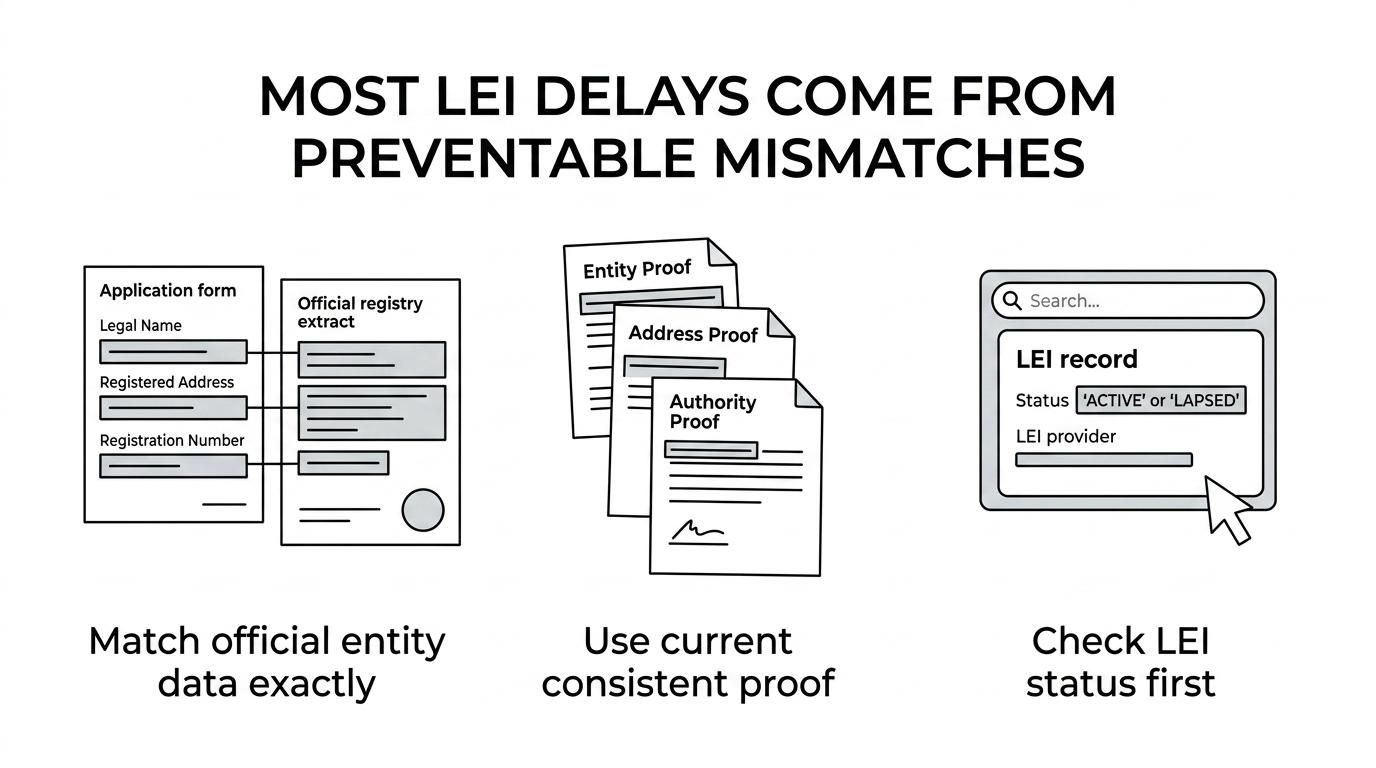
In practice, most delays fall into a few familiar buckets:
- legal name mismatch
- registered address mismatch
- incorrect registration number
- missing proof of authority
- outdated supporting documents
- renewal or transfer confusion
- formatting or data-rule errors
The useful point here is simple: an LEI application is not just a form-filling exercise. It is a verification process.
Legal entity reference data that must match official records
Applicants often assume that “close enough” is enough. It usually is not. If the company’s official name includes punctuation, spacing, abbreviations, or legal suffixes in a particular way, that exact version should be used. The same applies to the registered office address and the business registry details.
A mismatch may look minor to the applicant but still trigger manual review. If the official record says “Private Limited” and the application says “Pvt Ltd”, or if one address line is missing from the registered address, that difference may need to be checked. The more regulated or time-sensitive the transaction, the less room there is for rework.
This is why it helps to treat the application as a data-matching task rather than an admin form. Pull the details directly from the latest official source and use them consistently across the application and any uploaded documents.
| Data field | Common mistake | Better approach |
|---|---|---|
| Legal name | Using a trade name, short name, or edited version | Copy the full official legal name exactly as shown in official records |
| Registered address | Entering a branch, correspondence, or old address | Use the registered office address from the latest valid official source |
| Registration number | Typing errors or incomplete number | Check the number against the registry extract or registration certificate |
| Legal form | Selecting the wrong entity type | Match the legal form to the entity’s official status |
| Country and postcode details | Inconsistent formatting | Use the format shown in official records and proof documents |
For Indian entities, this means checking the relevant official record before submission rather than relying on memory, internal templates, or old vendor onboarding files.
Supporting documents and authorised representative checks
Even where public registry data is available, validation teams may still require documents to confirm the entity’s identity, status, or the authority of the person applying. Delays often start when the uploaded proof is incomplete, outdated, or inconsistent with the application data.
Another regular issue is authority. The applicant may be an employee, consultant, compliance officer, or intermediary, but the LEI request must still be linked to an authorised representative or an accepted basis of authority. If that chain is unclear, questions follow.
A strong document pack usually has a few basics in order:
- Entity proof: Current registration extract, certificate, or other acceptable official record
- Address proof: Document that supports the registered office details used in the application
- Authority proof: Evidence that the applicant is permitted to act for the legal entity
- Consistency check: Same legal name, address, and registration details across all submitted items
When applications slow down, it is often because one document is technically present but not actually usable. A scan may be unclear, a certificate may be too old, or the registered name may not match the spelling entered in the form.
Technical data errors and XSD validation problems
Some LEI problems are administrative. Others are technical.
The LEI ecosystem relies on structured data standards. If a file fails XSD validation, it cannot be included in the Global LEI Index. That means an application can be submitted in good faith and still fail at the publication stage because the underlying data does not meet format or rule requirements.
Applicants do not need to become experts in XML schemas to avoid this. They do, however, need to respect data quality. Incorrect date formatting, invalid field values, missing mandatory items, broken country codes, or improperly structured address data can all create avoidable friction. When a provider checks the data before submission, these issues are much easier to catch early than after the application enters review.
This is one reason professional support can save time, especially when a filing deadline is close.
LEI status issues: active, renewal, transfer and LAPSED records
Not every rejection happens at the first application stage. Status handling creates a second layer of confusion.
An LEI is not a one-time task that can be ignored after issuance. LEI records require periodic verification, typically through yearly certification. If renewal does not happen within the planned interval, the record may become LAPSED. GLEIF describes a lapsed LEI as one that is due for renewal and has not been verified within that interval.
That status matters because counterparties, banks, market infrastructures, and compliance teams may treat a lapsed LEI as a problem even though the code itself still exists in the system. A common mistake is assuming that a lapsed record requires a fresh LEI application. It usually needs renewal, not a second LEI. Another frequent problem is applying for a new LEI through one channel while the entity already has an existing record managed elsewhere, which can lead to duplicate checks and extra questions.
A quick status review can prevent a lot of wasted effort:
- Search the existing LEI record first
- Check whether the record is ACTIVE or LAPSED
- Confirm whether you need a new registration, a renewal, or a transfer
- Verify the current Managing LOU before changing providers
Because the full LEI data pool can be searched publicly, applicants have a practical way to confirm whether the entity already appears in the system before starting from scratch.
A pre-submission checklist for Indian LEI applicants
Speed usually comes from preparation, not luck. When the data is clean at the start, many routine applications move through validation much faster. Some service providers report that straightforward cases can be validated within 1 to 48 hours, while mismatches and ownership complexities take longer.
Before submitting an LEI request, it helps to run a short but disciplined review:
- Match the legal name exactly: Use the full official name from the latest valid record, not an internal short form.
- Use the registered office address: Do not substitute a branch, operating office, or mailing address.
- Verify the registration number: One mistyped digit can trigger manual review.
- Check entity status: Confirm whether you need a fresh registration, renewal, or transfer.
- Prepare current proof documents: Make sure they are legible and consistent with the application.
- Confirm applicant authority: The person submitting should be clearly linked to the entity or authorised to act for it.
- Review all fields once more: Small formatting mistakes can still cause larger delays.
This kind of checklist looks basic, but it removes many of the errors that slow LEI applications in practice.
Faster LEI processing when timelines are tight
There are moments when an LEI is needed urgently: a financial market transaction is approaching, a bank has asked for the code before onboarding can move forward, or a regulatory requirement has suddenly become time-critical. In those cases, prevention matters more than speed claims.
A fast service is only useful if the application data is right. If the legal name, registered address, and registration number match official sources, and the documents are in order, processing can be very quick. If they do not, even an express option may simply surface the problem earlier.
This is where a specialist registration agent can help by checking the application before submission, validating the entity data, and handling follow-up with the relevant LOU. For Indian applicants, practical details also matter: transparent pricing in INR, clear support in English, and a process that does not force the applicant to decode technical LEI terminology alone.
LEI Service, for example, offers new LEI registration, renewal, and transfer support with GLEIF fees included, free data updates, optional automatic renewal, and processing that can be as fast as 2 hours in suitable cases. That does not remove the need for accurate data, but it can reduce the back-and-forth that often causes avoidable delay.
The broader lesson is straightforward. LEI rejections and slowdowns usually do not come from obscure rules. They come from data that does not fully match official records, documents that do not support the submission, or status issues that were not checked in advance. When those three areas are handled properly, the application process becomes much more predictable, and much easier to complete on time.