How MCA Records Affect LEI Approval Speed in India
Speed matters when an entity needs an LEI for a trade, a reporting requirement, or a bank process with a fixed deadline. In India, one of the biggest drivers of that speed is not the application form itself. It is the quality of the entity’s official record.
For many Indian companies and LLPs, the Ministry of Corporate Affairs, or MCA, is the first place validators look when they need to confirm legal entity reference data. If the information in the LEI application matches MCA master data exactly, approval can move quickly. If it does not, the process can slow down while extra checks are carried out.
That is why MCA records are not just background administration. They often decide whether an LEI application feels effortless or gets pulled into manual review.
Why MCA records matter for LEI validation in India
An LEI is meant to identify a legal entity clearly and globally. To do that, the issuing side must validate the entity against official sources. GLEIF’s framework relies on recognised registration and validation authorities, and those authority references are formalised through its Registration Authorities List. In simple terms, the LEI system is built to trust official registers, not informal descriptions.
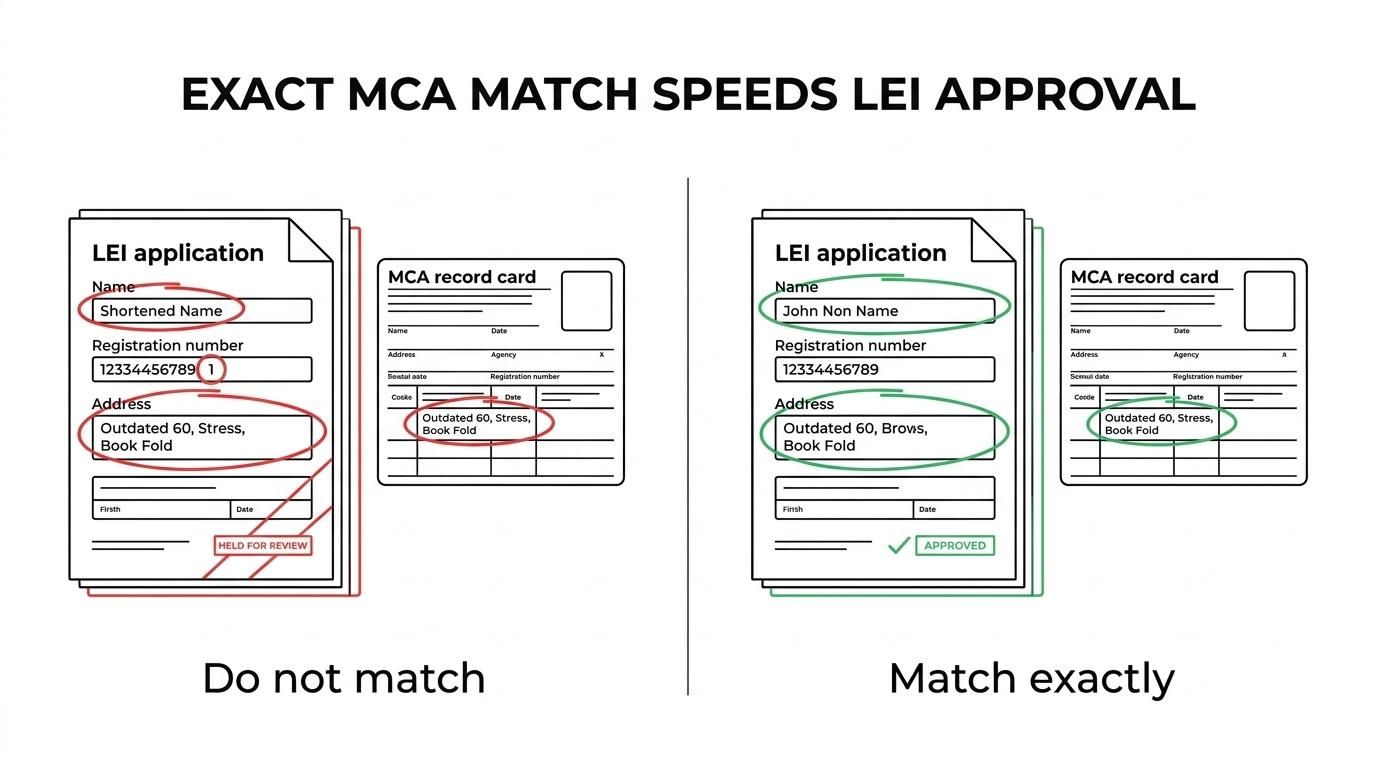
In India, MCA master data is a very practical source for this validation step. MCA makes company and LLP master data publicly searchable, and those records contain basic facts like legal name, incorporation date, status, and other core details. When an LEI application reflects those details accurately, validators can usually confirm identity faster.
This is where approval speed becomes predictable. A clean match between the application and the registry record cuts down back-and-forth emails, document requests, and analyst review time.
How GLEIF validation rules connect to Indian official records
GLEIF’s data standards refer to a Validation Authority and a ValidationAuthorityID. That sounds technical, but the core idea is straightforward. The LEI record should show which official authority supports the entity data and which source was used to validate it.
For an Indian company or LLP, that validation often ties back to MCA-linked records. The validator compares the legal entity reference data supplied in the application with the relevant official record. If the legal name is written differently, the address is outdated, or the registration number does not line up, the application may no longer qualify as a routine approval.
This is also why “almost correct” is not always enough. A business may use one version of its name in invoices, another on its website, and a third in internal documents. Yet for LEI purposes, the official registry version is the one that usually carries the most weight.
Which MCA data points most often affect LEI approval speed
Not every field causes equal delay. A typo in a contact email is easy to fix. A mismatch in the legal name or registration number is a different matter.
The following details are often the most sensitive during LEI validation because they are used to confirm the entity’s identity against MCA records and other official documentation.
| MCA-related detail | What validators look for | Effect on approval speed |
|---|---|---|
| Legal name | Exact match with official registered name | Fast if identical, slower if shortened or altered |
| Registration number or CIN/LLPIN | Clear link to the correct entity record | Strong speed driver when accurate |
| Registered office address | Match with official address on record | Mismatch may trigger document review |
| Entity status | Active status and valid legal existence | Inactive or unclear status can halt progress |
| Date of incorporation | Consistency with official filing data | Useful for confirming identity |
| Entity type | Company, LLP, fund, charity, or other structure | Wrong classification can create follow-up questions |
A surprising number of delays begin with very ordinary differences. “Private Limited” may be shortened in one place. A registered office may have changed recently but not yet been reflected in all supporting material. A group entity may submit the parent’s details by mistake. Each of these can create friction.
For regulated market activity, even small inconsistencies matter because the LEI is expected to map to one specific legal entity, not just a familiar business name.
Common MCA record mismatches that slow an LEI application
Most delayed applications are not blocked by unusual legal problems. They are slowed by basic data mismatches and incomplete evidence.
When validators cannot confirm the entity quickly through official records, they usually move to manual checks. That may involve reviewing uploaded documents, requesting clarification, or checking ownership information. The application is still possible to approve, but the timeline becomes less certain.
Some of the most common problem areas include:
- Legal name mismatch: abbreviations, missing suffixes, or use of a trade name instead of the registered name
- Old registered office address: application reflects a new address while MCA still shows the previous one
- Incorrect registration number: one digit wrong is enough to break automated matching
- Entity status issues: struck off, inactive, or record not clearly current
- Document inconsistency: supporting papers do not match the details entered in the form
These issues are especially relevant when an applicant expects same-day approval. A fast LEI process usually depends less on urgency and more on whether the file is clean from the start.
MCA master data and the difference between automated and manual checks
When the application data mirrors MCA master data, much of the validation path is simpler. The reviewer can confirm the entity against a trusted official source without needing to interpret conflicting evidence. That supports quicker issuance, and in routine cases it can mean approval within the same day.
When the data does not mirror official records, automation loses confidence. At that point, a human reviewer may need to verify whether the mismatch is harmless or whether it suggests the wrong entity, stale records, or missing documentation.
That distinction matters because many applicants assume speed depends only on the provider. In reality, the provider can process only as fast as the record quality allows.
How ownership information can add another layer of review
LEI validation is not always limited to basic reference data. In some cases, ownership information also needs attention, especially where parent-child relationships, fund structures, or layered legal arrangements are involved.
A straightforward Indian company with clean MCA records is usually easier to validate than a structure with multiple holding entities, recent reorganisations, or cross-border ownership that is not obvious from the initial application. This does not mean complex entities face a problem by default. It means they should expect a closer look if the ownership picture is not immediately clear.
That is one reason applications from funds, charities, SPVs, and group entities can benefit from careful preparation before submission.
Practical checks before submitting an LEI application in India
A short pre-check can save hours later. Many entities rush into the form because the application itself is quick. The smarter move is to verify what the official record says first.
Before applying, it helps to review the basic MCA entry and compare it with the details that will appear on the LEI request.
- Check the exact registered name
- Confirm the current registered office
- Verify CIN or LLPIN
- Review entity status
- Match incorporation date with records
One more step is often useful: make sure the person preparing the application is using official source documents, not copied details from older internal templates. Internal records are often where outdated addresses and legacy name formats linger.
What to prepare when MCA data is current but questions still arise
Even a well-maintained MCA record may not answer every validation question. An entity might have changed address very recently, completed a restructuring, or operate within a group where ownership needs clarification.
In those cases, supporting documents help keep the process moving. The aim is not to bury the validator in paperwork. The aim is to provide clear, consistent evidence.
Helpful documents may include:
- Recent official filing evidence: when a change has been submitted and registry visibility is catching up
- Address proof: where the registered office needs confirmation beyond the application entry
- Authorisation proof: if the applicant is acting on behalf of the entity
- Ownership material: where parent entity data or reporting exceptions need review
A concise, accurate document set is usually better than sending many unrelated files. Reviewers want consistency, not volume.
What fast LEI processing really depends on
Providers can simplify the application experience, keep pricing transparent, include GLEIF fees, and offer responsive support. Those factors matter, especially when businesses need clarity and quick replies. Some services also offer express handling and same-day processing for routine files.
Still, validation quality remains the real engine of speed. Published timelines in the market often note that straightforward applications can move through in as little as a few hours, while others take longer because of mismatches, missing documents, or ownership follow-up. That pattern is completely in line with how LEI controls are designed.
For Indian entities, this leads to a clear message. If MCA records are current, and the LEI application matches them exactly, approval is usually much faster.
Why exact matching is worth the effort for Indian entities
This is not just an administrative best practice. It has a direct effect on transaction readiness. When an LEI is required for participation in certain financial market activities or related compliance processes, avoidable validation delays can become an operational problem.
The good news is that the fix is usually simple. Keep official registration details current. Use the registered name exactly as it appears. Double-check the registration number. Be ready with concise supporting documents if there has been a recent change or a more complex ownership structure.
For companies, funds, charities, and other legal entities in India, that small amount of preparation often makes the difference between a smooth approval window and a slower review cycle. And when timing matters, clean MCA records are one of the strongest advantages an applicant can have.