LEI Application Checklist: Documents and Details You’ll Need (India)
Getting an LEI in India is much easier when the paperwork is ready before the application starts. The form itself is only one part of the process. The bigger task is proving that the legal entity exists, that its registration details match official records, and that the person applying has the authority to do so.
That matters even more when the LEI is needed against a regulatory deadline. Indian entities may need an LEI for specific banking and market activities, and once the identifier is issued, the related reporting expectations can continue beyond the original trigger. A little preparation at the start can save days of back-and-forth later.
Why LEI application documents matter for Indian entities
An LEI is a global identifier for legal entities, issued through organisations accredited by GLEIF. These issuers, often called Local Operating Units, handle registration, identity verification, renewal, and related services. An Indian entity is not limited to an issuer based only in India. It can use any GLEIF-accredited issuer authorised for its jurisdiction.
In practice, the application is a validation exercise. The issuer or registration agent checks your entity details against recognised registration sources and tax information. If automated matching is clear, the process can move quickly. If the registry record is incomplete, outdated, or hard to match, supporting papers may be requested.
There is also a strong India-specific reason to be organised. The Reserve Bank of India directed AD Category-I banks to obtain LEIs from resident non-individual entities for capital or current account transactions of ₹50 crore and above, effective 1 October 2022. RBI also stated that once an entity has an LEI, it must be reported in all transactions of that entity, regardless of transaction size.
An individual acting in a personal capacity is outside the LEI framework. The applicant must be a legal entity, such as a company, LLP, fund, trust, society, charity, or another recognised organisational form.
LEI application document checklist for India
The exact document set can vary by legal form and by how easily the entity can be verified through public records. Still, a fairly stable checklist appears again and again in Indian LEI applications, especially where LEIL-style validation standards are followed.
| Document | What it supports | Typical note |
|---|---|---|
| Certificate of Incorporation or Registration Certificate | Proof that the entity legally exists | Common starting document for most entities |
| PAN card proof | Tax identity verification | Usually mandatory for Indian legal entities |
| Audited financial statements | Entity verification and relationship review | May support ownership and parent checks |
| Board Resolution | Proof of authority | Used when the applicant acts on behalf of the entity |
| Letter of Authority or Power of Attorney | Proof of authority | Useful where authority is delegated to a named person |
| Undertaking-cum-Indemnity | Applicant declaration | Often requested in issuer-specific workflows |
| Statutory Auditor’s Certificate | Additional validation support | May be requested when core records do not fully match |
| Registration authority reference | Official registry linkage | MCA, SEBI registration, DICGC bank code, or similar |
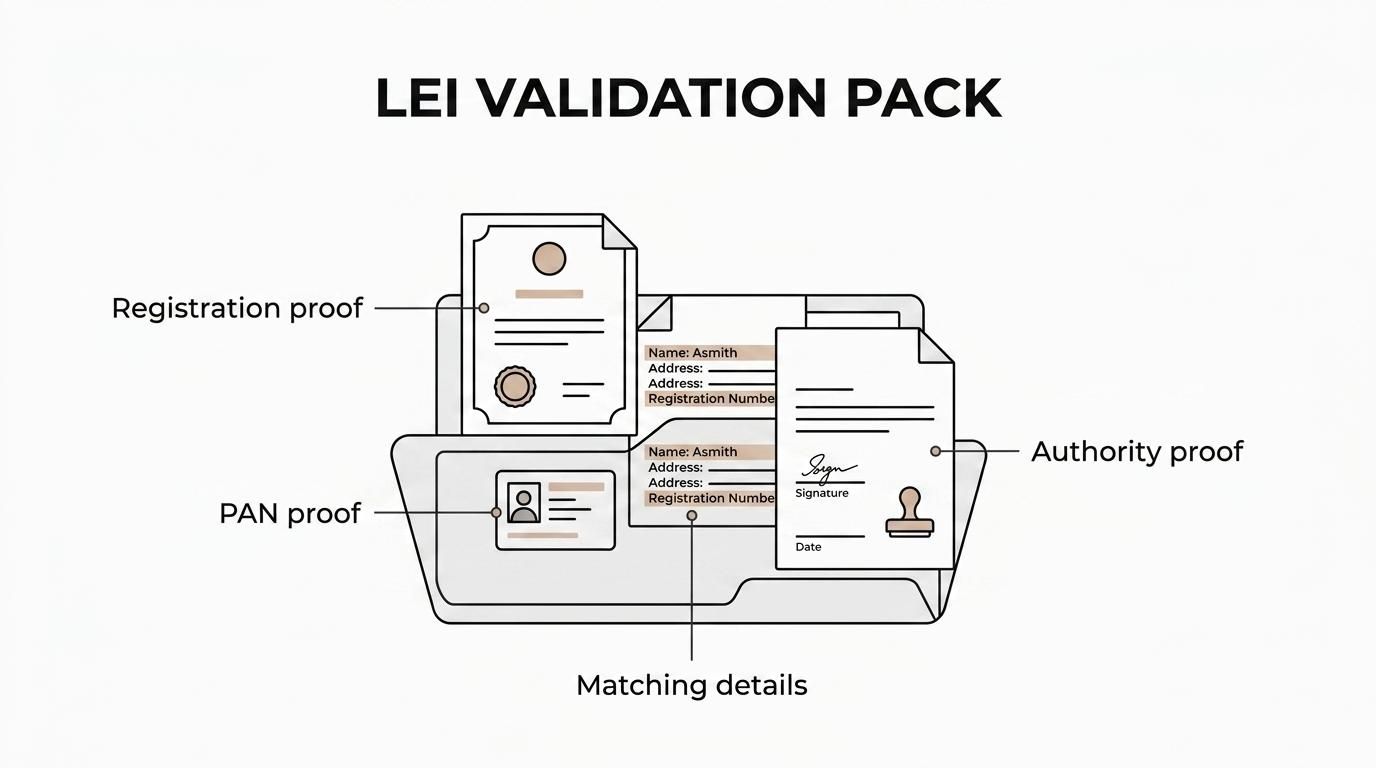
If you are preparing the file pack in advance, these are the documents most entities should keep at hand:
- Certificate of Incorporation or Registration Certificate
- PAN proof
- Recent audited financial statements
- Board Resolution or Letter of Authority
- Power of Attorney, if applicable
- Undertaking-cum-Indemnity
- Statutory Auditor’s Certificate, if requested later
This does not mean every paper will be uploaded in every case. It means these are the items most likely to be relevant if the issuer cannot validate the entity cleanly from official sources alone.
Key LEI application details that must match official records
A common misconception is that the LEI application is mainly about uploading documents. In reality, the data fields matter just as much. If the typed details do not match the records held by the Registration Authority or tax databases, the application can stall even when the documents look complete.
LEIL’s published guidance says LEI requests are independently validated with the identified source. That gives a useful picture of how Indian applications are reviewed more broadly. The issuer is not simply accepting the form at face value. It is checking whether the entity details are verifiable.
The most sensitive fields are usually these:
- Official legal name: It should match the name shown in the registration record, including spacing, abbreviations, and legal suffixes where relevant.
- Registered address: This should reflect the legal formation or registration address on record.
- Headquarters address: If different from the registered address, it should still be supportable through official or business records.
- PAN or Tax ID: For Indian entities, PAN is generally mandatory, with limited exceptions for certain sovereign agencies or government offices.
- Registration Authority reference: The registration number must connect clearly to the relevant authority record.
- Entity status and dates: Incorporation status, LEI assignment dates, expiry or next renewal dates, and last update details should remain consistent across records.
There can also be ownership-related fields. The LEI record may contain direct parent relationship details and, where relevant, ultimate parent information. Audited financial statements often become important here because they help establish whether parent reporting is applicable or whether there is a reason to report an exception.
One mismatch is enough to trigger a request for clarification. A slightly different company name, an old address, or a missing registration reference can all create avoidable delay.
Authorised signatory rules for LEI application in India
The authority question deserves special attention. The person filling the form may not always be the same person legally empowered to authorise the LEI request.
LEIL’s FAQs state that a duly authorised person is someone authorised through a Letter of Authority or a General Board Resolution. They also indicate that the main user or primary user can submit the online form, while a secondary authorised official can be named in the authority document. That is useful for entities where compliance, finance, secretarial, and treasury tasks sit with different teams.
If your entity uses an internal operations person, consultant, or registration agent to file the application, the authority document should make that role clear. This is one of the most common friction points in practice. The entity exists, the PAN is valid, and the registration number is correct, but the issuer still needs comfort that the applicant is acting with permission.
If the person filling the form cannot prove authority, the application can pause even when every other document is correct.
A sensible internal check is to confirm three things before submission:
- Who is named: The authorised signatory’s name should match the ID and authority document exactly.
- What authority is granted: The wording should cover LEI application, renewal, update, or transfer if those actions may be needed.
- Which email is used: The email on the application should belong to the person or function that will receive validation queries and renewal notices.
Changes in the primary official should also be updated later, so that the right user email remains linked to the LEI record.
Registration Authority details for Indian LEI applications
For companies, LLPs, one-person companies, and asset management companies, Ministry of Corporate Affairs records are commonly used as the Registration Authority source. If the MCA record is current and the application data mirrors it properly, validation is usually more straightforward.
Not every entity type sits neatly inside the MCA framework, though. Indian LEI applications can also involve other reference systems. Published LEIL guidance mentions cases where the applicant may need to select a Registration Authority name or type based on identifiers such as a SEBI registration number, NSDL or CDSL reference, DICGC bank code, Gazette notification number, or NSDL(ITD).
That is especially relevant for funds, market intermediaries, financial institutions, statutory bodies, and specialised legal forms. The practical lesson is simple: use the identifier that genuinely proves your entity’s legal existence or regulated status, rather than trying to force the application into the wrong authority category.
When extra supporting documents may be requested
Even a well-prepared application can attract a follow-up query. That does not always mean something is wrong. Sometimes the public record is too limited. Sometimes the registry data is old. Sometimes the legal form is unusual and needs a stronger documentary trail.
A few common triggers include:
- Address mismatch between PAN and registration record
- Name variation after conversion, merger, or restructuring
- Missing authority proof for the applicant
- Incomplete ownership or parent reporting support
- Non-MCA entities with specialised registration references
This is why it helps to treat the LEI pack as a verification folder, not just a form attachment exercise. Keep the core documents ready in clean PDF format, use recent records where possible, and make sure the dates and spellings line up across every file.
How to prepare LEI application files for faster approval
A faster approval often comes down to presentation and consistency. Many delays are administrative rather than legal. A document is uploaded sideways, the board resolution is unsigned, or the PAN copy is unreadable. Small issues add up.
If your entity is applying close to a transaction deadline, it is wise to prepare the application as if a manual review will happen. That means using exact legal names, checking whether the registered office has changed, and confirming that the signatory document is current.
A practical prep routine looks like this:
- Match spellings exactly: Use the legal name exactly as it appears in the registration source.
- Check PAN readability: Blurred scans can slow tax verification.
- Confirm addresses: Registered office and headquarters details should be intentional, not copied casually from an old template.
- Use current authority proof: Board resolutions and letters should be signed, dated, and relevant to the action being taken.
- Keep financial statements ready: They may not be needed at once, but they are often useful if ownership or validation questions come up.
It also helps to choose an application route that is easy to manage. Since any GLEIF-accredited issuer authorised for India can issue the LEI, entities have options. Some prefer a direct issuer workflow. Others use a registration agent that handles validation, submission, reminders, and support in English. When pricing is shown clearly in INR, GLEIF fees are included, and renewal can be automated, the process becomes easier to budget and easier to maintain year after year.
For teams handling multiple entities, this matters even more. A clean process for new registration, renewal, and transfer can reduce internal follow-up and keep the LEI record current without last-minute pressure.