LEI Lookup & Verification Report (Counterparty Due Diligence Support)
When you need to know exactly who sits on the other side of a transaction, an LEI verification report gives you a clear starting point. It pulls together official Legal Entity Identifier data so compliance teams, finance teams, and onboarding teams can confirm whether a counterparty is correctly identified, active, and linked to the right registration details.
For businesses in India, this is especially useful where a valid LEI may affect trading access, reporting, treasury operations, lending workflows, and vendor or client due diligence. A structured lookup saves time, reduces manual checking, and gives teams a consistent record they can review before moving ahead.
LEI verification report for counterparty identity checks
An LEI is a global 20 character code assigned to a legal entity. Its value goes far beyond the code itself. Behind it sits standardised reference data that helps answer two basic due diligence questions: who is this entity, and, where available, who owns whom.
An LEI verification report supports this process by presenting core identity data in one place. Instead of relying on multiple internal records, website claims, or informal documents, teams can check a recognised global identifier linked to official entity information.
This matters in practical situations. A treasury desk may need to verify a borrower before a transaction. A fund administrator may need to confirm an issuer before booking exposure. A procurement or compliance team may need to confirm whether the legal name on an agreement matches the legal entity that actually holds the LEI.
That clarity helps reduce misidentification risk.
Data included in an LEI lookup and verification report
A useful report should be easy to read and strong on the details that matter for due diligence. LEI data sourced from the Global LEI Index can show the entity’s legal name, status, registration references, addresses, legal form, and issuance details for the LEI itself.
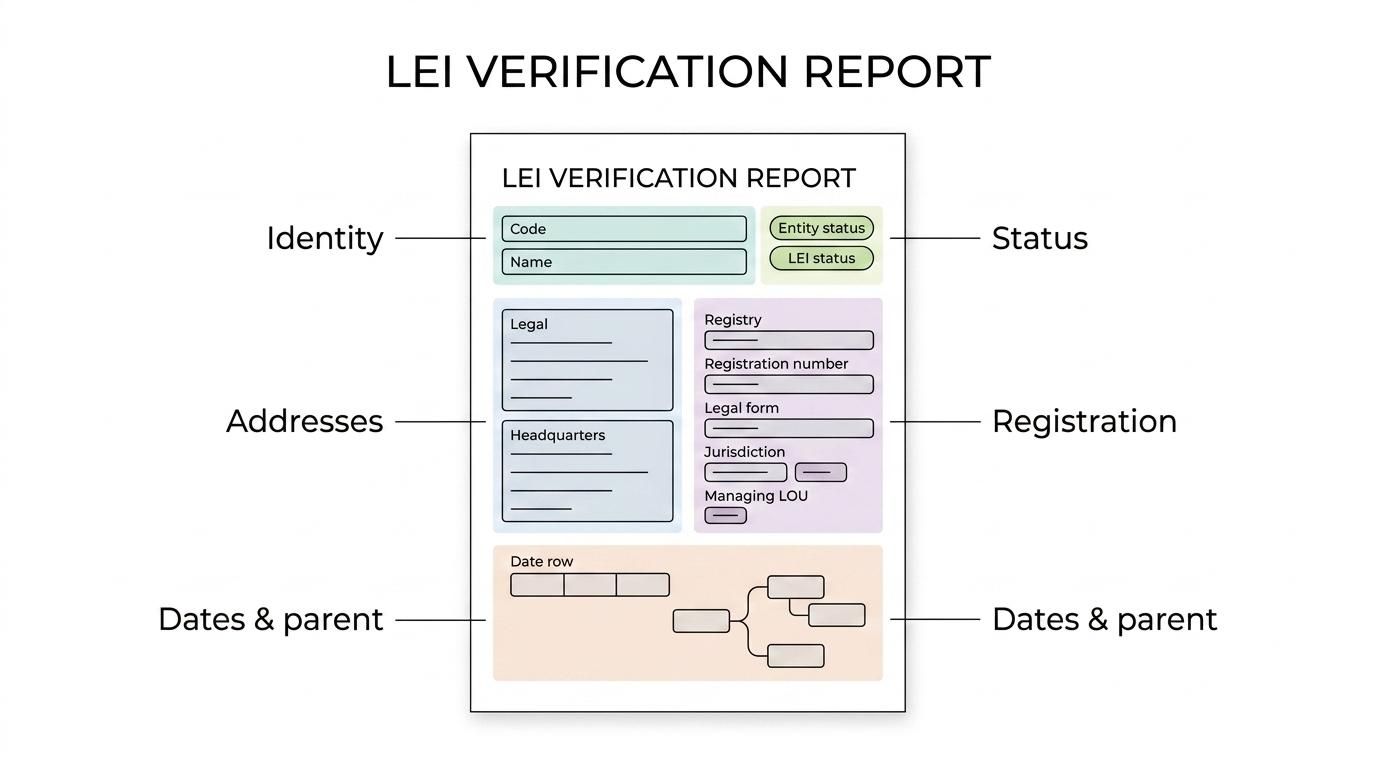
Where relationship data is available, parent information may also be included. This can be helpful when a review goes beyond basic identity and moves into ownership structure and group exposure.
| Report element | What it shows | Why it matters for due diligence |
|---|---|---|
| LEI code | The unique 20 character identifier | Confirms the entity has a recognised global identifier |
| Legal name | Official entity name linked to the LEI | Helps match contracts, trade tickets, and onboarding records |
| Entity status | Active or inactive entity status, where available | Flags whether the entity still appears operational in source records |
| LEI status | Issued, lapsed, retired, or similar status | Shows whether the LEI is current and usable |
| Legal address and headquarters address | Official recorded addresses | Supports entity matching and jurisdiction checks |
| Registration authority details | Registry name and entity registration number | Links the LEI to formal company registration data |
| Legal form and jurisdiction | Entity type and country of registration | Useful for classification, documentation, and policy checks |
| Registration and renewal dates | Initial issue date, last update, next renewal | Helps assess whether the LEI record is current |
| Managing LOU | Issuing Local Operating Unit | Shows the official issuance path within the LEI system |
| Parent relationship data | Direct and ultimate parent details, where reported | Useful for group risk review and ownership screening |
A strong report can be used as a supporting document in internal files, especially when teams want a dated record of the identity check performed before a transaction or onboarding decision.
LEI due diligence support for KYC, AML, and onboarding
LEI data is not a full KYC file, and it does not replace sanctions screening, beneficial ownership review, or document collection. What it does is improve the quality of the first layer of entity verification. That first layer often shapes everything that follows.
When the legal name is inconsistent, the registration number is missing, or the LEI has lapsed, compliance work becomes slower and more uncertain. An LEI verification report helps teams spot those issues early, before they create delays in onboarding or exceptions in reporting.
This is where the report becomes more than a simple lookup.
- Identity confirmation: match the LEI to the correct legal name and registration details
- Status review: check whether the LEI is active, lapsed, or otherwise outdated
- Ownership visibility: review parent relationship data where it is available
- Jurisdiction check: confirm where the entity is legally registered
- Record consistency: compare LEI data with contracts, account forms, and internal systems
For firms handling cross border counterparties, that consistency is valuable. A globally standardised identifier can reduce confusion caused by local naming variations, abbreviations, and duplicate records in internal databases.
Common uses of LEI verification reports in India
Indian entities use LEI verification reports in a wide range of settings. Some need them before market transactions. Others use them during counterparty onboarding, periodic reviews, or internal audit checks. The same report can support both operational efficiency and compliance discipline.
It is also helpful when an organisation is dealing with a party for the first time and wants an independent way to check identity data before documents are signed or funds move.
Common situations include:
- Trade counterparty checks
- Treasury and borrowing workflows
- Fund and securities operations
- Vendor due diligence
- Corporate client onboarding
- Charity and trust compliance reviews
- Periodic LEI validity checks before renewal dates
In regulated environments, even a small mismatch can slow down approval. A quick LEI check often prevents a much longer review later.
LEI data sources, update frequency, and practical limits
LEI verification reports depend on official LEI reference data published through the Global LEI system. That means the report reflects a recognised public source rather than a private directory. It also means the quality of the result is tied to the quality and currency of the official LEI record.
The Global LEI Index is refreshed regularly, typically on a daily cycle. In practice, this is very useful for most due diligence workflows, though it may not capture changes instantly at the exact moment they occur. Teams handling highly time sensitive decisions should keep that update rhythm in mind.
There are also sensible limits to what an LEI report can prove. It can confirm official entity reference data linked to the LEI. It cannot, by itself, prove credit quality, authorised signatory powers, source of funds, or full AML clearance.
That distinction is important.
A good due diligence process uses LEI data as a reliable identity layer, then adds other checks depending on the risk profile of the counterparty and the nature of the transaction.
LEI lookup support with fast registration, renewal, and transfer help
Sometimes a verification report shows exactly what the problem is: the entity has no LEI, the LEI has lapsed, or the record sits with another provider and needs to be moved for easier management. In those cases, the next step should be simple.
LEI Service supports new LEI registration, LEI renewal, and LEI transfer for legal entities that need a valid code quickly and at a clear price in INR. The application process is designed to be completed in about a minute, with data validation and submission handled through GLEIF accredited issuance channels.
For urgent cases, express processing may be available in as little as 2 hours.
That can be a real advantage when a trade, reporting deadline, or banking requirement cannot wait.
After the initial application, entities can also choose multi year plans and automatic renewal to reduce the risk of future lapses. Free updates to entity data are included, and English speaking customer support is available with a guaranteed email response within 24 hours.
- New LEI registration: for entities applying for the first time
- LEI renewal: for entities with an LEI nearing expiry or already lapsed
- LEI transfer: for entities moving their LEI to a provider with simpler service and pricing
- Automatic renewal option: helps keep the LEI current year after year
- Transparent INR pricing: clear costs with GLEIF fees included
For organisations that rely on due diligence records, this creates a practical workflow: verify the counterparty, identify any LEI issue, and fix it without moving between multiple providers or systems.