RBI LEI Rules for Large Borrowers
For many Indian businesses, the LEI requirement under RBI rules is not just another compliance item sitting in a finance checklist. It directly affects how a borrower is identified by banks, how group exposure is tracked, and whether a credit facility can be renewed or expanded on time.
That is why the RBI approach to LEI for large corporate borrowers deserves close attention. It began as a way to improve visibility over sizeable borrowings, and it has since become part of a wider financial reporting structure that touches bank systems, CRILC reporting, annual renewal discipline, and even selected payment-system data fields.
What the RBI LEI mandate means for large corporate borrowers
An LEI, or Legal Entity Identifier, is a unique 20-character alphanumeric code used to identify legal entities participating in financial transactions. It is based on the global ISO 17442 standard and issued through the GLEIF framework via accredited Local Operating Units, or LOUs.
In the RBI context, the logic is quite practical. When banks lend to corporates, they need a reliable way to identify the exact borrowing entity across systems, branches, reporting lines, and connected group structures. A standardised identifier helps reduce ambiguity around names, group relationships, and aggregate exposure.
This matters even more when a corporate borrows from more than one bank. A company may have fund-based facilities, non-fund-based limits, and group entities borrowing in parallel. Without a common identifier, tracking the full picture becomes harder. The LEI addresses that gap by creating a consistent identity layer across lenders and reports.
RBI exposure thresholds and phased LEI timeline
RBI first linked LEI to large corporate borrowing through a phased rollout. Existing large corporate borrowers with total exposure of ₹50 crore and above were brought within the policy direction, with the earliest deadlines aimed at the biggest borrowers first. Over time, the requirement widened and later reached borrowers with aggregate fund-based and non-fund-based exposure of ₹5 crore and above from any bank, with the LEI required to be captured in CRILC.
The early phase structure is useful because it shows how RBI treated LEI as a credit-control tool, not merely a registry formality. The larger the borrowing, the earlier the compliance expectation.
| Borrower segment | RBI treatment | Practical meaning |
|---|---|---|
| ₹1,000 crore and above | First phase of LEI compliance, due by 31 March 2018 | Largest borrowers had to move first |
| ₹500 crore to below ₹1,000 crore | Next phase, due by 30 June 2018 | Banks expected LEI capture quickly after phase I |
| ₹100 crore to below ₹500 crore | Later phase, due by 31 March 2019 | Mid-sized large borrowers came into scope |
| ₹50 crore and above | Covered by the broad large borrower direction | LEI became part of borrower compliance planning |
| ₹5 crore and above aggregate fund-based and non-fund-based exposure from any bank | LEI registration required, with code captured in CRILC | Scope widened well beyond the original large-borrower focus |
This staged approach is worth noting for one simple reason: RBI did not wait for LEI to become common across every business segment before tying it to bank credit processes. It used the mandate first where visibility over borrower exposure was most needed.
Why LEI affects renewal and enhancement of credit facilities
The strongest operational point in the RBI rules is easy to miss if one reads only the top line. RBI said borrowers that do not obtain an LEI as per the prescribed schedule are not to be granted renewal or enhancement of credit facilities. That changes the discussion completely.
So the LEI mandate is not just about being identifiable in a database. It can affect access to working capital renewals, limit increases, and routine credit reviews. A borrower may be financially sound and commercially active, yet still face avoidable friction if the LEI is missing, expired, or not mapped correctly in lender records.
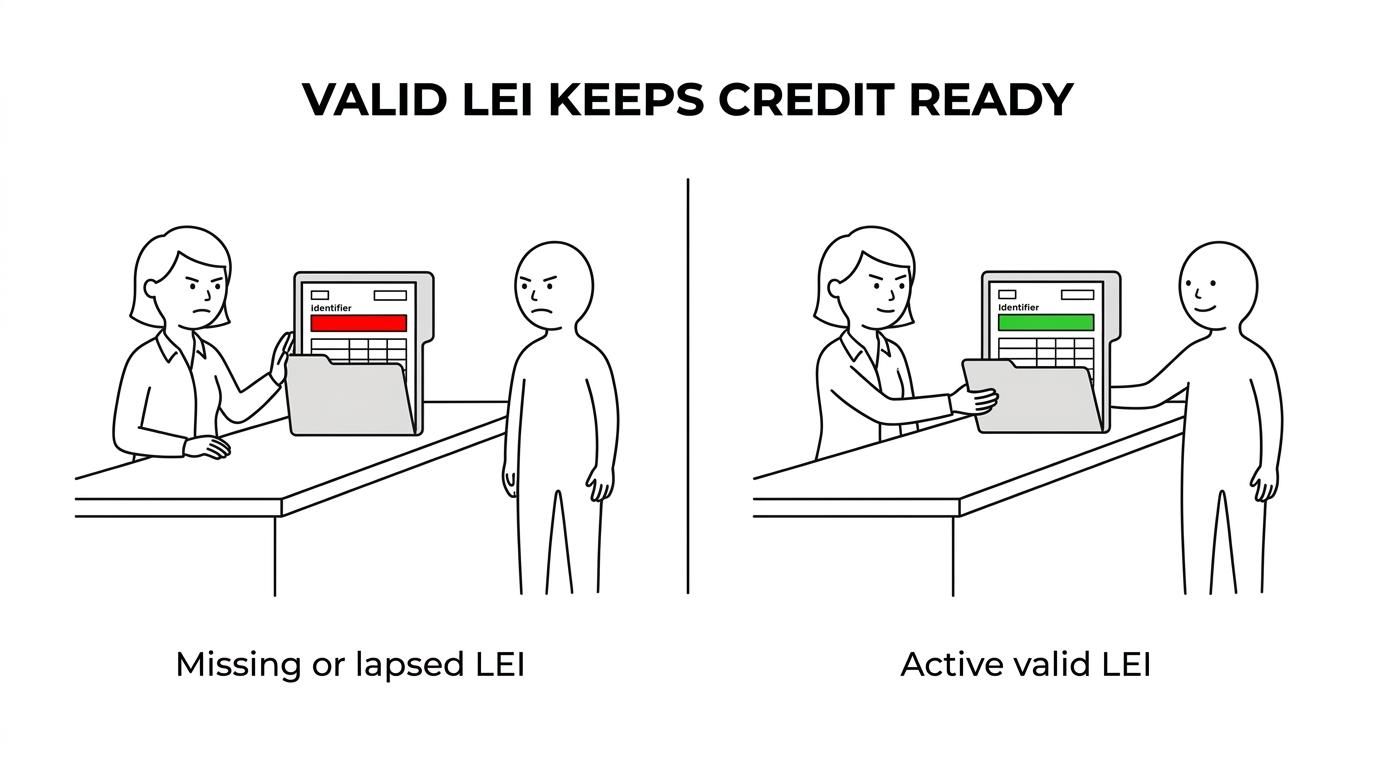
From a company’s point of view, this means treasury, finance, secretarial, and banking teams should treat LEI status as part of lending readiness.
- Credit renewal: Banks should not grant renewal or enhancement of facilities if the LEI has not been obtained as required.
- Borrower identification: The same entity can be recognised consistently across lenders and internal bank systems.
- Reporting discipline: LEI details feed into monitoring structures like CRILC.
- Group exposure visibility
- Better record matching across institutions
A business that depends on annual or periodic bank renewals should not leave LEI work to the last week before sanction review. The administrative step is small. The downstream effect can be substantial.
LEI renewal requirements and lapsed LEI status
One of the most common misconceptions is that an LEI is a one-time exercise. It is not. LEI reference data is revalidated annually. If the renewal is not completed by the next renewal date, the LEI status changes from issued to lapsed in the GLEIF system.
That lapsed status matters because RBI’s credit-linked use of LEI is ongoing. Banks are not only interested in whether an entity once obtained a code. They also need current, valid reference data for an entity they are lending to or reporting on. A lapsed LEI can trigger follow-up questions, manual checks, or delays at awkward moments.
For Indian borrowers, renewal should sit in the same calendar as other annual compliance tasks. If a company has regular fund-limit reviews, external borrowing milestones, or quarter-end bank reporting cycles, LEI renewal should be completed comfortably ahead of those dates.
A practical internal checklist usually includes:
- active LEI status
- matching legal name
- current registered address
- current company registration details
- updated authorised contact details
Many businesses now prefer multi-year plans or automatic renewal options because they reduce the risk of last-minute lapses. Where speed matters, a registration agent that offers transparent INR pricing, quick validation, and English-speaking support can make the process much simpler for finance teams.
CRILC reporting, connected counterparties, and bank exposure monitoring
The LEI framework makes even more sense when viewed alongside the bank exposure lens. RBI’s large-exposure approach looks closely at concentration risk, including exposure to a single counterparty and to groups of connected counterparties. Under the large exposure framework, a bank’s exposure becomes a large exposure at or above 10% of its eligible capital base, and reporting requirements apply at that level.
That bank-side perspective explains why entity identification matters so much. If different borrowing entities within a group are not tracked properly, concentration can be understated. If related counterparties are not visible, a lender’s risk picture can become less reliable than it appears on paper.
LEI helps here because each code is unique to one entity. It does not solve every group-mapping issue by itself, yet it gives banks and regulators a dependable starting point for exposure aggregation and connected-entity review. In practical terms, it supports cleaner reporting and stronger credit surveillance.
The later requirement that LEI be captured in CRILC for borrowers with aggregate exposure of ₹5 crore and above shows this clearly. The policy direction moved well past the idea of one-off registration. It became part of the data infrastructure for borrower monitoring.
LEI fields in RTGS and large value payments
LEI later appeared in another RBI-linked use case: selected large value payment information. RBI’s RTGS-related guidance and FAQs state that remittance information for eligible transactions includes the sender and beneficiary LEI. RTGS, of course, is mainly used for large value transfers and has a minimum transaction value of ₹2,00,000 with no upper ceiling.
This does not mean the borrowing mandate and payment-system use case are identical. They are separate operational settings. Yet the broader message is clear enough. RBI sees LEI as a practical identity tool across financial market activity, large-value transaction flows, and institutional reporting.
For corporates, that means the LEI should be managed as part of core financial infrastructure, not as an isolated lending document.
Practical steps for RBI LEI compliance
A smooth LEI process usually depends less on legal complexity and more on timing, ownership, and data accuracy. If the company waits until a bank asks for the code during a renewal cycle, the work becomes unnecessarily urgent.
A better approach is to assign clear responsibility before the next banking event. In many firms, treasury owns the bank relationship while secretarial or compliance teams hold the official entity records. The strongest process brings both sides together early.
A simple operating plan can look like this:
- Check exposure bands: Review total bank exposure, including fund-based and non-fund-based facilities, to confirm whether the entity is in scope.
- Verify entity data: Match the legal name, registration details, and registered office data with authoritative records before applying or renewing.
- Track renewal dates: Put LEI renewal in the same diary as loan review dates, annual filings, and board approval cycles.
- Choose a dependable filing route: Use a provider or registration agent that handles validation efficiently and keeps renewal support available when bank deadlines are close.
Companies that do this well usually find LEI compliance quite manageable. The value is not only in avoiding a missed requirement. It is also in making credit interactions cleaner, faster, and easier to support with accurate data when lenders ask questions.