What Happens to an LEI After a Merger or Name Change?
An LEI is meant to identify a legal entity, not just a trading name printed on contracts or invoices. That distinction becomes very important when an organisation changes its name, combines with another entity, or is restructured as part of a merger.
For businesses, funds, trusts, charities, and other entities in India, the practical question is usually simple: do you keep the same LEI, update the record, or apply for a new one? The answer depends on whether the legal entity itself still exists in law.
LEI rules after a legal name change
A simple legal name change does not usually mean a new LEI. If the same legal entity continues to exist, the LEI normally stays with that entity and the record is updated to reflect the new legal name.
This fits the core GLEIF model of one LEI for one entity. The identifier is tied to the legal person, not to branding, marketing language, or a revised corporate style. So if a private limited company changes its registered legal name but remains the same incorporated entity with the same legal continuity, the LEI should usually remain the same.
GLEIF treats this as a legal entity event. In the LEI record, the change can be captured with event information, including the date the event became legally effective and the date it was recorded in the LEI system. That helps users of LEI data see not only what changed, but also when it changed.
A name update is usually the right path when the facts look like this:
- Same legal entity
- Same registration identity in its home jurisdiction
- Same corporate continuity
- Updated legal name only
When a name change needs a new LEI
This is where many entities get caught out. Not every “name change” is just a name change.
If the old entity has been replaced by a newly formed legal entity, GLEIF rules point to a different outcome. In that case, a new LEI should be issued for the new entity. The previous LEI should not simply be edited as though nothing changed, because that would blur the line between two separate legal entities.
This often matters in restructurings where paperwork, transaction announcements, or internal teams refer to the result as a rename, while the legal reality is formation, conversion, or transfer into a new entity. If the underlying legal person is new, the LEI must be new as well.
In those cases, GLEIF rules also allow the old record to be linked to the new one through successor information. That helps preserve an auditable chain in the public data.
LEI outcomes for merger, acquisition, and name change scenarios
The easiest way to assess the right action is to separate commercial change from legal change. A refreshed brand is not the same as a merger. A merger is not the same as an internal update to legal name spelling.
| Scenario | Typical LEI outcome | What changes in the record |
|---|---|---|
| Simple legal name change with same entity continuing | Keep existing LEI | Legal name updated, legal entity event added, dates recorded |
| Brand change only, no legal name change | Usually no LEI change needed | Possibly no update unless official data changes |
| Merger where the entity survives and keeps legal continuity | Surviving entity keeps its LEI | Event data may be updated |
| Merger where the entity is absorbed and ceases to exist | Old LEI becomes MERGED or INACTIVE | Successor details may be added |
| Transaction creates a new legal entity | New entity needs a new LEI | Old LEI linked to successor LEI where applicable |
| Duplicate registration found | Non-surviving LEI marked DUPLICATE | Only one valid LEI should continue |
What happens to an LEI after a merger
A merger can lead to a very different result from a straightforward name update. If one entity is merged into another and stops existing as an operating legal entity, the old LEI will usually no longer remain active for normal use.
GLEIF data definitions recognise statuses like MERGED and INACTIVE. In practice, these statuses help the market understand that the entity tied to that LEI is no longer operating in the same legal form, or no longer exists because it was absorbed into another entity.
That does not mean the old LEI vanishes. LEI data is meant to remain useful as a historical reference. Past trades, reports, and regulatory records may still point to the former LEI, and that historical trail is valuable.
A merger usually leads to one of these paths:
- Surviving entity: keeps its own LEI if it remains the same legal entity after the transaction
- Non-surviving entity: old LEI is retired from active use and may be marked MERGED or INACTIVE
- Newly created entity: must obtain a fresh LEI because it is a new legal person
Why successor links matter in LEI records
Successor links are one of the most useful parts of the LEI data model after a restructuring. If Entity A disappears into Entity B, or if a new legal entity replaces the old one, the record can show that connection through successor fields such as SuccessorEntity or SuccessorLEI.
This matters for counterparties, compliance teams, auditors, and market infrastructures. They need to know whether the entity they dealt with last year is still the same legal person this year. A successor link reduces guesswork and supports cleaner onboarding, reporting, and historical reconciliation.
For Indian entities dealing with banks, counterparties, or regulated market activity, that clarity is not just administrative neatness. It can save time when questions arise about old contracts, derivative reporting, securities activity, treasury transactions, or KYC review.
Legal entity events in GLEIF data
GLEIF uses the term legal entity event for changes that affect reference data or relationship data. That includes name changes, mergers and acquisitions, dissolutions, absorptions, and other events that alter how the entity should appear in LEI records.
Two dates are especially important in these records. One is the effective date, meaning the date on which the event became legally valid in the relevant jurisdiction. The other is the recorded date, meaning when the event was captured in the LEI system.
These dates are useful because business announcements and legal effect often happen on different days. A scheme of arrangement may be announced earlier, approved later, and become legally effective on yet another date. LEI data is built to reflect that distinction.
A well-maintained LEI record after a restructuring often includes:
- Event type: name change, merger, absorption, dissolution, or another recognised event
- Effective date: when the event took legal effect
- Recorded date: when the LEI record was updated
- Affected fields: legal name, other entity names, successor details, or status
How to tell whether you need an LEI update or a new LEI
The key question is not “what did the business call the transaction?” It is “does the same legal entity still exist?”
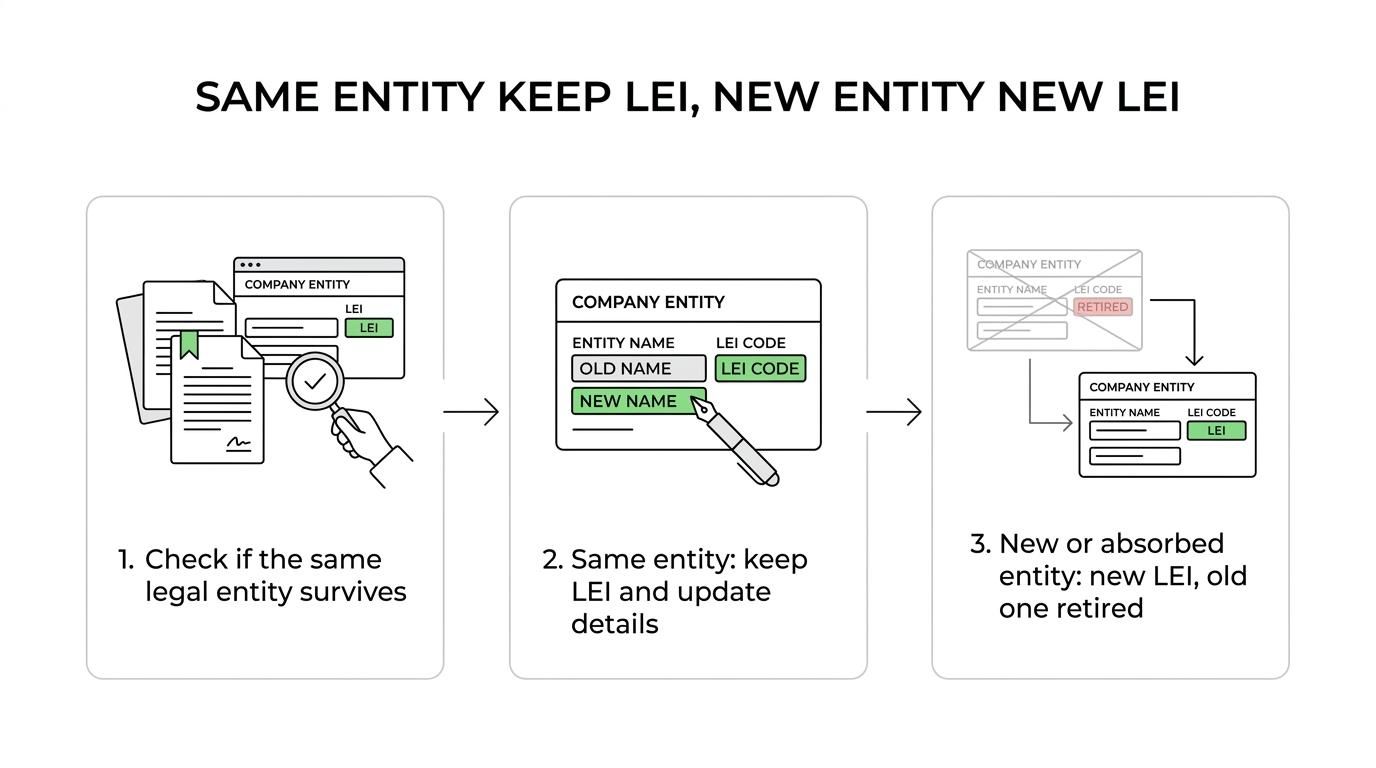
That sounds simple, but internal labels can be misleading. A press release may say “rebranding”, while the legal paperwork shows a conversion into a newly incorporated entity. A merger announcement may sound like a combined group continues under one banner, while one of the old entities has in fact ceased to exist.
A quick internal review should look at legal formation documents, registry extracts, court or regulator approvals where relevant, and the post-transaction legal identity of the entity that will keep trading or reporting.
A practical test can help:
- Keep the existing LEI: the same legal person continues, and only its official details have changed
- Apply for a new LEI: the post-event entity is legally new, even if the business name looks familiar
- Retire the old LEI from active use: the old entity has been merged, absorbed, dissolved, or replaced
Common Indian business situations and the likely LEI response
Indian entities often encounter LEI questions during corporate reorganisations, especially where market-facing obligations continue without much interruption. Treasury teams may assume the LEI should stay because trading continues. Legal teams may know the entity has changed. Both views can seem reasonable until the registry documents are checked closely.
A few examples are common. A company changes its name after a board and shareholder process but remains the same incorporated entity. In that case, the LEI usually stays and the legal name should be updated. A fund manager merges one scheme vehicle into another entity and the absorbed vehicle no longer exists. That old LEI would generally not remain active as though the vehicle still existed independently.
NBFCs, listed issuers, SPVs, charitable entities, and trust structures can face the same issue. The deciding factor is still legal continuity, not operational continuity.
Many teams benefit from asking three direct questions early in the process:
- Has the original legal entity survived?
- Has a new legal entity been formed?
- Do official records support the intended LEI action?
Data quality and timing after a merger or name change
LEI records are only as reliable as the updates filed after a legal event. GLEIF’s data quality framework expects event-driven updates to fields like legal name and successor information. That means waiting too long after a merger or name change can leave stale data in circulation.
This matters because banks, counterparties, and reporting systems may compare your submitted LEI details with public LEI data. If your documents show one legal name while the LEI record still shows another, the mismatch can trigger follow-up queries and delays.
A fast update becomes especially useful when the entity is active in capital markets, derivatives, large-value treasury operations, or other regulated reporting flows. Even where rules allow a short operational lag, clean data makes day-to-day compliance much easier.
Practical steps to update an LEI after a legal entity event
Once the legal position is clear, the operational next steps are usually straightforward. The entity should gather the relevant official evidence and ensure the LEI record reflects the current legal reality.
That process often moves faster when the application or renewal agent checks the registry details, validates supporting information, and submits the update in the correct format.
A good working checklist looks like this:
- Board-approved or legally filed change documents
- Updated registry extract
- Merger documentation, if relevant
- Effective date of the event
- Confirmation of the surviving or successor entity
If the entity needs support, it is sensible to look for a registration agent that offers:
- Transparent pricing: clear INR cost with GLEIF fee included
- Fast processing: useful when a reporting or trading deadline is near
- Simple application flow: fewer delays for internal teams
- Renewal support: helpful when the LEI also needs to remain current after the update
For entities that need to act quickly, LEI Service handles new LEI registrations, renewals, and transfers, with support for data validation, free entity data updates, and optional automatic renewal. That can be especially useful when a merger or name change needs to be reflected in LEI data without slowing down trading or compliance work.