What Is GLEIF? How the Global LEI System Works (LEI, LOU, Validation)
If your business has ever been asked for an LEI, it is easy to assume that GLEIF is the organisation that issues the code directly. That is not quite how the system works.
GLEIF sits at the centre of the global LEI framework, but its job is governance, accreditation, open data publication, and quality control. The actual issuance of LEIs is handled by accredited issuers called Local Operating Units, or LOUs. Around them sits a wider network of registration agents and validation processes that make the system practical for businesses, funds, charities, and other legal entities.
For Indian entities dealing with banks, market counterparties, investment activity, or regulated reporting, this distinction matters. It helps you know who is setting the rules, who is issuing the LEI, who is checking your data, and where your record finally appears.
What GLEIF means in the LEI system
GLEIF stands for the Global Legal Entity Identifier Foundation. It was established in 2014 following international reforms aimed at improving transparency in financial markets after the global financial crisis.
Its purpose is straightforward: create trust in legal entity identification across borders. A company name alone is often not enough. Names can be similar, translated differently, abbreviated, or changed over time. An LEI solves that by giving each eligible legal entity a unique 20-character code linked to verified reference data.
GLEIF does not function as a commercial seller of LEIs. It is a not-for-profit foundation that supports the operation of the Global LEI System and keeps the framework consistent worldwide. It works under public-interest oversight from the Regulatory Oversight Committee, often called the ROC, which includes regulators and authorities from many jurisdictions.
That structure is one reason the LEI system has gained credibility. It was built not as a private directory, but as an internationally governed identification network.
How the Global LEI System is structured
The LEI ecosystem is easier to follow when each participant is separated by role. GLEIF is the centre of the operating model, though not the front-end issuer in most customer interactions.
| Participant | Main role | What it does not do |
|---|---|---|
| ROC | Public-interest oversight | Does not issue LEIs |
| GLEIF | Maintains system integrity, accredits issuers, publishes the Global LEI Index | Does not usually process end-customer applications |
| LOU | Issues and maintains LEIs | Does not set global policy |
| Registration Agent | Helps entities apply, renew, or transfer through an issuer | Does not hold direct issuer authority unless also accredited |
| Validation Agent | Uses existing onboarding or KYC processes to support LEI workflows | Does not replace the issuer’s accountability |
This three-layer logic is central to the system. Regulators oversee the public-interest side, GLEIF manages the operating framework, and LOUs issue and maintain records.
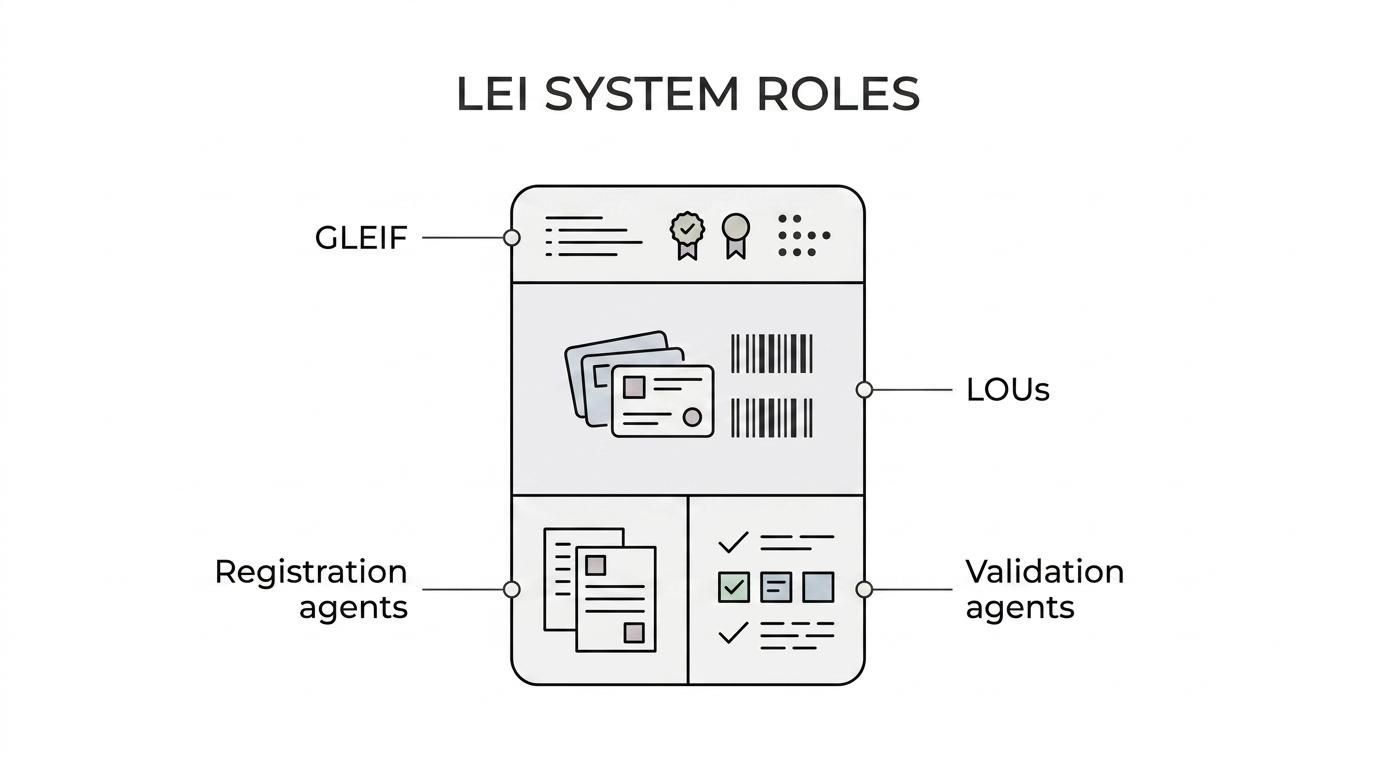
In practical terms, many businesses never interact with GLEIF directly. They apply through an issuer or through a registration agent working with an issuer. Even so, every valid LEI sits inside the same global structure and becomes visible through the open Global LEI Index.
What an LEI actually identifies
An LEI is a unique, standardised identifier for a legal entity, not for an individual. It follows ISO 17442 and always contains 20 alphanumeric characters.
The code links to reference data that answers a basic question: who is this entity? In many cases, it may also include relationship data that helps answer another question: who owns whom?
For Indian organisations, the entities that may need an LEI can include:
- Companies
- LLPs
- Funds
- Trust structures where eligible
- Charities and non-profits
- Government-related entities
- Financial market participants
Each LEI corresponds to one legal entity only. It is not a licence, not a tax registration, and not a replacement for local incorporation records. It is an internationally recognised identity layer that helps counterparties, regulators, and institutions identify the same entity in the same way.
How LEI issuance works from application to publication
The process is more structured than many first-time applicants expect. Even when the application form feels simple, the back-end checks are built around formal data standards and issuer responsibility.
A typical LEI workflow includes the following steps:
- Application submission: the entity or its authorised representative provides legal name, registration details, address information, and other required fields
- Authority check: the issuer or agent confirms that the applicant is entitled to act for the legal entity
- Data validation: records are checked against official or authoritative sources
- LEI issuance: the LOU issues the code once validation is complete
- Publication: the LEI record is published in the Global LEI Index
- Annual renewal: the issuer reconfirms that the entity data remains current
This is why fast processing and proper validation need to coexist. A quick service is useful, but an LEI only has value when the supporting data is accurate and accepted within the GLEIF framework.
For many entities, especially those applying under time pressure for a trade or compliance deadline, registration agents add convenience. They simplify the form, help review data, communicate with the underlying issuer, and support renewals. The issuer, though, remains responsible within the GLEIF system.
How LEI validation works in practice
Validation is one of the most important parts of the LEI model, and it is also the least visible to applicants.
When a legal entity applies for an LEI, the issuer checks the submitted details against reliable sources. That may include corporate registries, official business records, legal status data, jurisdiction records, and parent-entity information where applicable. The aim is not just to create a code, but to create a verified identity record.
GLEIF supports this with technical and procedural rules used across the system. Two terms come up often here: the Common Data File, or CDF, and the State Transition and Validation Rules, or STVR. These define how LEI data should be structured, validated, updated, and published.
A useful way to think about LEI data is this:
- Level 1 data: who the entity is
- Level 2 data: who owns the entity, where reportable and available
That structure makes LEIs valuable beyond compliance. It supports cleaner counterparty identification, better risk aggregation, stronger onboarding, and more reliable entity matching across systems.
Why GLEIF’s open data model matters
GLEIF’s strongest contribution is not branding. It is openness.
The Global LEI Index is available publicly and free of charge. That means the system is not just useful to regulators or banks. It can also help corporates, service providers, investors, and compliance teams confirm whether an entity exists in the LEI network and whether its record is current.
This open model creates several practical advantages:
- Transparency: entity reference data can be checked by market participants
- Consistency: the same LEI can be used across jurisdictions and reporting systems
- Quality control: inaccurate records can be challenged and corrected
- History: current and historical LEI data can be traced over time
GLEIF also monitors data quality formally. It runs checks, publishes reports, and measures record quality across the network. Public reporting of these metrics supports confidence in the system as a whole, not just in individual issuers.
That matters because an identifier is only useful if users believe the underlying data is current and credible.
LOU, registration agent, and GLEIF: the difference that businesses should know
A common source of confusion is the assumption that every website offering LEI registration is itself a direct issuer. That is not always true.
Some providers are GLEIF-accredited LOUs. Others are registration agents that help businesses obtain, renew, or transfer an LEI through an accredited issuer. Both can be valid routes, but they are not the same role.
For businesses comparing providers, the real question is not only price. It is also who the underlying issuer is, how quickly validation is handled, what support is available, and how renewals are managed.
A registration agent can be especially useful when the priority is convenience and support. A well-run service can provide:
- Faster application handling
- Simple online forms
- Transparent INR pricing
- Renewal reminders or automatic renewal options
- English-speaking customer support
- Help with data updates and transfers
That service layer can save time for finance teams, fund managers, trustees, and compliance teams that do not want to deal with issuer workflows directly. Still, it is worth checking that the provider is working with a recognised accredited issuer and that the final LEI record appears correctly in the Global LEI Index.
What GLEIF means for Indian businesses and market participants
For entities in India, GLEIF’s role may feel distant, but its effect is very immediate. If your bank, exchange participant, regulator, counterparty, or transaction platform requires an LEI, the standards behind that requirement are tied back to the global framework GLEIF maintains.
This brings a few clear benefits. First, the LEI is internationally recognisable. Second, the same identifier can support reporting and verification across different markets. Third, the open-data model reduces the dependence on manual name matching, which is often unreliable.
In cross-border activity, that matters even more. A standard legal entity identifier reduces ambiguity when counterparties sit in different countries, operate in different languages, or use different registry systems.
It also supports stronger internal controls. Treasury teams, compliance units, and finance functions can use the LEI as a stable reference point when checking legal entity data across documentation, contracts, and reporting records.
How to verify an LEI provider before applying
Before you apply for a new LEI or renew an existing one, it is sensible to check where the provider fits in the system.
If the provider is a registration agent, that is perfectly acceptable, but the relationship with the accredited issuer should be clear. The issuer remains the party accountable within the GLEIF framework.
A sensible verification checklist includes:
- Issuer identity: confirm which accredited LOU will issue or manage the LEI
- Provider role: check whether the company is an issuer or a registration agent
- Pricing clarity: see whether fees include GLEIF charges and renewal costs
- Support standards: look for clear response timelines and contact options
- Record visibility: verify that issued LEIs are published in the Global LEI Index
- Renewal process: check how reminders, data updates, and transfers are handled
This is also where service quality becomes meaningful. If a provider offers rapid processing, straightforward applications, transparent INR pricing, and reliable support, that can make the LEI process far easier without changing the integrity of the underlying system.
Where GLEIF is heading next with digital identity
GLEIF is no longer focused only on traditional LEI records.
It is also advancing the verifiable LEI, or vLEI, which is designed for digital identity use cases. A vLEI can support cryptographically verifiable organisational identity in digital interactions, including signed submissions and automated trust frameworks.
That signals an important shift. The LEI began as a response to financial market opacity. It is now becoming part of a broader digital trust infrastructure.
For organisations that want cleaner entity identification today and stronger digital credentials tomorrow, GLEIF’s role is becoming more relevant, not less.